CCSS.
The Standard
Relate volume to the operations of multiplication and addition and solve real world and mathematical problems involving volume.
Common Core State Standards for Mathematics · Measurement and Data
Teacher's field guide
What This Standard Means
What Students Need to Do
- Students find the volume of rectangular prisms by multiplying three side lengths or multiplying base area by height. They find total volume by splitting a solid into nonoverlapping prisms and adding their volumes.
What Mastery Looks Like
- Students choose an efficient volume formula and explain what each factor represents. They split composite solids into rectangular prisms, add the volumes, and label answers in cubic units.
Common Misconceptions
- Students may add the three dimensions instead of multiplying them. They may label answers with square units or count shared faces when combining prisms.
How to Assess It
- Give an exit ticket: A solid combines nonoverlapping prisms measuring 4 by 3 by 2 units and 2 by 3 by 5 units. Find its total volume and show an equation.
Lesson moves
Ways to Teach It
Build a 4 by 3 by 2 prism with unit cubes, count cubes in one layer, then connect layers to multiplication.
Write how 6 times 4 times 3 and 24 times 3 represent the same prism in different ways.
Play a matching game using cards with prism diagrams, dimensions, volume expressions, and answers in cubic units.
Measure two classroom storage boxes, calculate each volume, and decide which one can hold more supplies.
Free download
Printable 5.MD.C.5 Worksheet
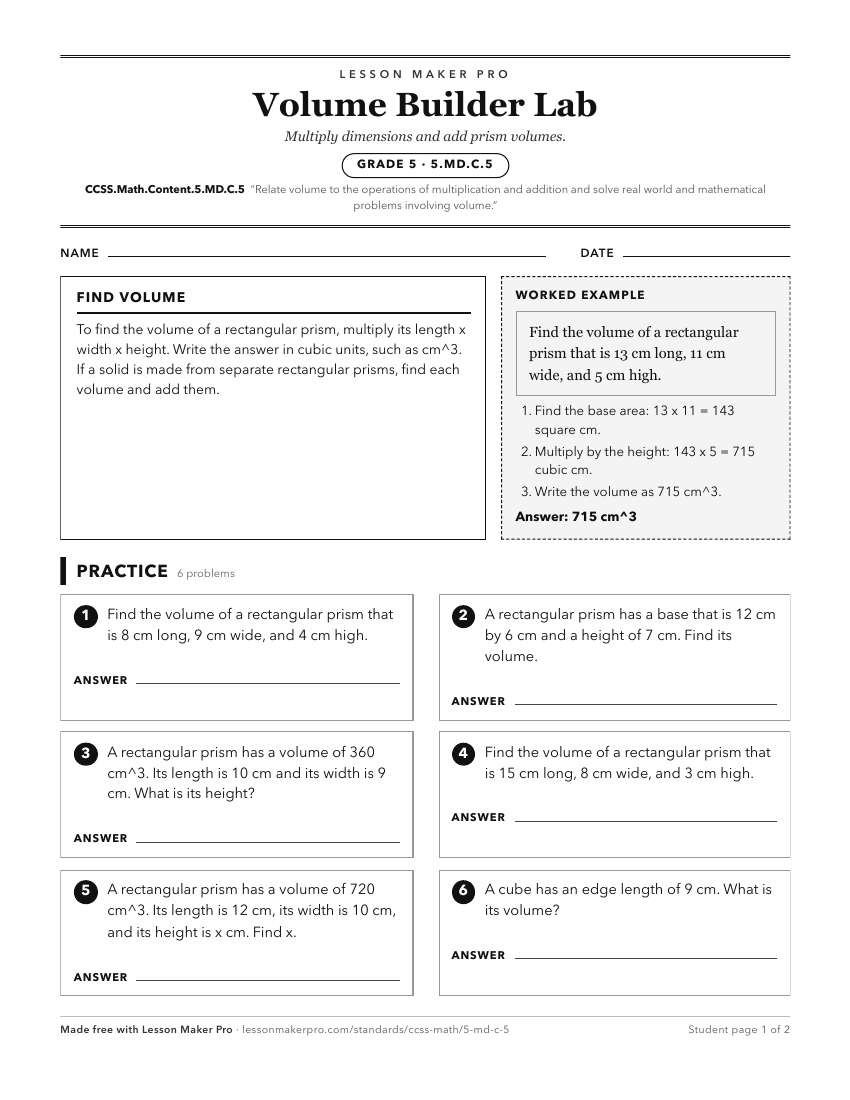
A ready-to-print activity worksheet aligned to CCSS.Math.Content.5.MD.C.5, with an answer key for the teacher on its own page. No account needed.
PDF, US Letter, prints cleanly in black and white.
Download the worksheetLearning progression
Where This Standard Sits
See the whole path on the Measurement & Data progression map.
Before This Standard
If students are struggling here, check these first.
- CCSS.Math.Content.5.MD.C.3
Students need unit-cube volume concepts before using multiplication and addition to find and combine volumes of solids.
- CCSS.Math.Content.5.MD.C.4
Counting unit cubes gives the meaning of volume that multiplication and addition later shorten and combine in volume problems.
- CCSS.Math.Content.3.MD.C.7
Area arrays, tiling, and decomposition carry over to volume layers, formulas, and adding volumes of non-overlapping solids.
Keep exploring
Related Standards
- CCSS.Math.Content.8.G.C
Solve real-world and mathematical problems involving volume of cylinders, cones, and spheres.
- CCSS.Math.Content.7.G.B
Solve real-life and mathematical problems involving angle measure, area, surface area, and volume.
- CCSS.Math.Content.5.MD.C
Geometric measurement: understand concepts of volume and relate volume to multiplication and to addition.
- CCSS.Math.Content.6.G.A
Solve real-world and mathematical problems involving area, surface area, and volume.
Turn this exact standard into a lesson
Grade, subject, topic, and the complete standard are prefilled. Create one free, no account needed.
Also for this standard:Make a WorksheetMake a QuizMake a Sub Lesson