CCSS.
Standard Cluster
Geometric measurement: understand concepts of volume and relate volume to multiplication and to addition.
Common Core State Standards for Mathematics
Cluster contents
Standards in This Cluster
CCSS.Math.Content.5.MD.C is a cluster heading. These are the individual standards under it.
- CCSS.Math.Content.5.MD.C.3
Recognize volume as an attribute of solid figures and understand concepts of volume measurement.
- CCSS.Math.Content.5.MD.C.3a
A cube with side length 1 unit, called a "unit cube," is said to have "one cubic unit" of volume, and can be used to measure volume.
- CCSS.Math.Content.5.MD.C.3b
A solid figure which can be packed without gaps or overlaps using n unit cubes is said to have a volume of n cubic units.
- CCSS.Math.Content.5.MD.C.4
Measure volumes by counting unit cubes, using cubic cm, cubic in, cubic ft, and improvised units.
- CCSS.Math.Content.5.MD.C.5
Relate volume to the operations of multiplication and addition and solve real world and mathematical problems involving volume.
- CCSS.Math.Content.5.MD.C.5a
Find the volume of a right rectangular prism with whole-number side lengths by packing it with unit cubes, and show that the volume is the same as would be foun...
- CCSS.Math.Content.5.MD.C.5b
Apply the formulas V = l × w × h and V = b × h for rectangular prisms to find volumes of right rectangular prisms with whole-number edge lengths in the context ...
- CCSS.Math.Content.5.MD.C.5c
Recognize volume as additive. Find volumes of solid figures composed of two non-overlapping right rectangular prisms by adding the volumes of the non-overlappin...
Teacher's field guide
What This Cluster Means
What Students Need to Do
- Students measure volume by counting unit cubes and using cubic units. They find the volume of rectangular prisms with multiplication, then add volumes to solve composite solid problems.
What Mastery Looks Like
- A student can explain why length times width times height gives the number of unit cubes in a rectangular prism. They can find missing dimensions and add volumes of separate prisms without double-counting.
Common Misconceptions
- Students may label volume in square units or confuse volume with surface area. They may add side lengths instead of multiplying, count only visible cubes, or double-count parts of a composite solid.
How to Assess It
- Give students a solid made from a 4 by 3 by 2 prism and a separate 2 by 3 by 2 prism. Ask for the total volume, two equations, and cubic units.
Lesson moves
Ways to Teach It
Give pairs 24 unit cubes to build three different rectangular prisms, then record each prism's dimensions and volume.
Ask students to explain, with a sketch, why multiplying three side lengths counts all cubes in a rectangular prism.
Play a matching game with cards showing prism dimensions, cube diagrams, multiplication equations, and volumes.
Measure small boxes in centimeters, calculate each capacity in cubic centimeters, and rank the boxes from least to greatest volume.
Free download
Printable 5.MD.C Worksheet
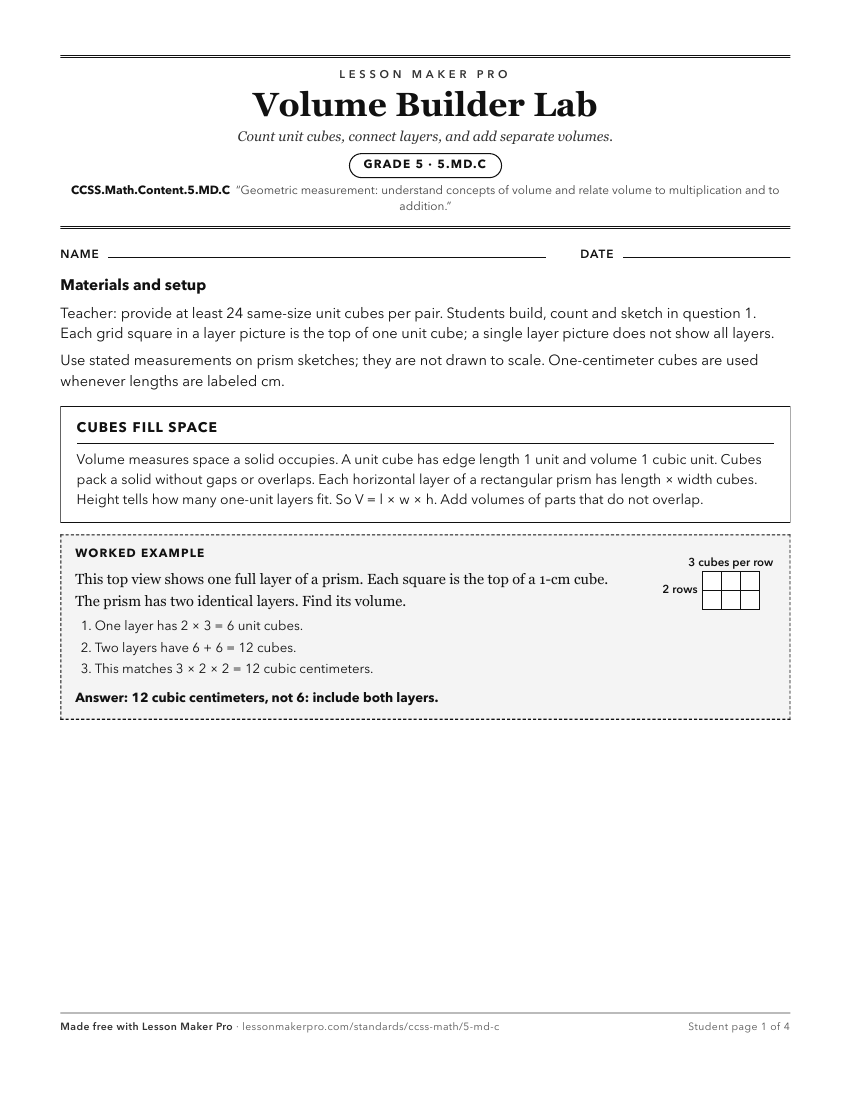
A ready-to-print activity worksheet aligned to CCSS.Math.Content.5.MD.C, with an answer key for the teacher on its own page. No account needed.
PDF, US Letter, prints cleanly in black and white.
Download the worksheetKeep exploring
Related Standards
Turn this cluster into a lesson
Grade, subject, topic, and the complete cluster are prefilled. Create one free, no account needed.
Also for this cluster:Make a WorksheetMake a QuizMake a Sub Lesson