CCSS.
The Standard
Find the volume of a right rectangular prism with whole-number side lengths by packing it with unit cubes, and show that the volume is the same as would be found by multiplying the edge lengths, equivalently by multiplying the height by the area of the base. Represent threefold whole-number products as volumes, e.g., to represent the associative property of multiplication.
Common Core State Standards for Mathematics
Teacher's field guide
What This Standard Means
What Students Need to Do
- Students pack or model a right rectangular prism with unit cubes and count the cubes by layers. They connect the model to length × width × height and base area × height, including regrouping three factors.
What Mastery Looks Like
- Students can find volume from whole-number dimensions and explain the calculation using cube layers. They can write equivalent products, such as (4 × 3) × 2 and 4 × (3 × 2), and label answers in cubic units.
Common Misconceptions
- Students may add the three dimensions instead of multiplying them. They may count only visible cubes, confuse base area with volume, or label the answer in square units instead of cubic units.
How to Assess It
- Exit ticket: A prism is 4 units long, 3 units wide, and 2 units high. Draw its cube layers, find its volume two ways, and explain why the answers match.
Lesson moves
Ways to Teach It
Build a 3-by-4 base with linking cubes, stack 2 layers, and record the cubes in each layer and the total.
Write a response to: “How do (3 × 4) × 2 and 3 × (4 × 2) describe the same prism?” Include a labeled sketch.
In pairs, draw three dimension cards, sketch the prism, calculate its volume, and earn a point for using correct cubic units.
Use a package labeled with whole-number dimensions to calculate its volume and estimate how many unit cubes would fill it.
Free download
Printable 5.MD.C.5a Worksheet
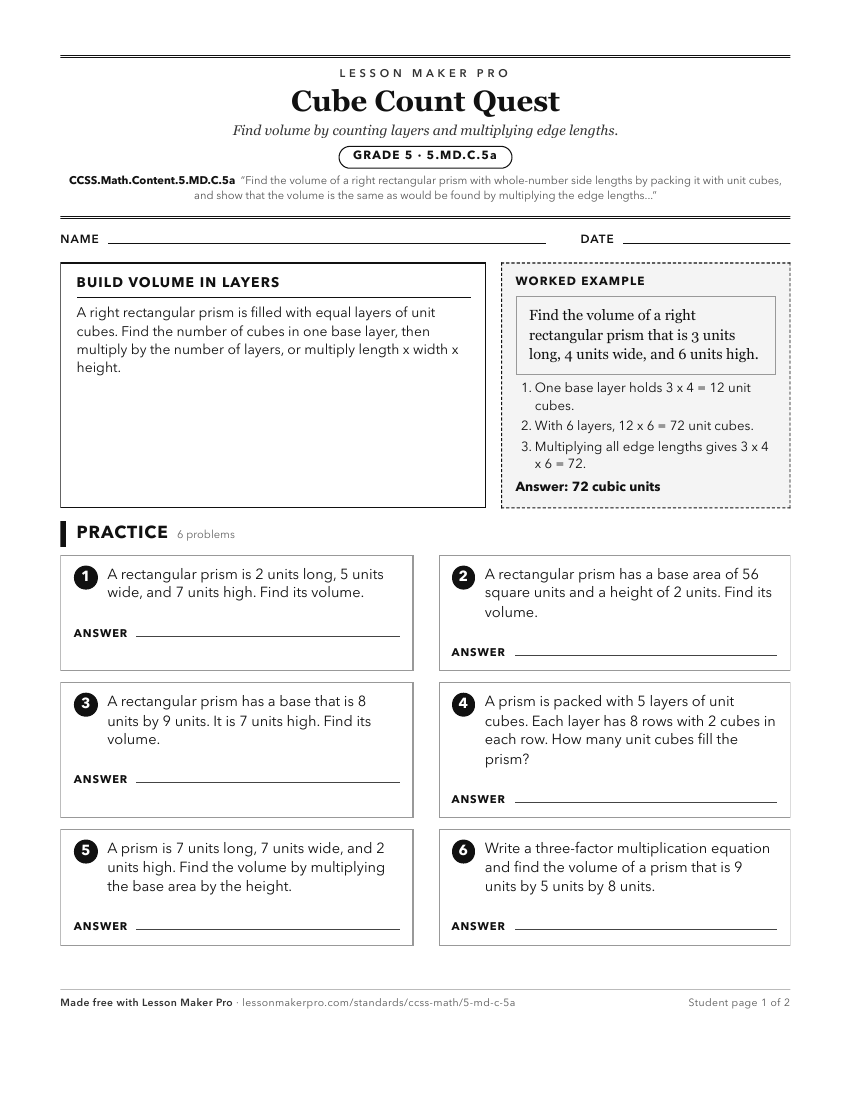
A ready-to-print activity worksheet aligned to CCSS.Math.Content.5.MD.C.5a, with an answer key for the teacher on its own page. No account needed.
PDF, US Letter, prints cleanly in black and white.
Download the worksheetLearning progression
Where This Standard Sits
Before This Standard
If students are struggling here, check these first.
- CCSS.Math.Content.5.MD.C.3
Understanding volume as counted unit cubes is necessary before packing prisms and connecting cube counts to length by width by height.
- CCSS.Math.Content.5.MD.C.4
Counting unit cubes gives the volume meaning needed to pack prisms and connect cube counts to multiplying edge lengths.
- CCSS.Math.Content.3.MD.C.7a
Rectangular area by tiling becomes the base layer count used to justify volume as height times base area.
What This Unlocks
Mastery here sets students up for these next.
Keep exploring
Related Standards
- CCSS.Math.Content.5.MD.C.5c
Recognize volume as additive. Find volumes of solid figures composed of two non-overlapping right rectangular prisms by adding the volumes of the non-overlappin...
- CCSS.Math.Content.3.MD.C.7b
Multiply side lengths to find areas of rectangles with whole-number side lengths in the context of solving real world and mathematical problems, and represent w...
Turn this exact standard into a lesson
Grade, subject, topic, and the complete standard are prefilled. Create one free, no account needed.
Also for this standard:Make a WorksheetMake a QuizMake a Sub Lesson