CCSS.
The Standard
Find the area of a rectangle with whole-number side lengths by tiling it, and show that the area is the same as would be found by multiplying the side lengths.
Common Core State Standards for Mathematics
Teacher's field guide
What This Standard Means
What Students Need to Do
- Students cover rectangles with equal-size square tiles and count the tiles to find area. They show that multiplying the whole-number side lengths gives the same total.
What Mastery Looks Like
- Students tile a rectangle with equal-size squares, count every square, and state the area in square units. They connect the rows and columns to a multiplication equation using the side lengths.
Common Misconceptions
- Students may count only the tiles along the edges or add the side lengths instead of finding all square units. They may also leave gaps, overlap tiles, or write an answer without square units.
How to Assess It
- Give students a 4-by-6 rectangle and ask them to draw square tiles, find the area, and write a multiplication equation that matches.
Lesson moves
Ways to Teach It
Give pairs square tiles and paper rectangles with whole-number sides, then have them cover each rectangle and record the area.
Ask students to explain in writing why counting tiles and multiplying side lengths give the same area.
Play Rectangle Match by pairing tiled rectangle cards with matching multiplication equations and area cards.
Measure a book cover in whole inches, sketch one-inch square tiles, and calculate its area by multiplication.
Free download
Printable 3.MD.C.7a Worksheet
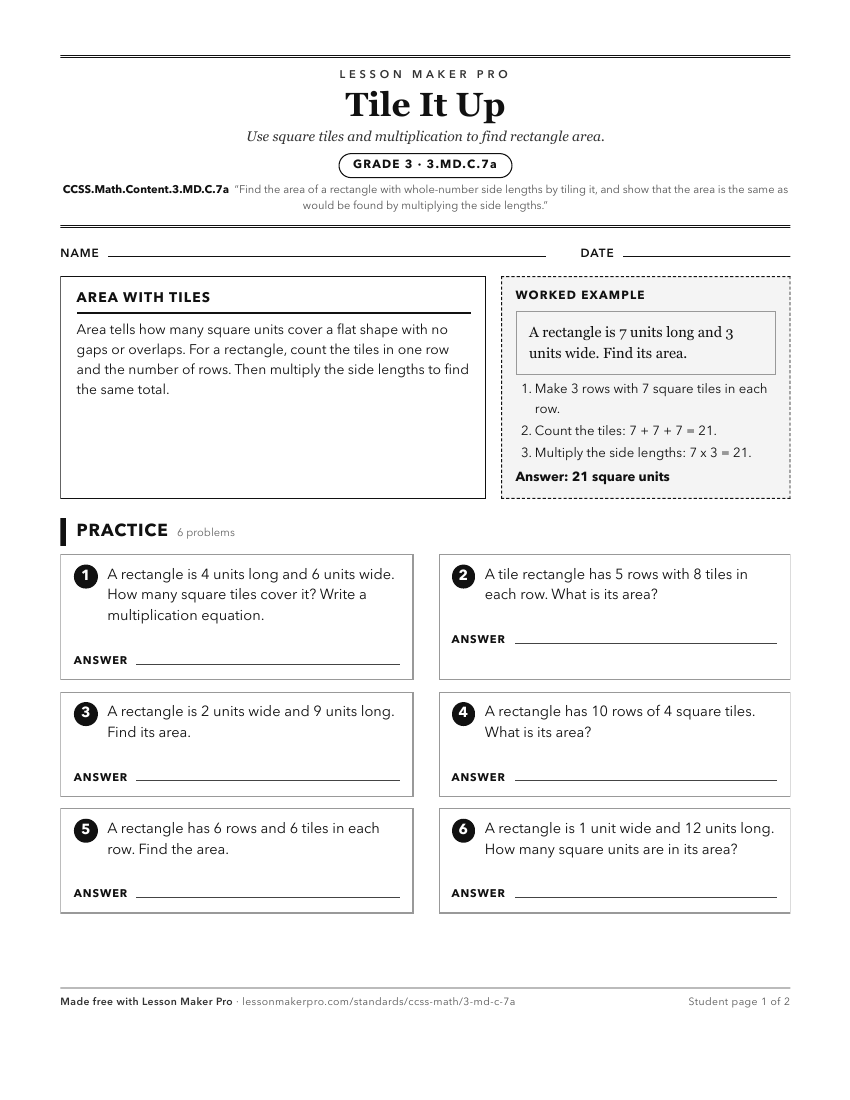
A ready-to-print activity worksheet aligned to CCSS.Math.Content.3.MD.C.7a, with an answer key for the teacher on its own page. No account needed.
PDF, US Letter, prints cleanly in black and white.
Download the worksheetLearning progression
Where This Standard Sits
Before This Standard
If students are struggling here, check these first.
- CCSS.Math.Content.3.MD.C.5b
Students must understand area as the count of unit squares before tiling rectangles and linking the count to multiplication.
- CCSS.Math.Content.3.MD.C.6
Counting unit squares is needed to understand tiled rectangle area and why rows of equal squares match side-length multiplication.
- CCSS.Math.Content.3.OA.A.1
Interpreting multiplication as equal groups carries over to seeing rectangle rows of unit squares as side-length products.
What This Unlocks
Mastery here sets students up for these next.
- CCSS.Math.Content.5.NF.B.4b
Students extend tiling rectangles and multiplying side lengths from whole-number units to fractional unit squares and fraction products.
- CCSS.Math.Content.5.MD.C.5a
Rectangular area by tiling becomes the base layer count used to justify volume as height times base area.
- CCSS.Math.Content.3.MD.C.7b
Tiling rectangles connects rows and columns to multiplication, supporting use of side-length products for area problems and reasoning.
- CCSS.Math.Content.3.MD.C.7c
Students must connect tiled rectangle area to side-length products before splitting one rectangle into two product areas.
Turn this exact standard into a lesson
Grade, subject, topic, and the complete standard are prefilled. Create one free, no account needed.
Also for this standard:Make a WorksheetMake a QuizMake a Sub Lesson