CCSS.
The Standard
Use tiling to show in a concrete case that the area of a rectangle with whole-number side lengths a and b + c is the sum of a × b and a × c. Use area models to represent the distributive property in mathematical reasoning.
Common Core State Standards for Mathematics
Teacher's field guide
What This Standard Means
What Students Need to Do
- Students split a tiled rectangle into two smaller rectangles and find each area. They connect the partial areas to an equation, such as 4 × 7 = (4 × 5) + (4 × 2).
What Mastery Looks Like
- Given a rectangle with whole-number side lengths, students can choose a useful split, label dimensions, and calculate both partial areas. They can explain why adding those areas gives the area of the original rectangle.
Common Misconceptions
- Students may add side lengths instead of multiplying to find area. They may forget to use the shared side length in both partial products. Some write 4 × 5 + 2 instead of (4 × 5) + (4 × 2).
How to Assess It
- Exit ticket: Draw a 6-by-8 grid, split 8 into 5 + 3, write a matching multiplication equation, and find the total area.
Lesson moves
Ways to Teach It
Build a 5-by-9 rectangle with square tiles, mark a split after six columns, and record both partial areas and the total.
Write two equations for a 7-by-8 grid split into 5 and 3 columns, then explain why both equations name the same area.
Deal rectangle cards and split cards to partners; players draw each model, write a distributive equation, and check one another's total.
Plan a 9-by-10 tiled patio with two tile colors, calculate each colored section, and verify the total number of tiles.
Free download
Printable 3.MD.C.7c Worksheet
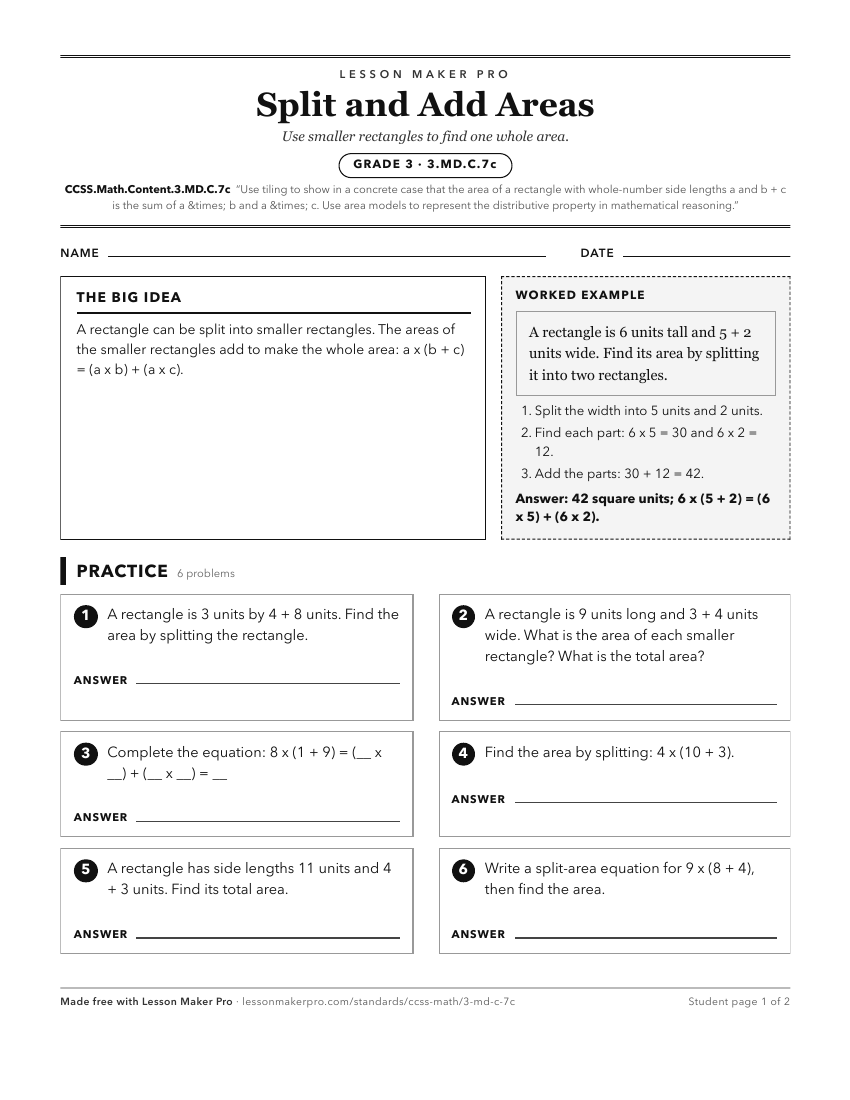
A ready-to-print activity worksheet aligned to CCSS.Math.Content.3.MD.C.7c, with an answer key for the teacher on its own page. No account needed.
PDF, US Letter, prints cleanly in black and white.
Download the worksheetLearning progression
Where This Standard Sits
Before This Standard
If students are struggling here, check these first.
- CCSS.Math.Content.3.OA.A.1
Interpreting a×b as equal groups lets students see each rectangle’s tiled area as a product in the distributive model.
- CCSS.Math.Content.3.MD.C.7a
Students must connect tiled rectangle area to side-length products before splitting one rectangle into two product areas.
- CCSS.Math.Content.3.MD.C.6
Counting unit squares supports seeing rectangle area as tiled parts whose counts add for the distributive property.
What This Unlocks
Mastery here sets students up for these next.
Keep exploring
Related Standards
- CCSS.Math.Content.5.NF.B.4b
Find the area of a rectangle with fractional side lengths by tiling it with unit squares of the appropriate unit fraction side lengths, and show that the area i...
- CCSS.Math.Content.3.MD.C
Geometric measurement: understand concepts of area and relate area to multiplication and to addition.
- CCSS.Math.Content.3.MD.C.7b
Multiply side lengths to find areas of rectangles with whole-number side lengths in the context of solving real world and mathematical problems, and represent w...
Turn this exact standard into a lesson
Grade, subject, topic, and the complete standard are prefilled. Create one free, no account needed.
Also for this standard:Make a WorksheetMake a QuizMake a Sub Lesson