CCSS.
The Standard
Recognize area as additive. Find areas of rectilinear figures by decomposing them into non-overlapping rectangles and adding the areas of the non-overlapping parts, applying this technique to solve real world problems.
Common Core State Standards for Mathematics
Teacher's field guide
What This Standard Means
What Students Need to Do
- Students split rectilinear shapes, such as L-shapes, into rectangles that do not overlap. They multiply side lengths to find each rectangle's area, then add the partial areas.
What Mastery Looks Like
- A student can mark a valid split, determine needed side lengths, and write an equation for the total area. They can explain why different rectangle splits give the same total.
Common Misconceptions
- Students may add all side lengths and report perimeter instead of area. They may create overlapping rectangles or leave a gap when splitting the figure. Some use the outer rectangle's area without removing the missing section.
How to Assess It
- Exit ticket: Draw an L-shape made from a 6 by 4 rectangle with a 2 by 2 corner removed. Show a rectangle split and find the area in square units.
Lesson moves
Ways to Teach It
Give pairs grid-paper L-shapes to cut into rectangles, label side lengths, calculate each area, and add the parts.
Ask students to draw two different rectangle splits for one shape and explain why both totals match.
Play Area Split Match: students pair irregular shape cards with rectangle equations that give the same total area.
Plan an L-shaped classroom rug by splitting its floor plan into rectangles and finding the square units needed.
Free download
Printable 3.MD.C.7d Worksheet
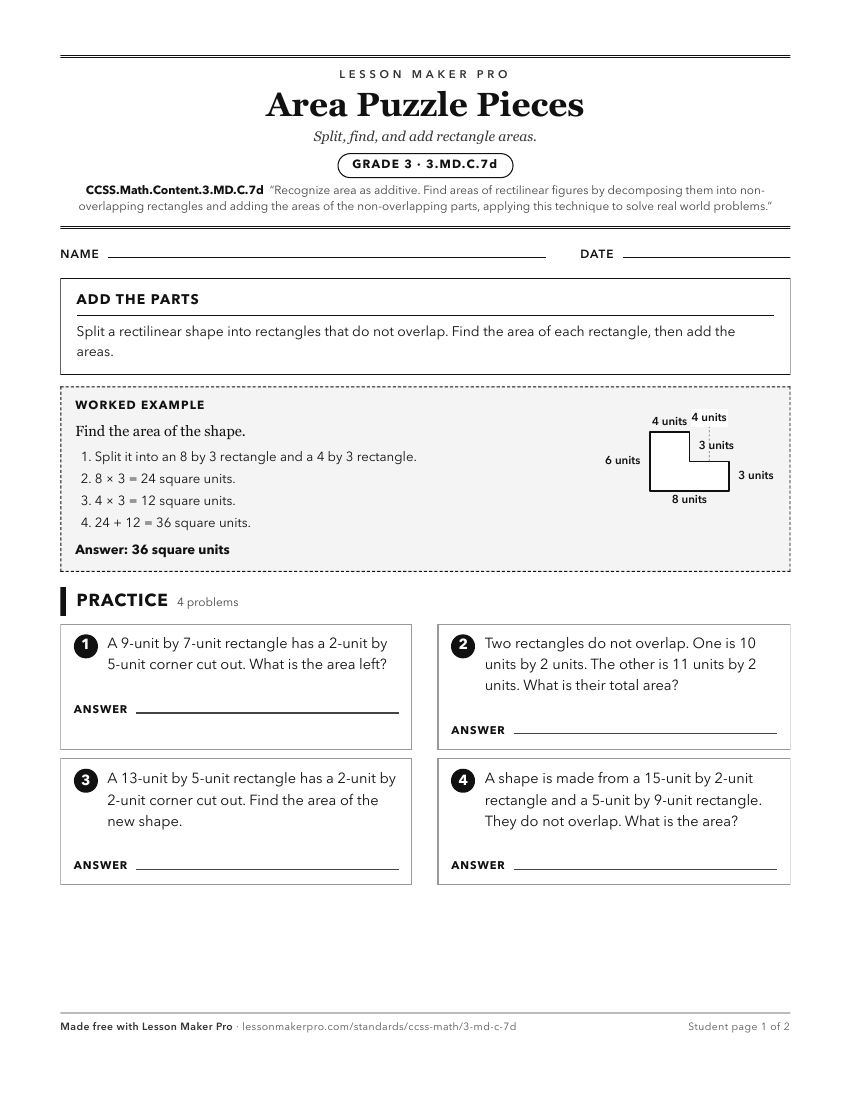
A ready-to-print activity worksheet aligned to CCSS.Math.Content.3.MD.C.7d, with an answer key for the teacher on its own page. No account needed.
PDF, US Letter, prints cleanly in black and white.
Download the worksheetLearning progression
Where This Standard Sits
Before This Standard
If students are struggling here, check these first.
- CCSS.Math.Content.3.MD.C.7b
Decomposing rectilinear figures requires finding each rectangle’s area from side lengths before adding the parts.
- CCSS.Math.Content.3.MD.C.7c
Splitting one rectangle into two parts and adding their areas supports decomposing rectilinear figures into rectangles.
- CCSS.Math.Content.3.MD.C.6
Counting unit squares grounds area as measurable space, which helps students see decomposed rectangle areas combine without overlap.
What This Unlocks
Mastery here sets students up for these next.
Keep exploring
Related Standards
- CCSS.Math.Content.6.G.A.1
Find the area of right triangles, other triangles, special quadrilaterals, and polygons by composing into rectangles or decomposing into triangles and other sha...
- CCSS.Math.Content.4.MD.A.3
Apply the area and perimeter formulas for rectangles in real world and mathematical problems.
Turn this exact standard into a lesson
Grade, subject, topic, and the complete standard are prefilled. Create one free, no account needed.
Also for this standard:Make a WorksheetMake a QuizMake a Sub Lesson