CCSS.
The Standard
Apply the area and perimeter formulas for rectangles in real world and mathematical problems.
Common Core State Standards for Mathematics · Measurement and Data
Teacher's field guide
What This Standard Means
What Students Need to Do
- Students use multiplication and addition to find the area or perimeter of a rectangle. They also find a missing side length when given the area or perimeter and another side.
What Mastery Looks Like
- Students choose the correct operation for area or perimeter and label answers with the right units. They can use division or a missing-factor equation to find an unknown side length.
Common Misconceptions
- Students often add length and width for area, or multiply them for perimeter. They may forget that perimeter includes two lengths and two widths. They may label area with linear units instead of square units.
How to Assess It
- Exit ticket: A rectangular garden has an area of 48 square feet and a length of 8 feet. Find its width and perimeter, and show equations.
Lesson moves
Ways to Teach It
Give pairs 24 square tiles and ask them to build different rectangles, then record each rectangle's side lengths, area, and perimeter.
Ask, "Can two rectangles have the same area but different perimeters?" Students draw examples and explain their reasoning.
Play Formula Sort with cards showing dimensions, areas, perimeters, and missing sides; students match cards into complete rectangle sets.
Measure a classroom tabletop, calculate its area and perimeter, then determine how much edging and covering material it would need.
Free download
Printable 4.MD.A.3 Worksheet
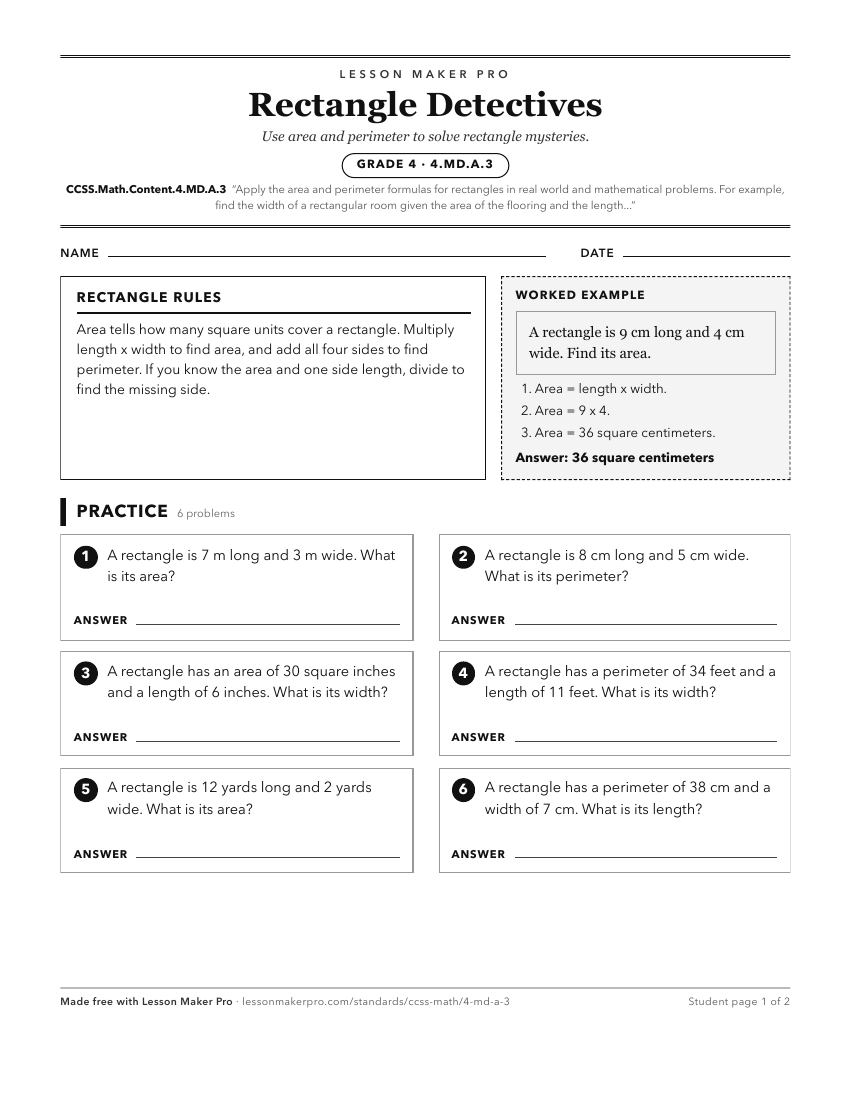
A ready-to-print activity worksheet aligned to CCSS.Math.Content.4.MD.A.3, with an answer key for the teacher on its own page. No account needed.
PDF, US Letter, prints cleanly in black and white.
Download the worksheetLearning progression
Where This Standard Sits
See the whole path on the Measurement & Data progression map.
Before This Standard
If students are struggling here, check these first.
- CCSS.Math.Content.3.MD.C.7b
Multiplying rectangle side lengths becomes the area formula, which students must use alongside perimeter in grade 4 problems.
- CCSS.Math.Content.3.MD.D.8
Perimeter problem solving with rectangles carries into using rectangle perimeter formulas and comparing perimeter with area in applications.
- CCSS.Math.Content.4.NBT.B.5
Rectangle area uses multiplication of side lengths, and prior array or area models support understanding and computing length times width.
What This Unlocks
Mastery here sets students up for these next.
Keep exploring
Related Standards
Turn this exact standard into a lesson
Grade, subject, topic, and the complete standard are prefilled. Create one free, no account needed.
Also for this standard:Make a WorksheetMake a QuizMake a Sub Lesson