CCSS.
The Standard
Multiply side lengths to find areas of rectangles with whole-number side lengths in the context of solving real world and mathematical problems, and represent whole-number products as rectangular areas in mathematical reasoning.
Common Core State Standards for Mathematics
Teacher's field guide
What This Standard Means
What Students Need to Do
- Students use rows and columns to connect a rectangle’s dimensions with multiplication. They find unknown areas and draw rectangles to show whole-number products in word problems.
What Mastery Looks Like
- A student can solve a rectangle area problem by multiplying the two side lengths and labeling the answer in square units. They can draw or explain an array that matches the equation.
Common Misconceptions
- Students may add the side lengths, find perimeter, or count only the squares along the edges. They may think a 3 by 5 rectangle and a 5 by 3 rectangle have different areas.
How to Assess It
- Exit ticket: A garden is 6 feet long and 4 feet wide. Find its area, write an equation, and sketch a matching grid.
Lesson moves
Ways to Teach It
Cover rectangle mats with square tiles, record the rows and columns, and write a multiplication equation for each area.
Ask, “How does a 4 by 7 array prove that 4 × 7 = 28?” Have students explain in two sentences.
Play Area Match: students pair dimension cards, array drawings, equations, and area cards, then check each set with a partner.
Give pairs a classroom floor plan and have them find the area of rectangular rugs, tables, or bulletin boards.
Free download
Printable 3.MD.C.7b Worksheet
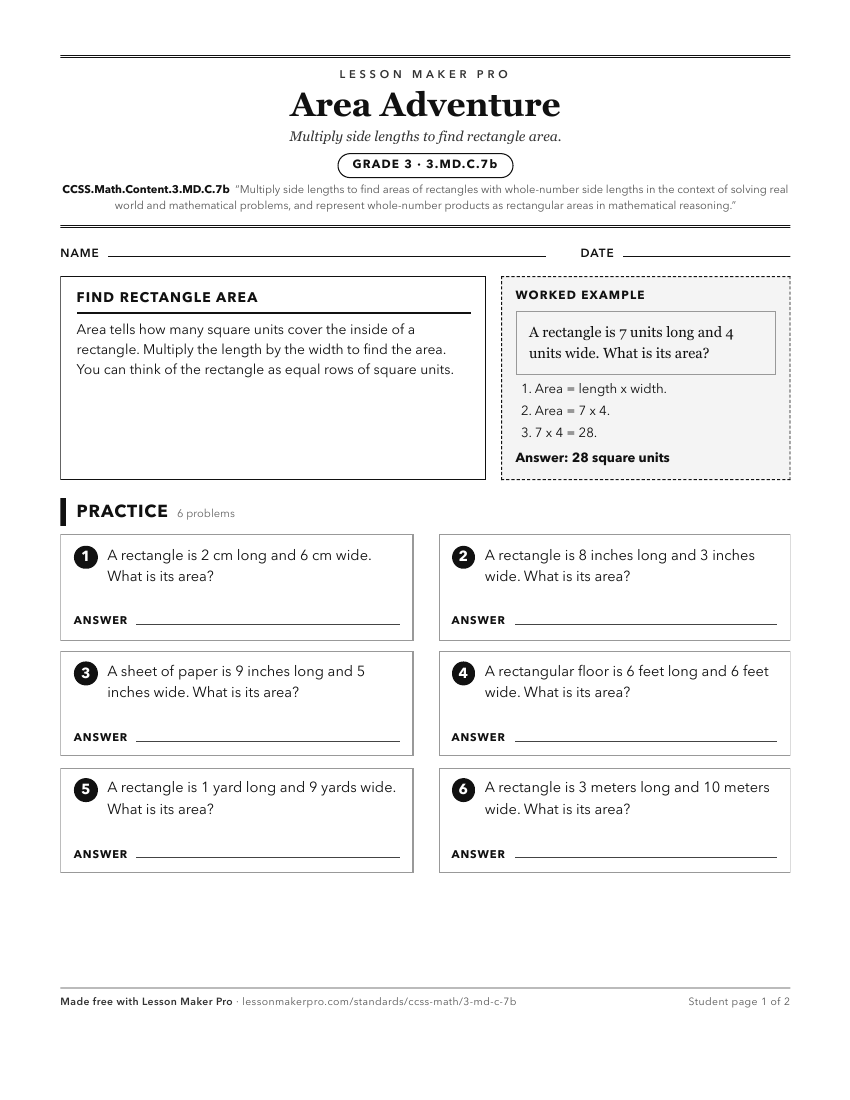
A ready-to-print activity worksheet aligned to CCSS.Math.Content.3.MD.C.7b, with an answer key for the teacher on its own page. No account needed.
PDF, US Letter, prints cleanly in black and white.
Download the worksheetLearning progression
Where This Standard Sits
Before This Standard
If students are struggling here, check these first.
- CCSS.Math.Content.3.MD.C.7a
Tiling rectangles connects rows and columns to multiplication, supporting use of side-length products for area problems and reasoning.
- CCSS.Math.Content.3.OA.A.1
Understanding multiplication as equal groups supports seeing rectangle rows or columns as factors whose product gives total square units.
- CCSS.Math.Content.2.OA.C.4
Array equal-addend sums support seeing rectangle area as rows times columns, but area multiplication can be introduced through measurement models.
What This Unlocks
Mastery here sets students up for these next.
- CCSS.Math.Content.5.MD.C.5b
Volume formulas for rectangular prisms use the rectangle’s length times width as base area, then multiply by height.
- CCSS.Math.Content.4.MD.A.3
Multiplying rectangle side lengths becomes the area formula, which students must use alongside perimeter in grade 4 problems.
- CCSS.Math.Content.3.MD.C.7d
Decomposing rectilinear figures requires finding each rectangle’s area from side lengths before adding the parts.
Keep exploring
Related Standards
- CCSS.Math.Content.5.NF.B.4b
Find the area of a rectangle with fractional side lengths by tiling it with unit squares of the appropriate unit fraction side lengths, and show that the area i...
- CCSS.Math.Content.3.MD.D.8
Solve real world and mathematical problems involving perimeters of polygons, including finding the perimeter given the side lengths, finding an unknown side len...
Turn this exact standard into a lesson
Grade, subject, topic, and the complete standard are prefilled. Create one free, no account needed.
Also for this standard:Make a WorksheetMake a QuizMake a Sub Lesson