CCSS.
The Standard
Use addition to find the total number of objects arranged in rectangular arrays with up to 5 rows and up to 5 columns; write an equation to express the total as a sum of equal addends.
Common Core State Standards for Mathematics · Operations and Algebraic Thinking
Teacher's field guide
What This Standard Means
What Students Need to Do
- Students organize or read objects in equal rows and columns. They use repeated addition to find the total and write an equation that matches the array.
What Mastery Looks Like
- Students identify the number of rows and the number of objects in each row. They write a correct equation such as 4 + 4 + 4 = 12 and explain what each addend represents.
Common Misconceptions
- Students may count every object one at a time instead of using equal groups. They may confuse rows with columns, write unequal addends, or use the wrong number of addends.
How to Assess It
- Exit ticket: Draw 3 rows with 4 dots in each row. Write an addition equation and find the total.
Lesson moves
Ways to Teach It
Give pairs 20 counters and grid mats, then have them build a 4-by-5 array and record its repeated-addition equation.
Show a 3-by-4 array and ask, “How can rows and columns give two different addition equations with the same total?”
Play Array Match with cards showing arrays, repeated-addition equations, and totals, with students collecting sets of three that belong together.
For a bakery tray picture, students circle equal rows of muffins, find the total, and write an addition equation.
Free download
Printable 2.OA.C.4 Worksheet
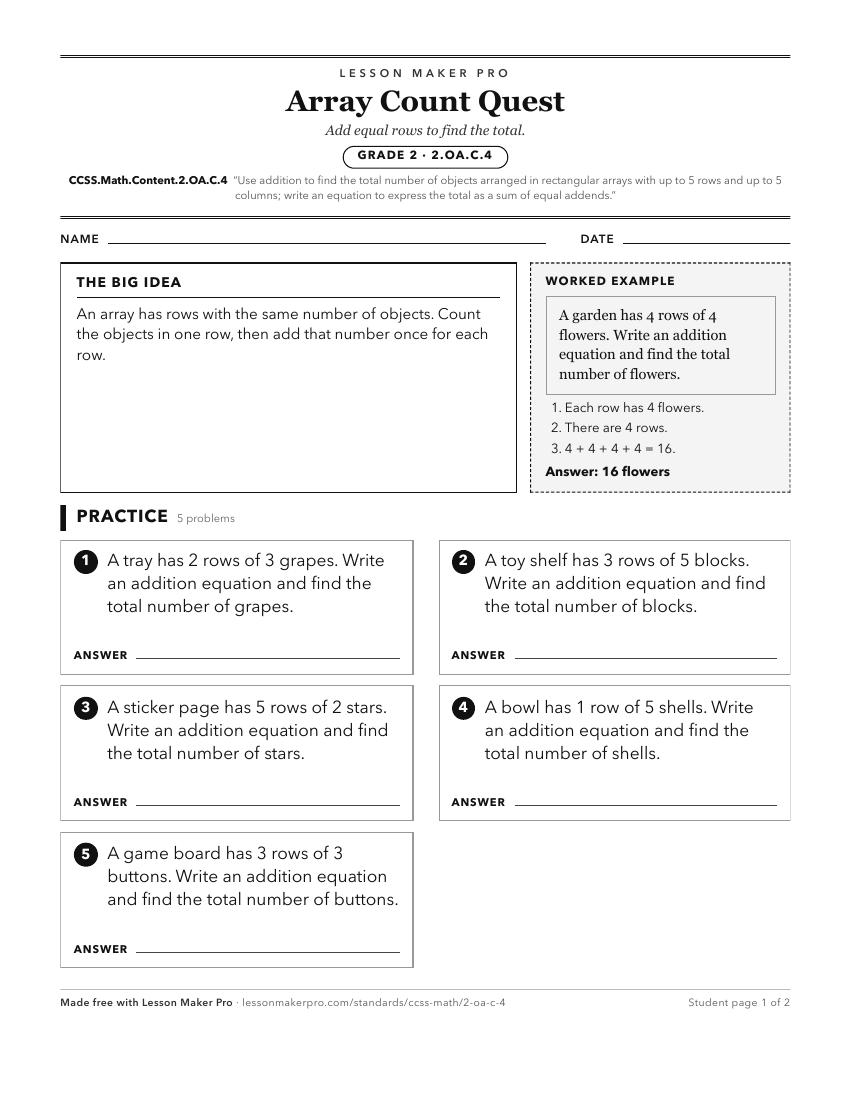
A ready-to-print activity worksheet aligned to CCSS.Math.Content.2.OA.C.4, with an answer key for the teacher on its own page. No account needed.
PDF, US Letter, prints cleanly in black and white.
Download the worksheetLearning progression
Where This Standard Sits
See the whole path on the Operations & Algebraic Thinking progression map.
Before This Standard
If students are struggling here, check these first.
- CCSS.Math.Content.K.OA.A.1
Representing addition with objects, drawings, and equations supports modeling arrays and writing repeated addition equations for equal rows or columns.
- CCSS.Math.Content.K.CC.B.5
Counting objects and understanding the last count as the total are necessary before using addition to total array objects.
- CCSS.Math.Content.1.OA.C.5
Counting on to add supports finding array totals by adding equal row or column groups instead of recounting every object.
What This Unlocks
Mastery here sets students up for these next.
- CCSS.Math.Content.3.OA.A.1
Writing array totals as equal addends prepares students to see multiplication as equal groups and a total number of objects.
- CCSS.Math.Content.3.OA.A.2
Equal rows and repeated addition introduce equal groups, which supports understanding division as sharing or grouping equal amounts.
- CCSS.Math.Content.3.MD.C.7b
Array equal-addend sums support seeing rectangle area as rows times columns, but area multiplication can be introduced through measurement models.
Keep exploring
Related Standards
- CCSS.Math.Content.1.OA.A.1
Use addition and subtraction within 20 to solve word problems involving situations of adding to, taking from, putting together, taking apart, and comparing, wit...
- CCSS.Math.Content.2.OA.C.3
Determine whether a group of objects (up to 20) has an odd or even number of members, e.g., by pairing objects or counting them by 2s; write an equation to expr...
- CCSS.Math.Content.1.OA.A.2
Solve word problems that call for addition of three whole numbers whose sum is less than or equal to 20, e.g., by using objects, drawings, and equations with a ...
- CCSS.Math.Content.2.G.A.2
Partition a rectangle into rows and columns of same-size squares and count to find the total number of them.
Turn this exact standard into a lesson
Grade, subject, topic, and the complete standard are prefilled. Create one free, no account needed.
Also for this standard:Make a WorksheetMake a QuizMake a Sub Lesson