CCSS.
The Standard
Relate counting to addition and subtraction (e.g., by counting on 2 to add 2).
Common Core State Standards for Mathematics · Operations and Algebraic Thinking
Teacher's field guide
What This Standard Means
What Students Need to Do
- Students start with a known number and count forward to add or backward to subtract. They connect each spoken count to one more or one less.
What Mastery Looks Like
- A student starts at one number and counts the correct number of steps forward or backward. The student gives the total or difference without recounting every object.
Common Misconceptions
- Students may begin at 1 instead of starting with the known amount. They may count the starting number again or count forward when subtracting.
How to Assess It
- Give the prompt, “Solve 8 + 3 and 12 − 2 by counting. Write the numbers you say as you count.”
Lesson moves
Ways to Teach It
Give students counters and number paths, then have them model 7 + 4 and 13 − 3 with one move per count.
Ask, “Why is starting at 8 faster than starting at 1 when solving 8 + 5?”
Play partner race with equation cards, where students count forward or backward aloud and earn a point for each correct answer.
Set up a classroom store where students add items to a basket or remove sold items by counting from the current amount.
Free download
Printable 1.OA.C.5 Worksheet
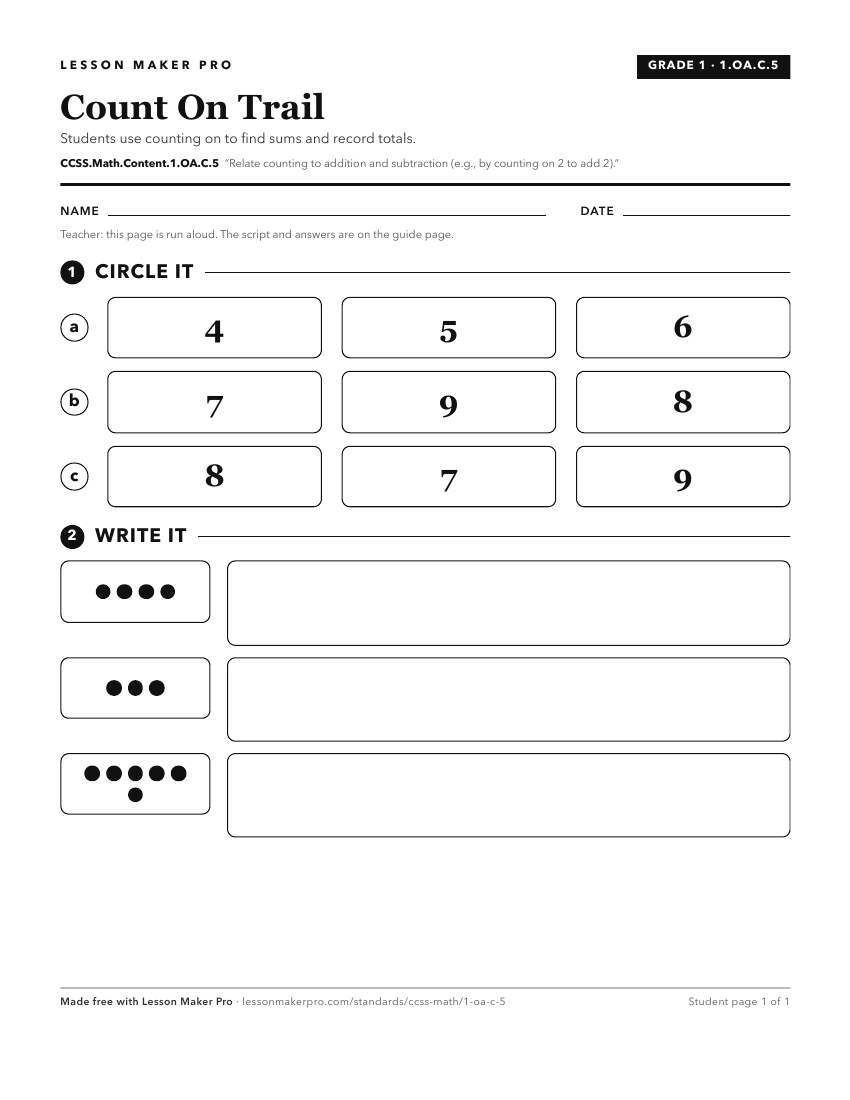
A ready-to-print activity worksheet aligned to CCSS.Math.Content.1.OA.C.5, with an answer key for the teacher on its own page. No account needed.
PDF, US Letter, prints cleanly in black and white.
Download the worksheetLearning progression
Where This Standard Sits
See the whole path on the Operations & Algebraic Thinking progression map.
Before This Standard
If students are struggling here, check these first.
- CCSS.Math.Content.K.CC.B.4c
Counting on for addition depends on knowing each next number name increases the quantity by one.
- CCSS.Math.Content.K.CC.A.2
Counting on for addition requires starting the count at an addend and continuing the number sequence accurately.
- CCSS.Math.Content.K.OA.A.1
Representing addition and subtraction with objects, drawings, and equations supports seeing counting on or back as an operation strategy.
What This Unlocks
Mastery here sets students up for these next.
- CCSS.Math.Content.2.MD.B.6
Counting on and counting back carry over to making forward and backward jumps for sums and differences on a number line.
- CCSS.Math.Content.2.OA.B.2
Counting on connects number sequence to adding and subtracting, supporting later mental strategies and fact fluency within 20.
- CCSS.Math.Content.1.OA.C.6
Counting on and counting back are core strategies students use before fluency and more advanced within-20 strategies.
- CCSS.Math.Content.3.OA.A.1
Counting on to combine quantities supports seeing equal groups as repeated additions when interpreting a product.
- CCSS.Math.Content.2.OA.C.4
Counting on to add supports finding array totals by adding equal row or column groups instead of recounting every object.
Keep exploring
Related Standards
- CCSS.Math.Content.1.NBT.C.4
Add within 100, including adding a two-digit number and a one-digit number, and adding a two-digit number and a multiple of 10, using concrete models or drawing...
- CCSS.Math.Content.3.MD.C.7
Relate area to the operations of multiplication and addition.
- CCSS.Math.Content.2.MD.B
Relate addition and subtraction to length.
Turn this exact standard into a lesson
Grade, subject, topic, and the complete standard are prefilled. Create one free, no account needed.
Also for this standard:Make a WorksheetMake a QuizMake a Sub Lesson