CCSS.
The Standard
Represent whole numbers as lengths from 0 on a number line diagram with equally spaced points corresponding to the numbers 0, 1, 2, …, and represent whole-number sums and differences within 100 on a number line diagram.
Common Core State Standards for Mathematics · Measurement and Data
Teacher's field guide
What This Standard Means
What Students Need to Do
- Students place whole numbers on a number line with equal spaces and explain each number as a distance from 0. They show addition with forward jumps and subtraction with backward jumps, within 100.
What Mastery Looks Like
- A student accurately labels equally spaced points and identifies each number’s distance from 0. They solve an equation using forward or backward jumps, label the jumps, and match the endpoint to the answer.
Common Misconceptions
- Students may count tick marks instead of spaces, causing an answer that is off by one. They may use uneven spacing between numbers. They may start subtraction at 0 or move right instead of starting at the first number and moving left.
How to Assess It
- Exit ticket: On an equally spaced number line from 0 to 100, mark 63, then show 63 minus 28 with labeled jumps and circle the endpoint.
Lesson moves
Ways to Teach It
Lay numbered floor tiles from 0 to 30; students stand on a start number, then step forward or backward to solve equation cards.
Students draw 46 plus 18 and 64 minus 18, then write how the jumps show that the equations are connected.
Play Number Line Target: pairs draw two number cards, choose addition or subtraction, and make labeled jumps to reach the correct endpoint.
On a bus route diagram, students start at stop 42, travel 23 stops, return 11 stops, and mark each position.
Free download
Printable 2.MD.B.6 Worksheet
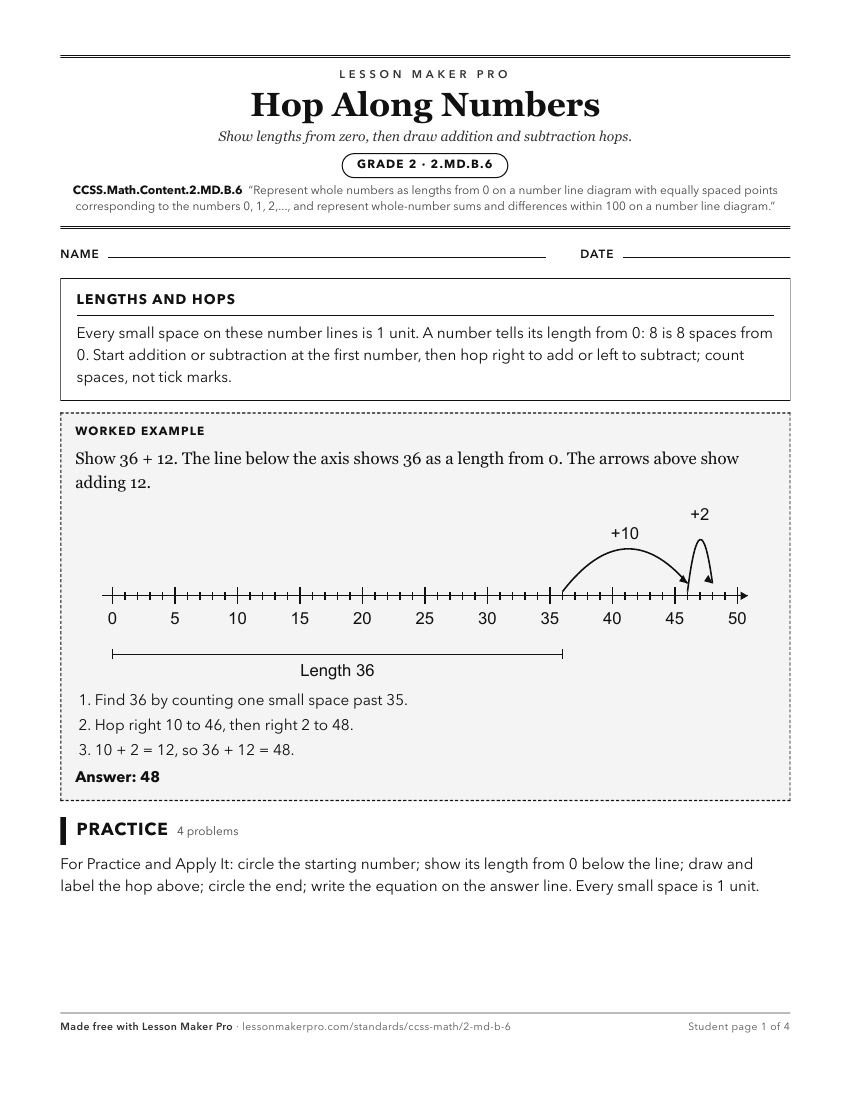
A ready-to-print activity worksheet aligned to CCSS.Math.Content.2.MD.B.6, with an answer key for the teacher on its own page. No account needed.
PDF, US Letter, prints cleanly in black and white.
Download the worksheetLearning progression
Where This Standard Sits
See the whole path on the Measurement & Data progression map.
Before This Standard
If students are struggling here, check these first.
- CCSS.Math.Content.1.NBT.A.1
Counting and reading numerals to 120 supports labeling number line points and tracking jumps for sums and differences within 100.
- CCSS.Math.Content.1.OA.C.5
Counting on and counting back carry over to making forward and backward jumps for sums and differences on a number line.
- CCSS.Math.Content.1.MD.A.2
Counting equal length units with no gaps supports seeing number line intervals as equal steps for representing numbers and jumps.
What This Unlocks
Mastery here sets students up for these next.
- CCSS.Math.Content.3.NF.A.2a
Whole-number number lines prepare students to see numbers as distances from 0 before partitioning 0 to 1 into unit fractions.
- CCSS.Math.Content.3.NF.A.2b
Fraction points require the same number line ideas of equal spacing, distance from 0, and endpoints locating numbers.
- CCSS.Math.Content.3.NF.A.2
Whole-number number lines establish equal spacing, zero, and distance from zero, which students extend to partitioning intervals into fractions.
- CCSS.Math.Content.3.MD.A.1
Number line jumps for sums and differences support representing elapsed minutes and solving time-interval problems on a timeline.
- CCSS.Math.Content.2.MD.D.9
Number line work supports reading and spacing the whole-number scale used to place measurements on a line plot.
Keep exploring
Related Standards
- CCSS.Math.Content.7.NS.A.1
Apply and extend previous understandings of addition and subtraction to add and subtract rational numbers; represent addition and subtraction on a horizontal or...
- CCSS.Math.Content.6.NS.C.6
Understand a rational number as a point on the number line. Extend number line diagrams and coordinate axes familiar from previous grades to represent points on...
Turn this exact standard into a lesson
Grade, subject, topic, and the complete standard are prefilled. Create one free, no account needed.
Also for this standard:Make a WorksheetMake a QuizMake a Sub Lesson