CCSS.
The Standard
Count to 120, starting at any number less than 120. In this range, read and write numerals and represent a number of objects with a written numeral.
Common Core State Standards for Mathematics · Number and Operations in Base Ten
Teacher's field guide
What This Standard Means
What Students Need to Do
- Students continue the counting sequence from any given number rather than always starting at 1. They connect spoken numbers, written numerals, and groups of objects through 120.
What Mastery Looks Like
- A student can begin at a number such as 47 and continue in order through each decade change. The student reads, writes, and matches numerals to collections through 120.
Common Misconceptions
- Students may restart at 1 instead of continuing from the given number. They often skip numbers at decade changes, reverse digits, or confuse numbers such as 106 and 160.
How to Assess It
- Give this exit ticket: “Start at 78 and write the next 12 numbers. Draw grouped tens and ones to show 93, then label it.”
Lesson moves
Ways to Teach It
Build numbers with ten-sticks and single cubes, count the total, then match each collection to a numeral card.
Ask, “What happens after 99?” Have students write or explain how the digits change.
Students draw a numeral card, read it aloud, then earn a point by saying the next five numbers correctly.
Count a classroom collection, such as crayons or craft sticks, group items by tens, and write a label showing the total.
Free download
Printable 1.NBT.A.1 Worksheet
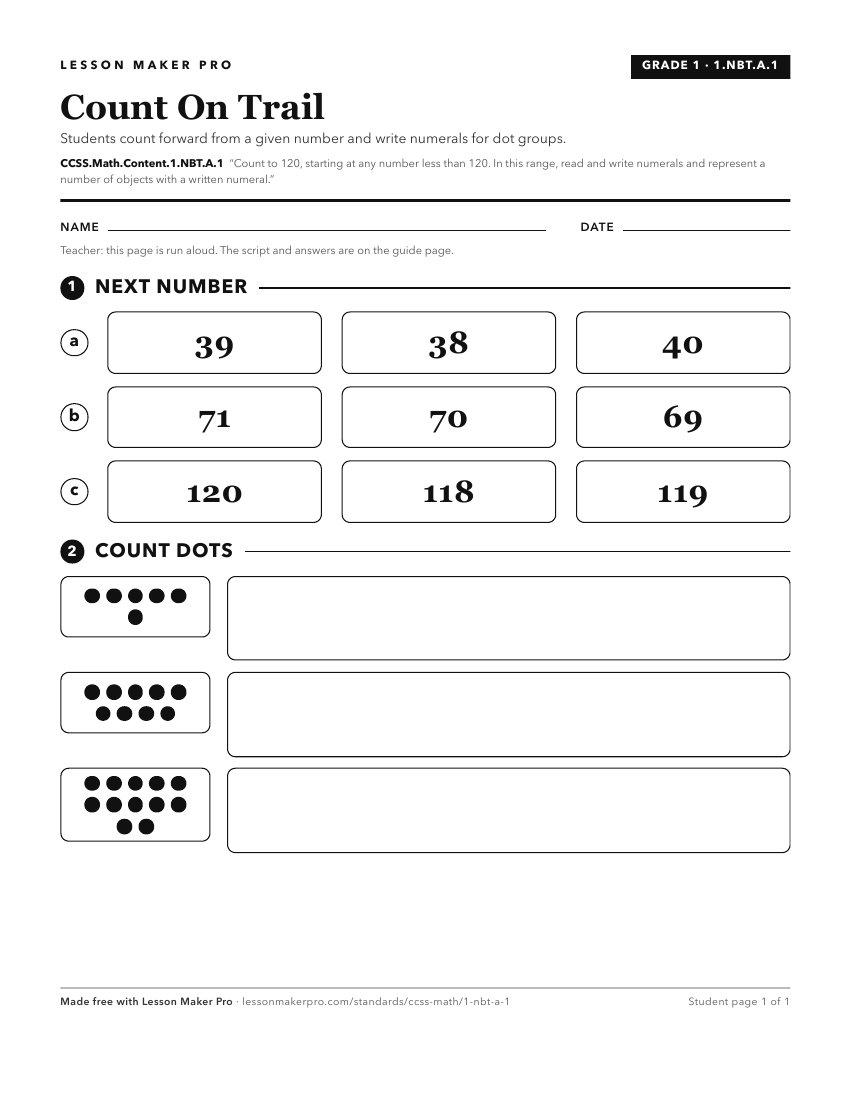
A ready-to-print activity worksheet aligned to CCSS.Math.Content.1.NBT.A.1, with an answer key for the teacher on its own page. No account needed.
PDF, US Letter, prints cleanly in black and white.
Download the worksheetLearning progression
Where This Standard Sits
See the whole path on the Number & Operations in Base Ten progression map.
Before This Standard
If students are struggling here, check these first.
- CCSS.Math.Content.K.CC.A.2
Counting on from a given number is required to count to 120 starting from any number less than 120.
- CCSS.Math.Content.K.CC.A.3
Writing numerals for 0 to 20 and matching them to counts is the base for reading and writing numbers to 120.
- CCSS.Math.Content.K.CC.A.1
Counting to 120 and starting anywhere depends on knowing the count sequence through 100 and decade transitions.
What This Unlocks
Mastery here sets students up for these next.
- CCSS.Math.Content.2.MD.B.6
Counting and reading numerals to 120 supports labeling number line points and tracking jumps for sums and differences within 100.
- CCSS.Math.Content.2.MD.A.1
Counting and reading numerals support using ruler marks and recording lengths, though tool use also requires separate measurement ideas.
- CCSS.Math.Content.2.NBT.A.3
Reading and writing numbers to 120 establishes the numeral sequence and notation needed to read, write, and expand numbers to 1000.
- CCSS.Math.Content.3.OA.A.1
Counting objects and matching quantities to numerals supports seeing a product as several equal groups with a total.
- CCSS.Math.Content.2.NBT.A.2
Counting and reading numbers to 120 supports extending the counting sequence and recognizing patterns used in skip-counting within 1000.
- CCSS.Math.Content.1.NBT.C.5
Reading two-digit numerals and knowing the number sequence supports seeing how numbers change when adding or subtracting ten.
Turn this exact standard into a lesson
Grade, subject, topic, and the complete standard are prefilled. Create one free, no account needed.
Also for this standard:Make a WorksheetMake a QuizMake a Sub Lesson