CCSS.
The Standard
Write numbers from 0 to 20. Represent a number of objects with a written numeral 0-20 (with 0 representing a count of no objects).
Common Core State Standards for Mathematics · Counting and Cardinality
Teacher's field guide
What This Standard Means
What Students Need to Do
- Students write numerals from 0 through 20 with recognizable shapes. They count objects, then record the total with the matching numeral, using 0 for an empty set.
What Mastery Looks Like
- Students write legible numerals through 20 when given a spoken number or a set of objects. They use 0 when a set has no objects and match each other quantity to the correct numeral.
Common Misconceptions
- Students may reverse numerals such as 2, 3, or 7, or confuse 6 and 9. They may count a set correctly but write the wrong numeral. Some write 1 for an empty set instead of 0.
How to Assess It
- Show sets containing 0, 6, 13, and 20 counters. Ask students to count each set and write the matching numeral.
Lesson moves
Ways to Teach It
Give students numeral cards and counters, then have them build a matching set beside each card, including an empty set for 0.
Show a set of objects and ask, “How do you know which numeral matches this set?”
Play numeral bingo by calling numbers or showing dot cards while students cover the matching written numeral.
Have students count classroom supplies, then write labels showing how many pencils, books, chairs, or glue sticks they found.
Free download
Printable K.CC.A.3 Worksheet
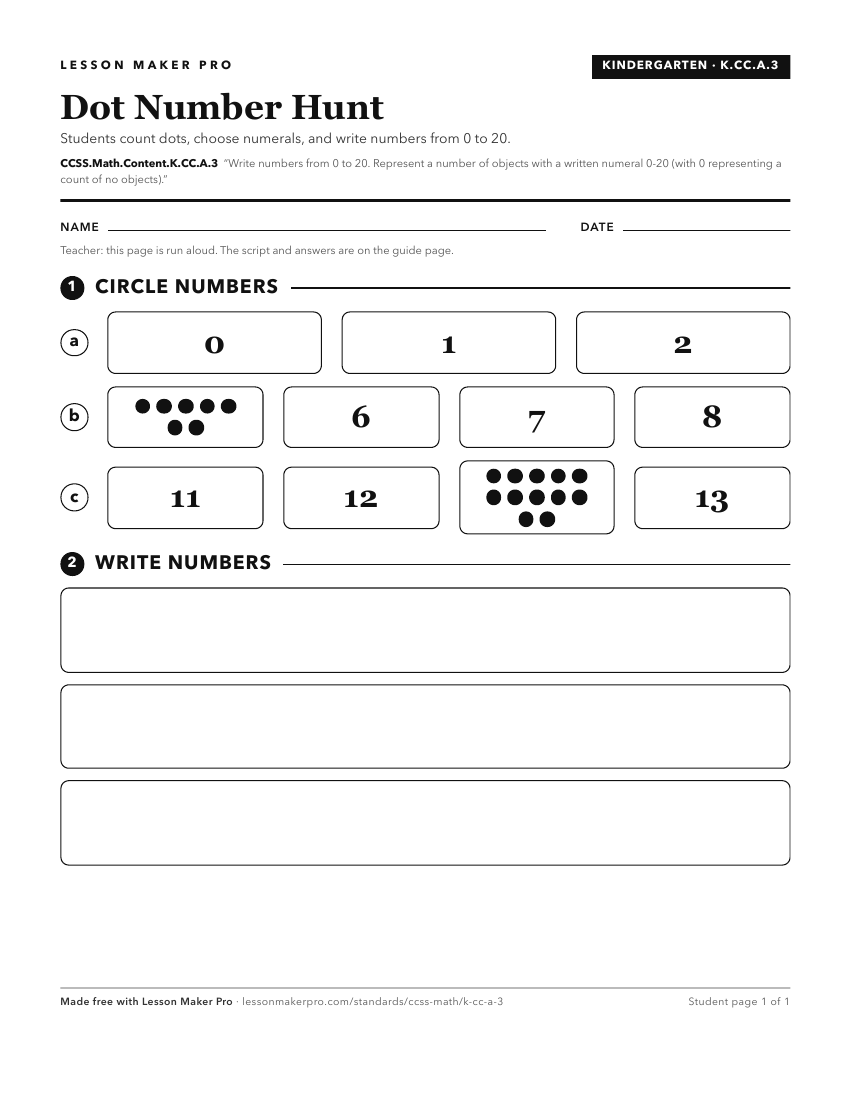
A ready-to-print activity worksheet aligned to CCSS.Math.Content.K.CC.A.3, with an answer key for the teacher on its own page. No account needed.
PDF, US Letter, prints cleanly in black and white.
Download the worksheetLearning progression
Where This Standard Sits
Before This Standard
If students are struggling here, check these first.
- CCSS.Math.Content.K.CC.B.4b
To write a numeral for a set, students must know the final count word gives the set’s total quantity.
- CCSS.Math.Content.K.CC.B.4
Students must connect a counted set to its total before choosing the written numeral that represents the objects.
- CCSS.Math.Content.K.CC.B.4a
One-to-one counting helps students find how many objects a written numeral should represent, though numeral writing can begin separately.
What This Unlocks
Mastery here sets students up for these next.
- CCSS.Math.Content.2.OA.C.3
Writing numerals to 20 supports recording group sizes and equal-addend equations after students pair objects or count by twos.
- CCSS.Math.Content.1.MD.B.3
Writing numerals 0 to 20 supports recording clock times and reading hour numbers on analog and digital clocks.
- CCSS.Math.Content.1.NBT.A.1
Writing numerals for 0 to 20 and matching them to counts is the base for reading and writing numbers to 120.
- CCSS.Math.Content.K.CC.C.7
Connecting written numerals to quantities supports comparing numeral symbols, though students can compare with recognition before fluent writing.
- CCSS.Math.Content.K.NBT.A.1
Writing numerals 0 to 20 supports recording teen decompositions like 18 = 10 + 8 and linking symbols to quantities.
Keep exploring
Related Standards
- CCSS.Math.Content.K.CC.B
Count to tell the number of objects.
- CCSS.Math.Content.K.CC.B.5
Count to answer "how many?" questions about as many as 20 things arranged in a line, a rectangular array, or a circle, or as many as 10 things in a scattered co...
- CCSS.Math.Content.1.NBT.B.2c
The numbers 10, 20, 30, 40, 50, 60, 70, 80, 90 refer to one, two, three, four, five, six, seven, eight, or nine tens (and 0 ones).
Turn this exact standard into a lesson
Grade, subject, topic, and the complete standard are prefilled. Create one free, no account needed.
Also for this standard:Make a WorksheetMake a QuizMake a Sub Lesson