CCSS.
The Standard
The numbers 10, 20, 30, 40, 50, 60, 70, 80, 90 refer to one, two, three, four, five, six, seven, eight, or nine tens (and 0 ones).
Common Core State Standards for Mathematics
Teacher's field guide
What This Standard Means
What Students Need to Do
- Students connect two-digit numbers ending in zero to groups of ten with no loose ones. They build, draw, name, and count these groups.
What Mastery Looks Like
- Given 60, a student says it has six tens and zero ones, then models it with six tens rods. Given eight tens rods, the student names the number as 80.
Common Misconceptions
- Students may read 60 as 6 because they think the zero has no purpose. They may also say 40 has four ones or four tens and four ones.
How to Assess It
- Give this exit ticket: “Draw a model for 70. Complete: 70 is ___ tens and ___ ones.”
Lesson moves
Ways to Teach It
Give pairs 90 straws and rubber bands, then call out a multiple of ten for them to build with bundled tens.
Ask, “How are 30 and 3 alike and different?” Have students draw place-value models and explain them to a partner.
Play Tens Match with numeral cards, tens-frame pictures, and cards labeled with phrases such as “six tens.”
Show boxes that hold ten crayons, then ask students to label totals for two, five, and eight full boxes.
Free download
Printable 1.NBT.B.2c Worksheet
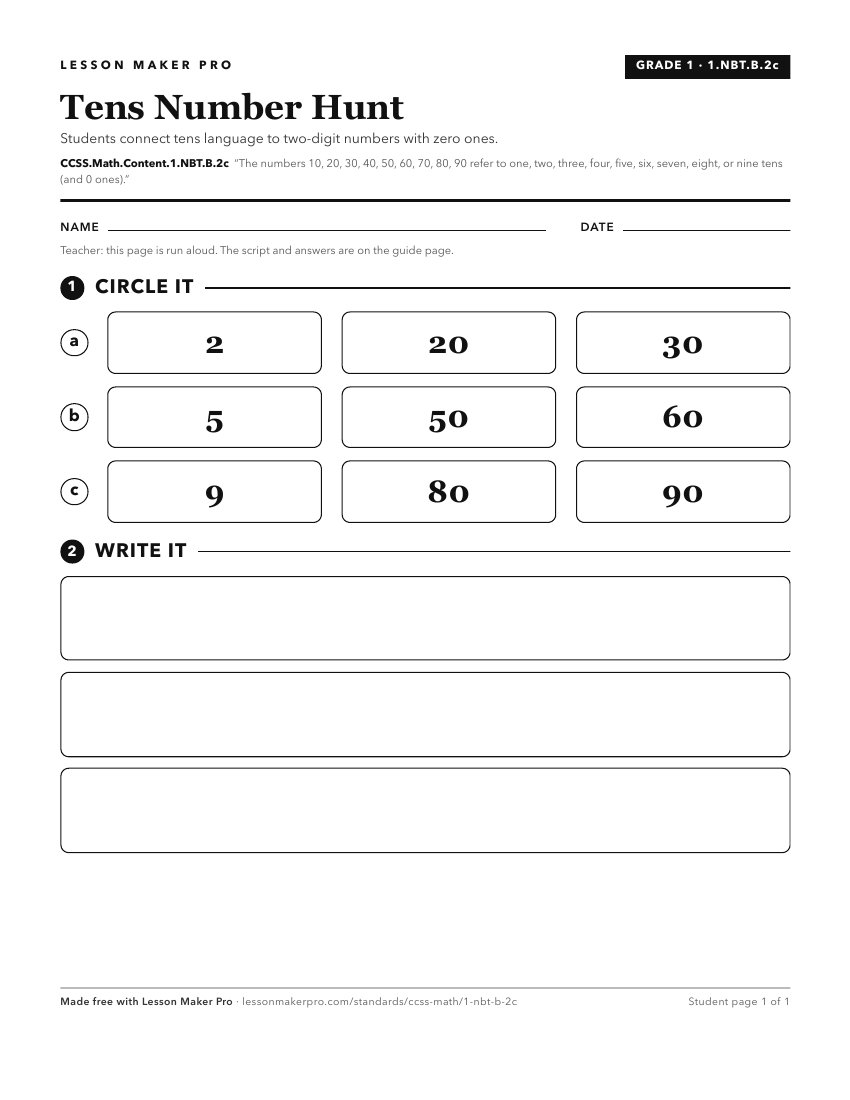
A ready-to-print activity worksheet aligned to CCSS.Math.Content.1.NBT.B.2c, with an answer key for the teacher on its own page. No account needed.
PDF, US Letter, prints cleanly in black and white.
Download the worksheetLearning progression
Where This Standard Sits
Before This Standard
If students are struggling here, check these first.
- CCSS.Math.Content.1.NBT.B.2a
Seeing 10 as one ten is necessary to understand 20 through 90 as counts of tens with no ones.
- CCSS.Math.Content.K.CC.A.1
Counting by tens gives the decade number sequence students connect to one through nine groups of ten.
- CCSS.Math.Content.K.CC.B.4
Understanding that number words name quantities is necessary before interpreting 30 or 80 as a quantity of tens.
What This Unlocks
Mastery here sets students up for these next.
- CCSS.Math.Content.3.NBT.A.3
Multiplying 9 × 80 as 9 groups of 8 tens requires knowing 80 means eight tens and zero ones.
- CCSS.Math.Content.2.NBT.A.1b
Understanding decade numbers as groups of tens supports seeing hundreds as larger place-value units with zero smaller units.
- CCSS.Math.Content.2.NBT.A.1a
Knowing decade numbers as groups of tens supports seeing ten tens as the next unit, one hundred.
- CCSS.Math.Content.1.NBT.C.6
Subtracting 70 minus 30 as 7 tens minus 3 tens requires knowing decade numbers represent groups of tens.
Keep exploring
Related Standards
- CCSS.Math.Content.2.NBT.A.1
Understand that the three digits of a three-digit number represent amounts of hundreds, tens, and ones; e.g., 706 equals 7 hundreds, 0 tens, and 6 ones. Underst...
- CCSS.Math.Content.1.NBT.B.2b
The numbers from 11 to 19 are composed of a ten and one, two, three, four, five, six, seven, eight, or nine ones.
Turn this exact standard into a lesson
Grade, subject, topic, and the complete standard are prefilled. Create one free, no account needed.
Also for this standard:Make a WorksheetMake a QuizMake a Sub Lesson