CCSS.
The Standard
The numbers from 11 to 19 are composed of a ten and one, two, three, four, five, six, seven, eight, or nine ones.
Common Core State Standards for Mathematics
Teacher's field guide
What This Standard Means
What Students Need to Do
- Students break teen numbers into one group of ten and leftover ones. They show each number with objects, drawings, or place-value language.
What Mastery Looks Like
- A student builds or draws any teen number as one group of ten and some single ones. They can name how many tens and ones are shown.
Common Misconceptions
- Students may count every object without seeing a group of ten. They may reverse the digits, or think the second digit tells the number of tens.
How to Assess It
- Give each student the number 16. Ask them to draw it using one ten stick and single cubes, then label each part.
Lesson moves
Ways to Teach It
Have students bundle ten craft sticks, then add loose sticks to build teacher-chosen teen numbers.
Show 14 with linking cubes and ask, "Where do you see the ten, and where do you see the four ones?"
Play Teen Number Match with cards showing numerals, ten-frames, and base-ten drawings for students to pair.
Count 17 classroom items, place ten in a cup, and leave seven outside to show grouped and leftover objects.
Free download
Printable 1.NBT.B.2b Worksheet
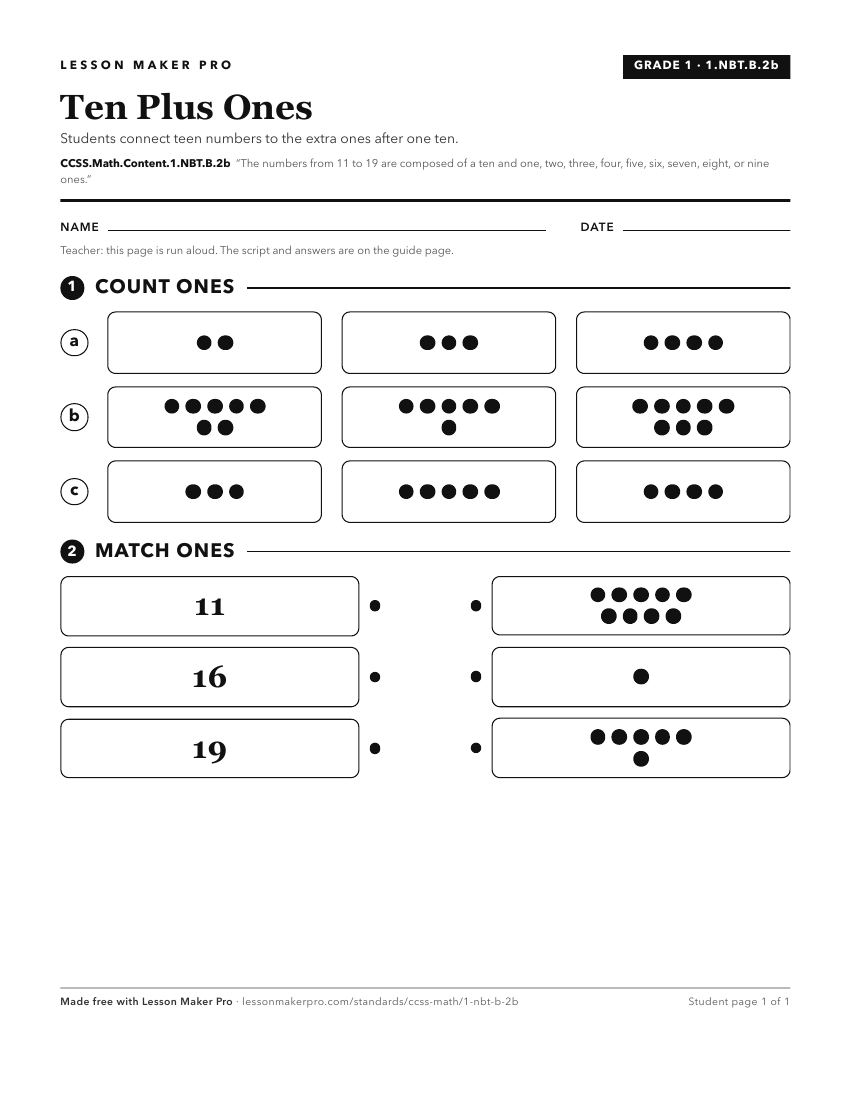
A ready-to-print activity worksheet aligned to CCSS.Math.Content.1.NBT.B.2b, with an answer key for the teacher on its own page. No account needed.
PDF, US Letter, prints cleanly in black and white.
Download the worksheetLearning progression
Where This Standard Sits
Before This Standard
If students are struggling here, check these first.
- CCSS.Math.Content.1.NBT.B.2a
Understanding 10 as one ten is necessary to see 11 to 19 as one ten plus extra ones.
- CCSS.Math.Content.K.NBT.A.1
Teen-number decompositions into ten ones and extra ones are the exact place-value understanding required for 11 through 19.
- CCSS.Math.Content.K.CC.B.5
Counting teen quantities and making sets to 20 supports seeing 11 to 19 as ten objects plus leftover ones.
Keep exploring
Related Standards
- CCSS.Math.Content.2.NBT.A.1b
The numbers 100, 200, 300, 400, 500, 600, 700, 800, 900 refer to one, two, three, four, five, six, seven, eight, or nine hundreds (and 0 tens and 0 ones).
- CCSS.Math.Content.1.NBT.B.2c
The numbers 10, 20, 30, 40, 50, 60, 70, 80, 90 refer to one, two, three, four, five, six, seven, eight, or nine tens (and 0 ones).
Turn this exact standard into a lesson
Grade, subject, topic, and the complete standard are prefilled. Create one free, no account needed.
Also for this standard:Make a WorksheetMake a QuizMake a Sub Lesson