CCSS.
The Standard
Count to answer "how many?" questions about as many as 20 things arranged in a line, a rectangular array, or a circle, or as many as 10 things in a scattered configuration; given a number from 1—20, count out that many objects.
Common Core State Standards for Mathematics · Counting and Cardinality
Teacher's field guide
What This Standard Means
What Students Need to Do
- Students count objects by matching one number word to each object. They tell how many are in a group and count out a requested number of objects. They keep track when objects are lined up, grouped, circular, or scattered.
What Mastery Looks Like
- A student touches or tracks each object once while counting in order. The student states the total and can make a group that matches any given number from 1 to 20.
Common Misconceptions
- Students may skip objects, count one object twice, or say numbers without matching each word to one object. Some recount after being asked how many, rather than using the last number said as the total.
How to Assess It
- Exit ticket: Show 8 scattered dots and ask, “How many dots are there?” Then say, “Draw 13 circles,” and check for an exact count.
Lesson moves
Ways to Teach It
Give students 20 counters and number cards, then have them build the exact collection shown on each card.
Show a circle of objects and ask, “Where should we start, and how can we avoid counting any object twice?”
Play Count and Cover, where students count pictured objects and cover the matching numeral on a game board.
Have students count classroom items, such as 12 crayons or 7 glue sticks, then check the amount with a partner.
Free download
Printable K.CC.B.5 Worksheet
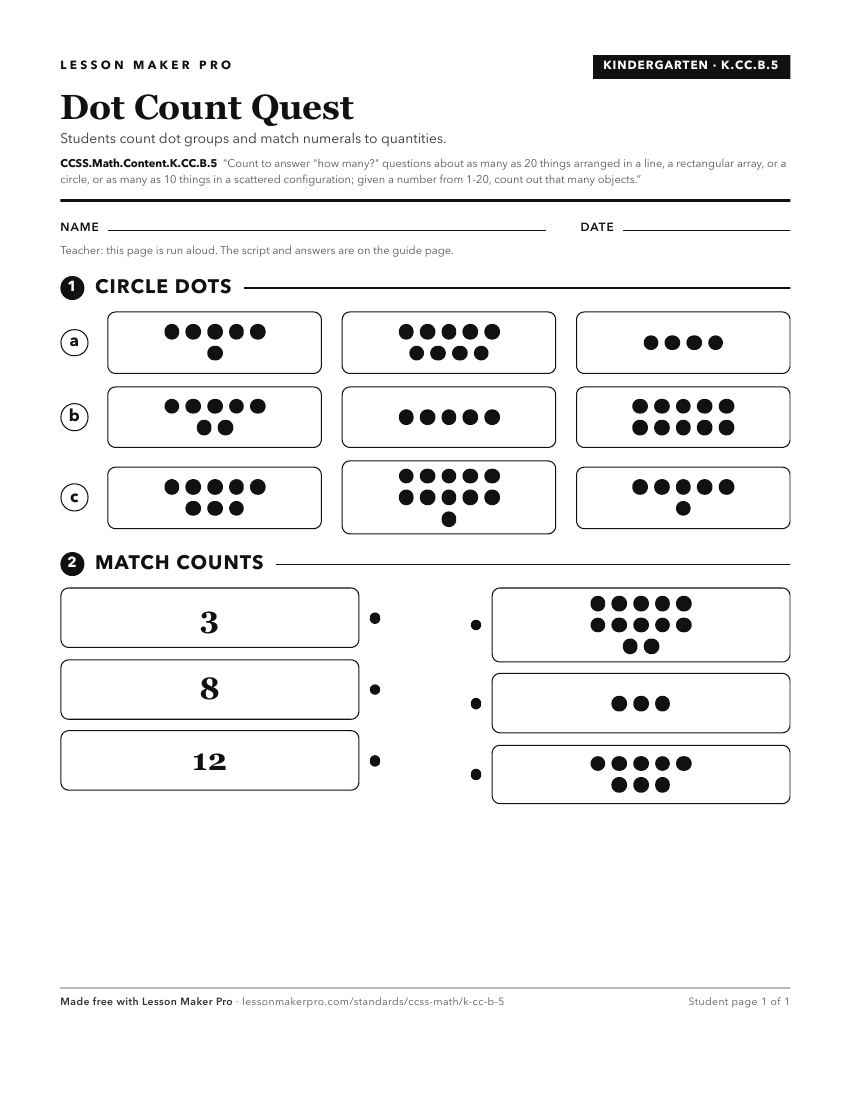
A ready-to-print activity worksheet aligned to CCSS.Math.Content.K.CC.B.5, with an answer key for the teacher on its own page. No account needed.
PDF, US Letter, prints cleanly in black and white.
Download the worksheetLearning progression
Where This Standard Sits
Before This Standard
If students are struggling here, check these first.
- CCSS.Math.Content.K.CC.B.4a
Answering “how many” and counting out sets require one-to-one pairing of number words with objects while counting.
- CCSS.Math.Content.K.CC.B.4b
Answering “how many” and counting out a set require knowing the last count word represents the whole quantity.
- CCSS.Math.Content.K.CC.B.4
Counting objects to answer “how many” requires one-to-one matching and knowing the last number names the total.
What This Unlocks
Mastery here sets students up for these next.
- CCSS.Math.Content.1.MD.C.4
Counting objects accurately carries over to finding category counts and total data points before comparing groups.
- CCSS.Math.Content.2.G.A.2
Counting objects in rectangular arrays carries over to counting the same-size squares after partitioning a rectangle.
- CCSS.Math.Content.2.OA.C.4
Counting objects and understanding the last count as the total are necessary before using addition to total array objects.
- CCSS.Math.Content.2.OA.C.3
Counting objects to 20 supports finding group size before checking pairs, counting by twos, or splitting into equal addends.
- CCSS.Math.Content.1.NBT.B.2a
Counting and making sets to 10 lets students see that ten individual ones can be grouped as one ten.
- CCSS.Math.Content.1.OA.A.1
Counting sets within 20 supports modeling and checking add-to, take-from, and compare problems with objects, but equations can develop alongside it.
Keep exploring
Related Standards
- CCSS.Math.Content.1.NBT.A.1
Count to 120, starting at any number less than 120. In this range, read and write numerals and represent a number of objects with a written numeral.
- CCSS.Math.Content.K.CC.B
Count to tell the number of objects.
- CCSS.Math.Content.K.CC.A.3
Write numbers from 0 to 20. Represent a number of objects with a written numeral 0-20 (with 0 representing a count of no objects).
Turn this exact standard into a lesson
Grade, subject, topic, and the complete standard are prefilled. Create one free, no account needed.
Also for this standard:Make a WorksheetMake a QuizMake a Sub Lesson