CCSS.
The Standard
Partition a rectangle into rows and columns of same-size squares and count to find the total number of them.
Common Core State Standards for Mathematics · Geometry
Teacher's field guide
What This Standard Means
What Students Need to Do
- Students divide a rectangle into an organized grid of equal squares. They identify rows and columns, then count every square to find the total.
What Mastery Looks Like
- Students make a complete grid of equal squares with no gaps or overlaps. They count all squares accurately and explain the total using rows or columns.
Common Misconceptions
- Students may draw unequal sections or leave gaps between squares. Some count only the rows or columns, rather than every square in the rectangle.
How to Assess It
- Give students a blank rectangle and say, "Draw 3 equal rows with 4 squares in each row. How many squares are there?"
Lesson moves
Ways to Teach It
Give students square tiles to cover paper rectangles, then trace the rows and columns and count the total tiles.
Show a 3-row, 5-column grid and ask, "How could you count the squares without losing your place?"
Play Grid Match by pairing rectangle grid cards with cards showing totals or repeated addition expressions.
Use a floor tile photo and have students mark rows, columns, and the total number of visible tiles.
Free download
Printable 2.G.A.2 Worksheet
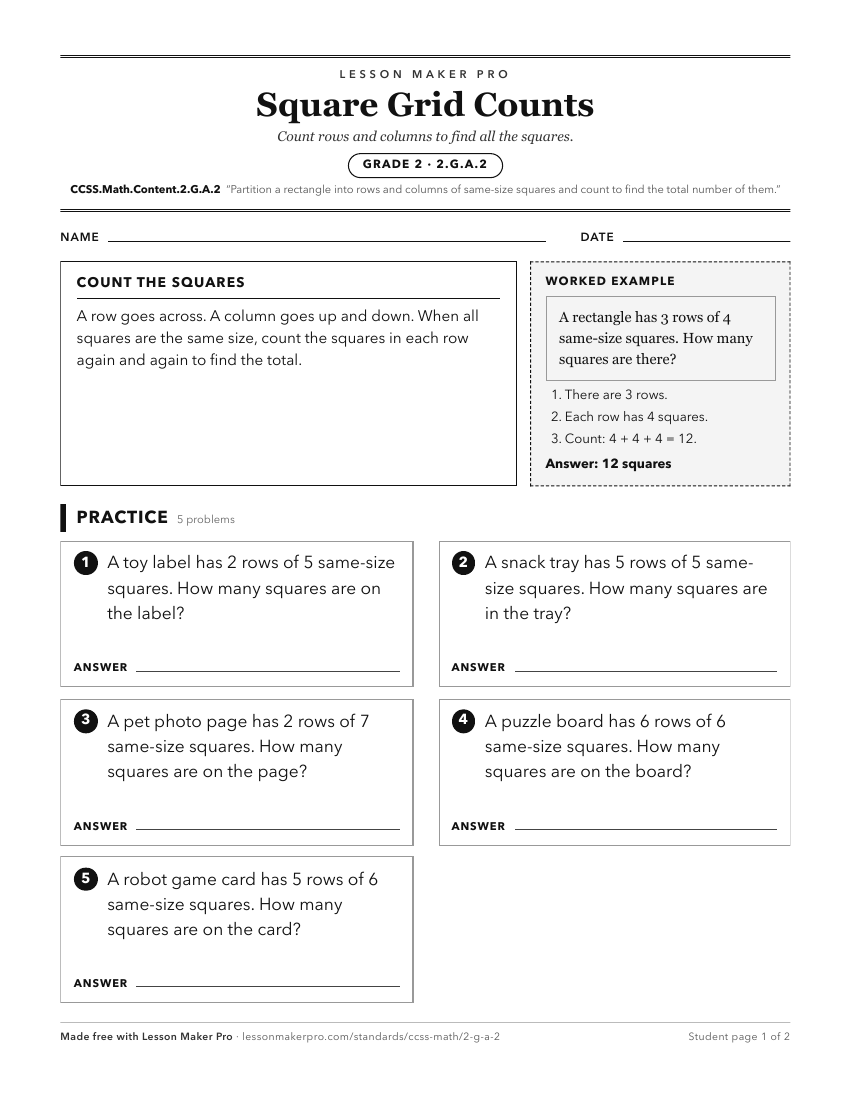
A ready-to-print activity worksheet aligned to CCSS.Math.Content.2.G.A.2, with an answer key for the teacher on its own page. No account needed.
PDF, US Letter, prints cleanly in black and white.
Download the worksheetBefore This Standard
If students are struggling here, check these first.
- CCSS.Math.Content.K.CC.B.5
Counting objects in rectangular arrays carries over to counting the same-size squares after partitioning a rectangle.
- CCSS.Math.Content.1.G.A.2
Composing shapes supports seeing a rectangle as made from equal squares, but array partitioning and counting are more specific new work.
- CCSS.Math.Content.1.G.A.3
Equal-share partitioning supports seeing a rectangle as a whole made of same-size parts before arranging squares in rows and columns.
What This Unlocks
Mastery here sets students up for these next.
- CCSS.Math.Content.3.MD.C.5
Counting equal squares in rectangle arrays prepares students to see area as covering a figure with unit squares.
- CCSS.Math.Content.3.MD.C.5b
Counting equal squares in a tiled rectangle prepares students to see area as the number of unit squares covering a figure.
- CCSS.Math.Content.3.MD.C.5a
Counting equal squares in rectangles prepares students to see a unit square as one area unit for measuring area.
- CCSS.Math.Content.3.MD.C.6
Counting equal squares in a tiled rectangle is the core action used to measure area with unit squares.
Keep exploring
Related Standards
- CCSS.Math.Content.2.OA.C.4
Use addition to find the total number of objects arranged in rectangular arrays with up to 5 rows and up to 5 columns; write an equation to express the total as...
- CCSS.Math.Content.3.G.A.2
Partition shapes into parts with equal areas. Express the area of each part as a unit fraction of the whole.
- CCSS.Math.Content.3.MD.C.7a
Find the area of a rectangle with whole-number side lengths by tiling it, and show that the area is the same as would be found by multiplying the side lengths.
- CCSS.Math.Content.2.G.A.3
Partition circles and rectangles into two, three, or four equal shares, describe the shares using the words halves, thirds, half of, a third of, etc., and descr...
Turn this exact standard into a lesson
Grade, subject, topic, and the complete standard are prefilled. Create one free, no account needed.
Also for this standard:Make a WorksheetMake a QuizMake a Sub Lesson