CCSS.
The Standard
Compose two-dimensional shapes (rectangles, squares, trapezoids, triangles, half-circles, and quarter-circles) or three-dimensional shapes (cubes, right rectangular prisms, right circular cones, and right circular cylinders) to create a composite shape, and compose new shapes from the composite shape.
Common Core State Standards for Mathematics · Geometry
Teacher's field guide
What This Standard Means
What Students Need to Do
- Students put smaller flat shapes together to make a larger shape, then use that larger shape in another design. They also combine solid blocks, cones, and cylinders to build new objects.
What Mastery Looks Like
- Given shape tiles or solid models, a student selects pieces, turns or flips them, and joins them to make a target. The student can name the parts and explain how rearranging them makes a different whole.
Common Misconceptions
- Students may think a rotated square is no longer a square. They may leave gaps or overlap pieces and still claim they formed the target shape. Some focus only on the outline and cannot identify the smaller shapes inside it.
How to Assess It
- Give each student two right triangles and one square. Say, “Make a rectangle, then use that rectangle with the square to make a new shape; draw it and label each piece.”
Lesson moves
Ways to Teach It
Give pairs paper triangles, squares, and half-circles to build a house, then combine two houses into a larger picture.
Show two pictures made from the same four shapes and ask, “How did moving the pieces change the whole?”
Play Shape Builder: draw a target card, choose two or three foam shapes, and race to make the target.
Use boxes, cans, and paper cones to model a playground, then name the solid shapes used in each structure.
Free download
Printable 1.G.A.2 Worksheet
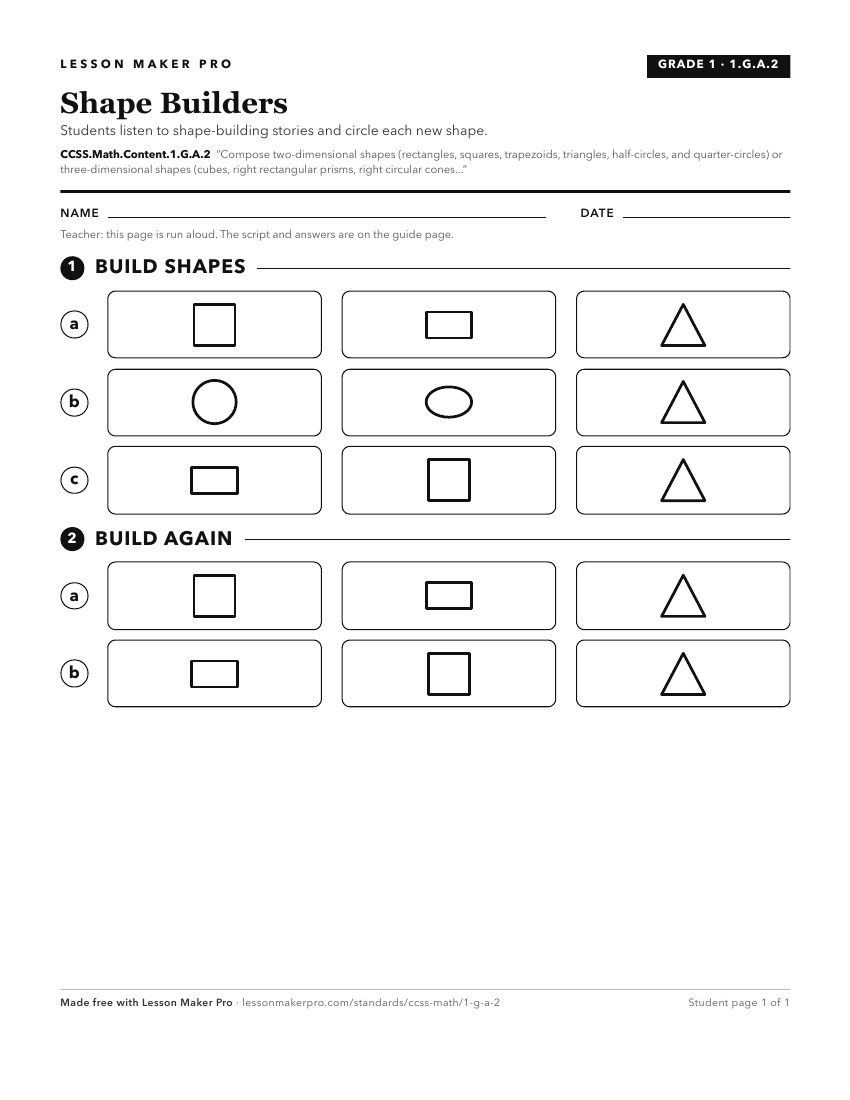
A ready-to-print activity worksheet aligned to CCSS.Math.Content.1.G.A.2, with an answer key for the teacher on its own page. No account needed.
PDF, US Letter, prints cleanly in black and white.
Download the worksheetBefore This Standard
If students are struggling here, check these first.
- CCSS.Math.Content.K.G.A.2
Naming shapes across size and orientation supports recognizing the parts used when composing and recomposing composite shapes.
- CCSS.Math.Content.K.G.B.6
Kindergarten composing simple shapes directly prepares students to combine and recombine specified 2D and 3D shapes in grade 1.
- CCSS.Math.Content.K.G.A.3
Sorting flat and solid shapes supports choosing and combining the right kinds of shapes in first-grade composition tasks.
What This Unlocks
Mastery here sets students up for these next.
- CCSS.Math.Content.2.G.A.2
Composing shapes supports seeing a rectangle as made from equal squares, but array partitioning and counting are more specific new work.
- CCSS.Math.Content.1.G.A.3
Composing shapes supports seeing equal parts as making one whole, but partitioning circles and rectangles can begin without composite-shape work.
Keep exploring
Related Standards
- CCSS.Math.Content.6.G.A.1
Find the area of right triangles, other triangles, special quadrilaterals, and polygons by composing into rectangles or decomposing into triangles and other sha...
- CCSS.Math.Content.K.G.B
Analyze, compare, create, and compose shapes.
- CCSS.Math.Content.K.G.A
Identify and describe shapes (squares, circles, triangles, rectangles, hexagons, cubes, cones, cylinders, and spheres).
Turn this exact standard into a lesson
Grade, subject, topic, and the complete standard are prefilled. Create one free, no account needed.
Also for this standard:Make a WorksheetMake a QuizMake a Sub Lesson