CCSS.
Standard Cluster
Analyze, compare, create, and compose shapes.
Common Core State Standards for Mathematics
Cluster contents
Standards in This Cluster
CCSS.Math.Content.K.G.B is a cluster heading. These are the individual standards under it.
- CCSS.Math.Content.K.G.B.4
Analyze and compare two- and three-dimensional shapes, in different sizes and orientations, using informal language to describe their similarities, differences,...
- CCSS.Math.Content.K.G.B.5
Model shapes in the world by building shapes from components (e.g., sticks and clay balls) and drawing shapes.
- CCSS.Math.Content.K.G.B.6
Compose simple shapes to form larger shapes.
Teacher's field guide
What This Cluster Means
What Students Need to Do
- Students name and describe flat and solid shapes using features such as sides, corners, faces, and curved surfaces. They compare shapes even when the size or position changes. They build shapes and join smaller shapes to make a larger one.
What Mastery Looks Like
- Students can sort shapes and explain their choices using features such as sides, corners, faces, and curved surfaces. They can recognize shapes in different positions and sizes. They can build a named shape and combine smaller shapes into a larger one.
Common Misconceptions
- Students may think a shape changes when it is turned, moved, or made larger. They may confuse flat shapes with solid shapes or count curved edges as sides. They may also believe shapes must look like familiar classroom examples.
How to Assess It
- Give each student two square tiles, a sideways triangle card, and a cube. Ask them to name and describe each shape, compare two shapes, then combine the tiles into a new shape.
Lesson moves
Ways to Teach It
Use pattern blocks to build a larger triangle, rectangle, or hexagon, then have students name the smaller shapes they used.
Show a square and a triangle, then ask, “How are these shapes alike, and how are they different?”
Play Shape Mystery by giving clues about sides, corners, faces, or curved surfaces while students point to the matching shape.
Take a classroom shape hunt, then sort found objects by flat or solid shape and explain each match.
Free download
Printable K.G.B Worksheet
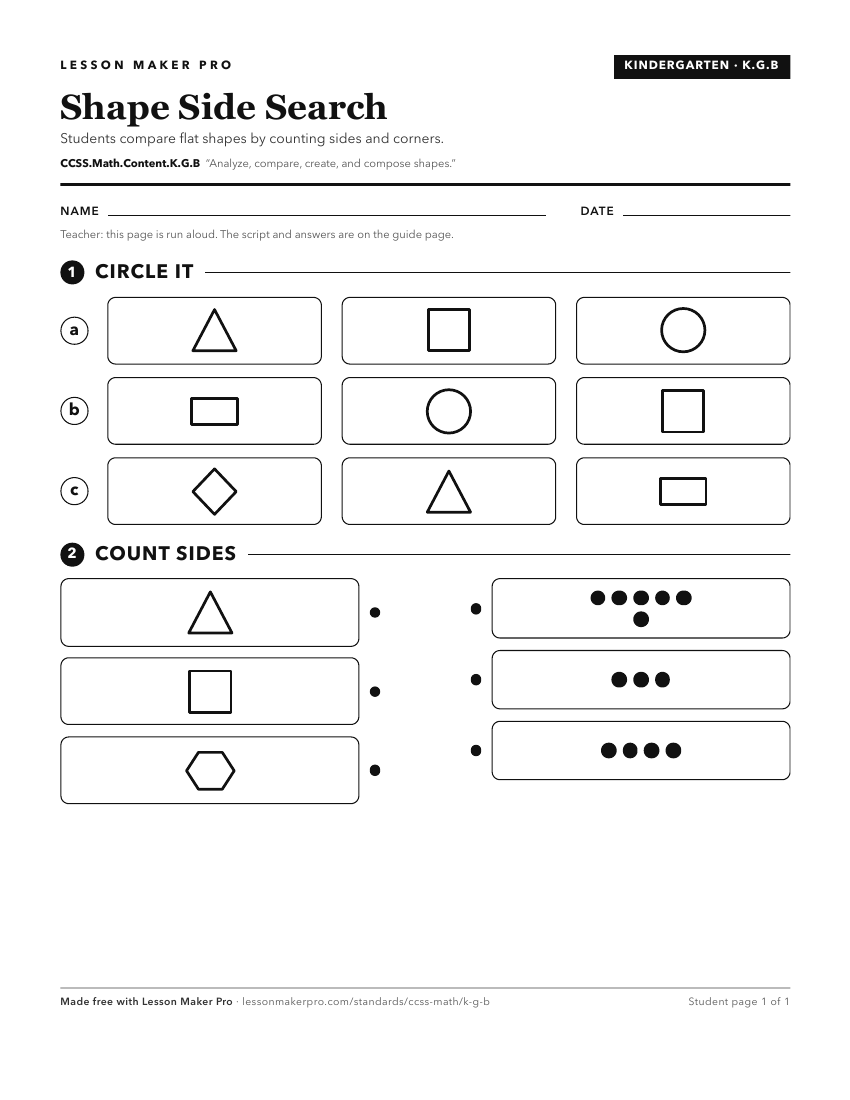
A ready-to-print activity worksheet aligned to CCSS.Math.Content.K.G.B, with an answer key for the teacher on its own page. No account needed.
PDF, US Letter, prints cleanly in black and white.
Download the worksheetKeep exploring
Related Standards
Turn this cluster into a lesson
Grade, subject, topic, and the complete cluster are prefilled. Create one free, no account needed.
Also for this cluster:Make a WorksheetMake a QuizMake a Sub Lesson