CCSS.
Standard Cluster
Identify and describe shapes (squares, circles, triangles, rectangles, hexagons, cubes, cones, cylinders, and spheres).
Common Core State Standards for Mathematics
Cluster contents
Standards in This Cluster
CCSS.Math.Content.K.G.A is a cluster heading. These are the individual standards under it.
- CCSS.Math.Content.K.G.A.1
Describe objects in the environment using names of shapes, and describe the relative positions of these objects using terms such as above, below, beside, in fro...
- CCSS.Math.Content.K.G.A.2
Correctly name shapes regardless of their orientations or overall size.
- CCSS.Math.Content.K.G.A.3
Identify shapes as two-dimensional (lying in a plane, "flat") or three-dimensional ("solid").
Teacher's field guide
What This Cluster Means
What Students Need to Do
- Students name common flat shapes and solid shapes. They describe each shape by its visible features and recognize it when its size or position changes.
What Mastery Looks Like
- Students correctly name flat and solid shapes in different sizes and positions. They describe shapes using features such as sides, corners, flat faces, and curved surfaces.
Common Misconceptions
- Students may think a shape changes when it is turned, stretched, or shown in a different size. They may call every four-sided shape a square or confuse flat shapes with solid objects.
How to Assess It
- Show a rotated triangle, rectangle, hexagon, cube, cone, and cylinder. Ask students to name each and describe one feature.
Lesson moves
Ways to Teach It
Have students sort foam shapes and solid blocks into groups, then explain the feature used for each group.
Ask, "How can you prove this shape is a triangle?" Have students point to and count its sides and corners.
Play shape bingo by calling clues such as, "Find a solid shape with one curved surface and no corners."
Take a classroom shape hunt and record objects such as a clock, door, tissue box, can, party hat, and ball.
Free download
Printable K.G.A Worksheet
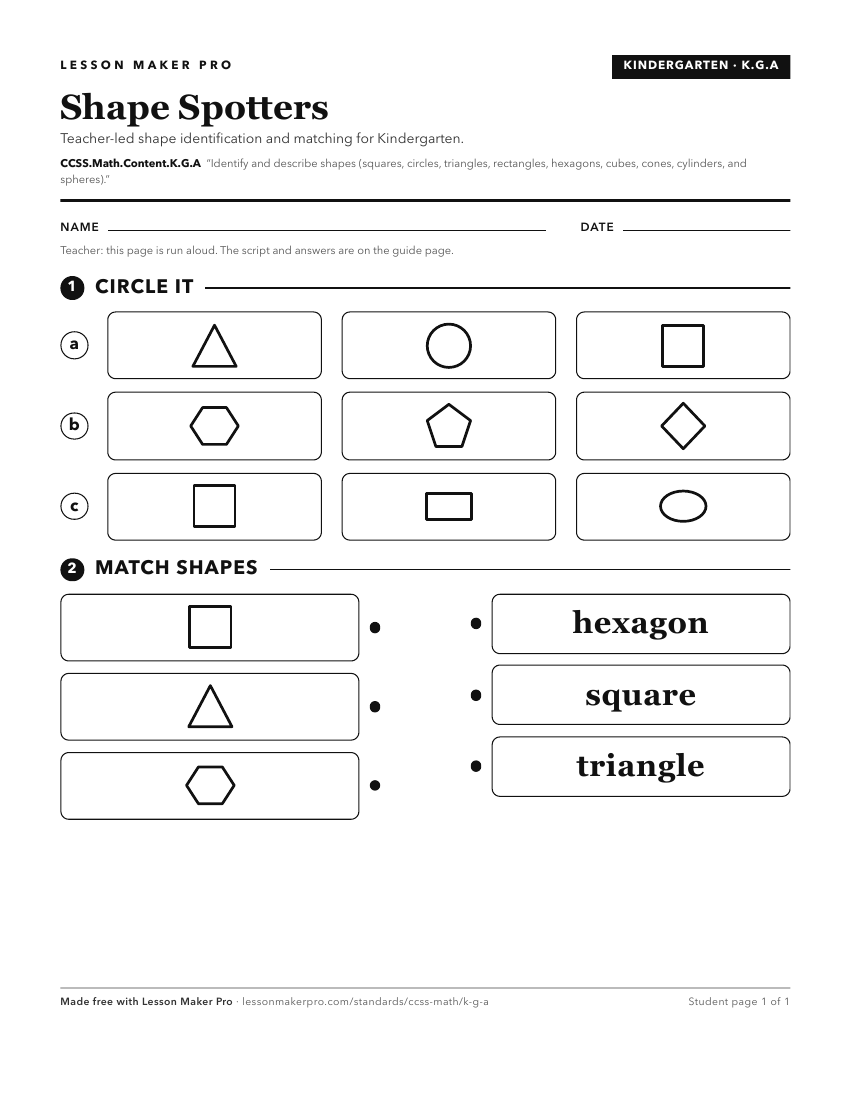
A ready-to-print activity worksheet aligned to CCSS.Math.Content.K.G.A, with an answer key for the teacher on its own page. No account needed.
PDF, US Letter, prints cleanly in black and white.
Download the worksheetKeep exploring
Related Standards
- CCSS.Math.Content.4.G.A
Draw and identify lines and angles, and classify shapes by properties of their lines and angles.
- CCSS.Math.Content.K.G.B.4
Analyze and compare two- and three-dimensional shapes, in different sizes and orientations, using informal language to describe their similarities, differences,...
- CCSS.Math.Content.2.G.A.1
Recognize and draw shapes having specified attributes, such as a given number of angles or a given number of equal faces. Identify triangles, quadrilaterals, pe...
- CCSS.Math.Content.HSG-MG.A.1
Use geometric shapes, their measures, and their properties to describe objects (e.g., modeling a tree trunk or a human torso as a cylinder).
Turn this cluster into a lesson
Grade, subject, topic, and the complete cluster are prefilled. Create one free, no account needed.
Also for this cluster:Make a WorksheetMake a QuizMake a Sub Lesson