CCSS.
The Standard
Identify shapes as two-dimensional (lying in a plane, "flat") or three-dimensional ("solid").
Common Core State Standards for Mathematics · Geometry
Teacher's field guide
What This Standard Means
What Students Need to Do
- Students decide whether a shape is flat or solid. They sort and name examples such as triangles, circles, cubes, cones, cylinders, and spheres.
What Mastery Looks Like
- Students correctly sort familiar shapes into two-dimensional and three-dimensional groups. They explain that flat shapes lie on a surface, while solid shapes can be held and turned.
Common Misconceptions
- Students may call a sphere a circle or a cube a square. They may classify a solid object as flat because one face looks flat.
How to Assess It
- Place a triangle card, circle card, cube, and cylinder on a table. Ask each student to sort them into flat shapes and solid shapes, then explain one choice.
Lesson moves
Ways to Teach It
Give pairs shape cards and solid blocks to sort into two hoops labeled flat and solid.
Show a circle and a sphere, then ask, “How are they alike, and how are they different?”
Play Shape Stand-Up: students stand for solid shapes and sit for flat shapes as you show objects or pictures.
Take a classroom shape hunt, listing flat shapes on signs and solid shapes such as cans, balls, and boxes.
Free download
Printable K.G.A.3 Worksheet
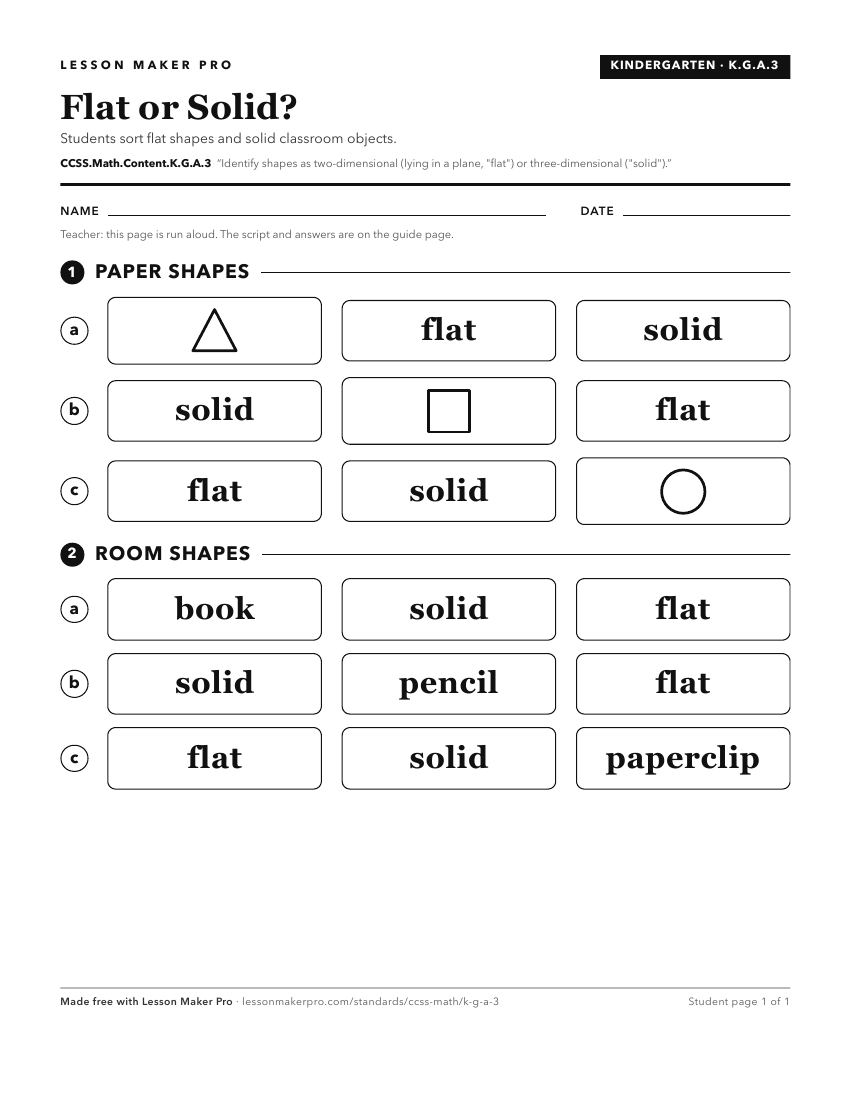
A ready-to-print activity worksheet aligned to CCSS.Math.Content.K.G.A.3, with an answer key for the teacher on its own page. No account needed.
PDF, US Letter, prints cleanly in black and white.
Download the worksheetBefore This Standard
If students are struggling here, check these first.
What This Unlocks
Mastery here sets students up for these next.
- CCSS.Math.Content.1.G.A.2
Sorting flat and solid shapes supports choosing and combining the right kinds of shapes in first-grade composition tasks.
- CCSS.Math.Content.K.G.B.4
Knowing flat versus solid helps students choose appropriate attributes when comparing shapes, such as sides and corners versus faces.
- CCSS.Math.Content.2.G.A.1
Sorting flat shapes from solids supports later work with polygons, cubes, faces, and attributes like angles.
- CCSS.Math.Content.K.G.B.5
Knowing flat versus solid shapes helps students choose and describe appropriate drawings or component-built models of real-world shapes.
- CCSS.Math.Content.K.G.B.6
Distinguishing flat shapes from solids helps students choose and orient pieces when composing larger flat shapes.
Keep exploring
Related Standards
- CCSS.Math.Content.5.G.B
Classify two-dimensional figures into categories based on their properties.
- CCSS.Math.Content.HSG-GMD.B.4
Identify the shapes of two-dimensional cross-sections of three-dimensional objects, and identify three-dimensional objects generated by rotations of two-dimensi...
- CCSS.Math.Content.4.G.A.2
Classify two-dimensional figures based on the presence or absence of parallel or perpendicular lines, or the presence or absence of angles of a specified size. ...
Turn this exact standard into a lesson
Grade, subject, topic, and the complete standard are prefilled. Create one free, no account needed.
Also for this standard:Make a WorksheetMake a QuizMake a Sub Lesson