CCSS.
The Standard
Identify the shapes of two-dimensional cross-sections of three-dimensional objects, and identify three-dimensional objects generated by rotations of two-dimensional objects.
Common Core State Standards for Mathematics
Teacher's field guide
What This Standard Means
What Students Need to Do
- Students visualize what appears when a flat cut passes through a solid at different angles. They also predict the solid formed when a flat figure turns around a given line.
What Mastery Looks Like
- Given a solid and a cutting plane, students correctly sketch and name the resulting figure. Given a flat figure and a marked axis, they predict the resulting solid and relate its dimensions to the original figure.
Common Misconceptions
- Students may assume every slice matches the solid’s base or one of its faces. They may ignore the cut angle or confuse rotating around an edge with rotating around a center point.
How to Assess It
- Exit ticket: Sketch and name the cross-sections of a cone cut parallel to its base and vertically through its apex. Then identify the solid made by rotating a rectangle around one side.
Lesson moves
Ways to Teach It
Shape clay into a cone, cylinder, and prism, then cut each with dental floss at different angles and trace every exposed face.
Prompt: A rectangle rotates around one side; sketch the solid and explain how the rectangle's side lengths set its dimensions.
Play a card match with solid cards, cutting-plane cards, and cross-section cards, requiring a sketch to justify each match.
Study CT scan images or sliced-food photos, then describe how the slice angle changes the visible shape.
Free download
Printable HSG-GMD.B.4 Worksheet
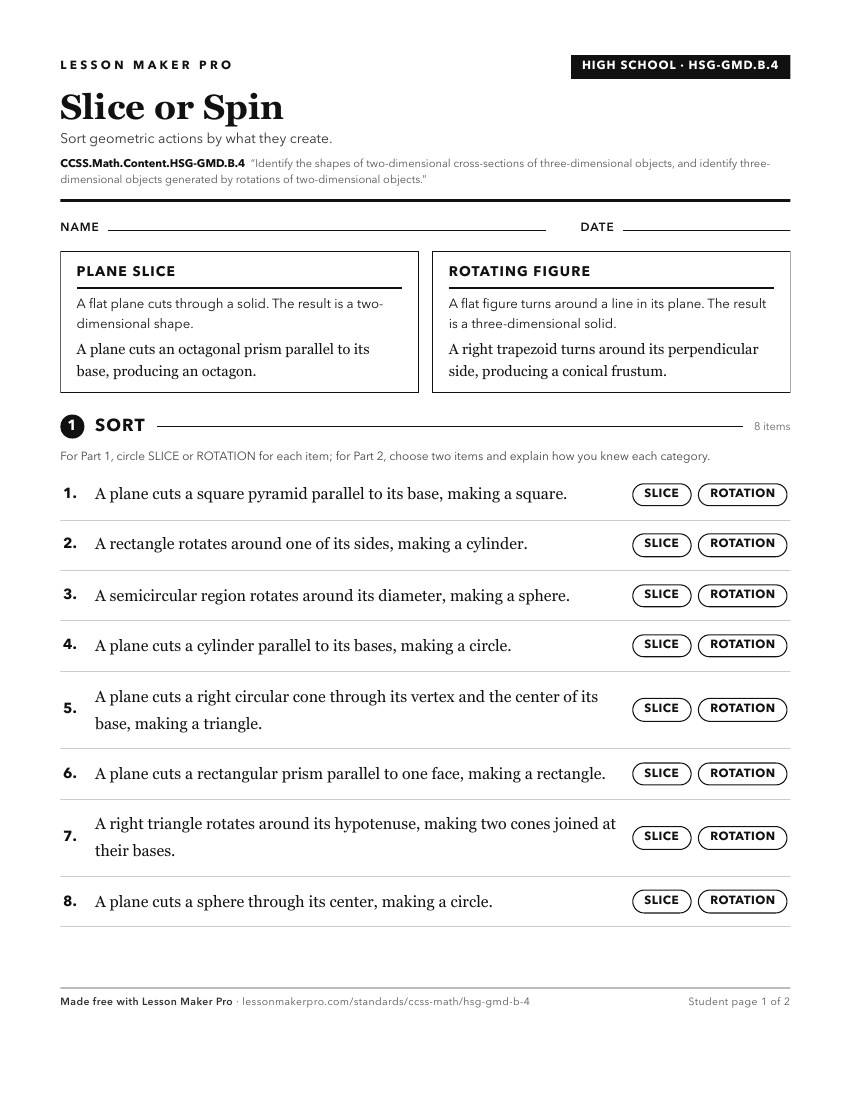
A ready-to-print activity worksheet aligned to CCSS.Math.Content.HSG-GMD.B.4, with an answer key for the teacher on its own page. No account needed.
PDF, US Letter, prints cleanly in black and white.
Download the worksheetLearning progression
Where This Standard Sits
Before This Standard
If students are struggling here, check these first.
- CCSS.Math.Content.7.G.A.3
Describing plane slices of prisms and pyramids supports identifying more general cross-sections and related 3D structure in high school.
- CCSS.Math.Content.HSG-MG.A.1
Recognizing real objects as cylinders, cones, and other solids supports visualizing their slices and rotations.
What This Unlocks
Mastery here sets students up for these next.
- CCSS.Math.Content.HSG-GMD.A.2
Cavalieri arguments compare matching cross-sections, so recognizing slices of solids supports deriving sphere and other volume formulas.
- CCSS.Math.Content.HSG-GMD.A.1
Recognizing slices and rotations of solids supports visual arguments for circle, cylinder, cone, and pyramid formulas.
Keep exploring
Related Standards
- CCSS.Math.Content.K.G.A.3
Identify shapes as two-dimensional (lying in a plane, "flat") or three-dimensional ("solid").
- CCSS.Math.Content.K.G.B.4
Analyze and compare two- and three-dimensional shapes, in different sizes and orientations, using informal language to describe their similarities, differences,...
- CCSS.Math.Content.HSG-GMD.B
Visualize relationships between two-dimensional and three-dimensional objects
- CCSS.Math.Content.K.G.A
Identify and describe shapes (squares, circles, triangles, rectangles, hexagons, cubes, cones, cylinders, and spheres).
Turn this exact standard into a lesson
Grade, subject, topic, and the complete standard are prefilled. Create one free, no account needed.
Also for this standard:Make a WorksheetMake a QuizMake a Sub Lesson