CCSS.
Standard Cluster
Classify two-dimensional figures into categories based on their properties.
Common Core State Standards for Mathematics
Cluster contents
Standards in This Cluster
CCSS.Math.Content.5.G.B is a cluster heading. These are the individual standards under it.
Teacher's field guide
What This Cluster Means
What Students Need to Do
- Students identify shapes by properties such as side lengths, angle types, and parallel or perpendicular lines. They place shapes in more than one group and describe how the groups fit together.
What Mastery Looks Like
- Students classify familiar and unfamiliar polygons using sides, angles, parallel lines, perpendicular lines, and equal side lengths. They explain nested groups, such as why every square is also a rectangle and a rhombus.
Common Misconceptions
- Students often think a square is not a rectangle or that a shape can belong to only one group. They may sort by size or orientation instead of sides, angles, and parallel lines.
How to Assess It
- Exit ticket: A quadrilateral has four equal sides and four right angles. Name every shape category it belongs to and justify each choice.
Lesson moves
Ways to Teach It
Give groups cutout polygons and property cards, then have students build a nested sorting mat and defend each placement.
Ask, "Is every square a rectangle, and is every rectangle a square?" Students write a claim and support it with properties.
Play Guess My Shape by revealing one property at a time while teams remove shapes that no longer fit.
Photograph signs, tiles, windows, and court markings around school, then label each figure with all matching categories and properties.
Free download
Printable 5.G.B Worksheet
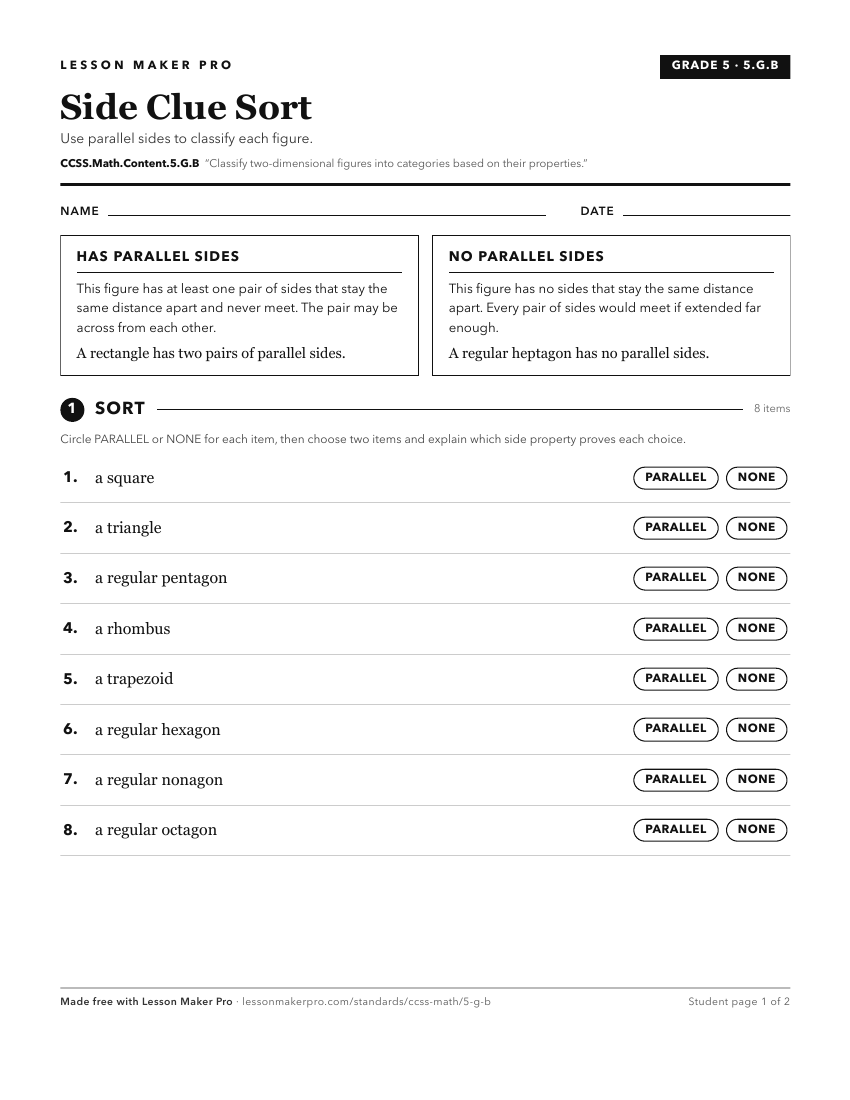
A ready-to-print activity worksheet aligned to CCSS.Math.Content.5.G.B, with an answer key for the teacher on its own page. No account needed.
PDF, US Letter, prints cleanly in black and white.
Download the worksheetKeep exploring
Related Standards
- CCSS.Math.Content.4.G.A
Draw and identify lines and angles, and classify shapes by properties of their lines and angles.
- CCSS.Math.Content.4.G.A.2
Classify two-dimensional figures based on the presence or absence of parallel or perpendicular lines, or the presence or absence of angles of a specified size. ...
Turn this cluster into a lesson
Grade, subject, topic, and the complete cluster are prefilled. Create one free, no account needed.
Also for this cluster:Make a WorksheetMake a QuizMake a Sub Lesson