CCSS.
The Standard
Understand that attributes belonging to a category of two-dimensional figures also belong to all subcategories of that category.
Common Core State Standards for Mathematics · Geometry
Teacher's field guide
What This Standard Means
What Students Need to Do
- Students classify two-dimensional figures using side, angle, and parallel-line properties. They recognize that one figure can belong to several nested categories and explain why.
What Mastery Looks Like
- Students place a figure in every category that fits, including broader and narrower groups. They explain that properties of a broader group also apply to its subgroups.
Common Misconceptions
- Students often think a square cannot also be a rectangle. They may treat shape categories as separate groups or classify figures by appearance instead of properties.
How to Assess It
- Give students a square, a nonsquare rectangle, and a rhombus. Ask them to name every category each shape belongs to and justify each choice with properties.
Lesson moves
Ways to Teach It
Sort shape cards into nested hoops labeled quadrilateral, parallelogram, rectangle, and square, then explain why each card belongs in every chosen hoop.
Ask students to respond to the claim, “A square is not a rectangle,” using side and angle properties as evidence.
Play Guess My Shape by giving property clues one at a time while students list all categories that still fit.
Find quadrilaterals in signs, tiles, and windows, then name every category each example belongs to based on its properties.
Free download
Printable 5.G.B.3 Worksheet
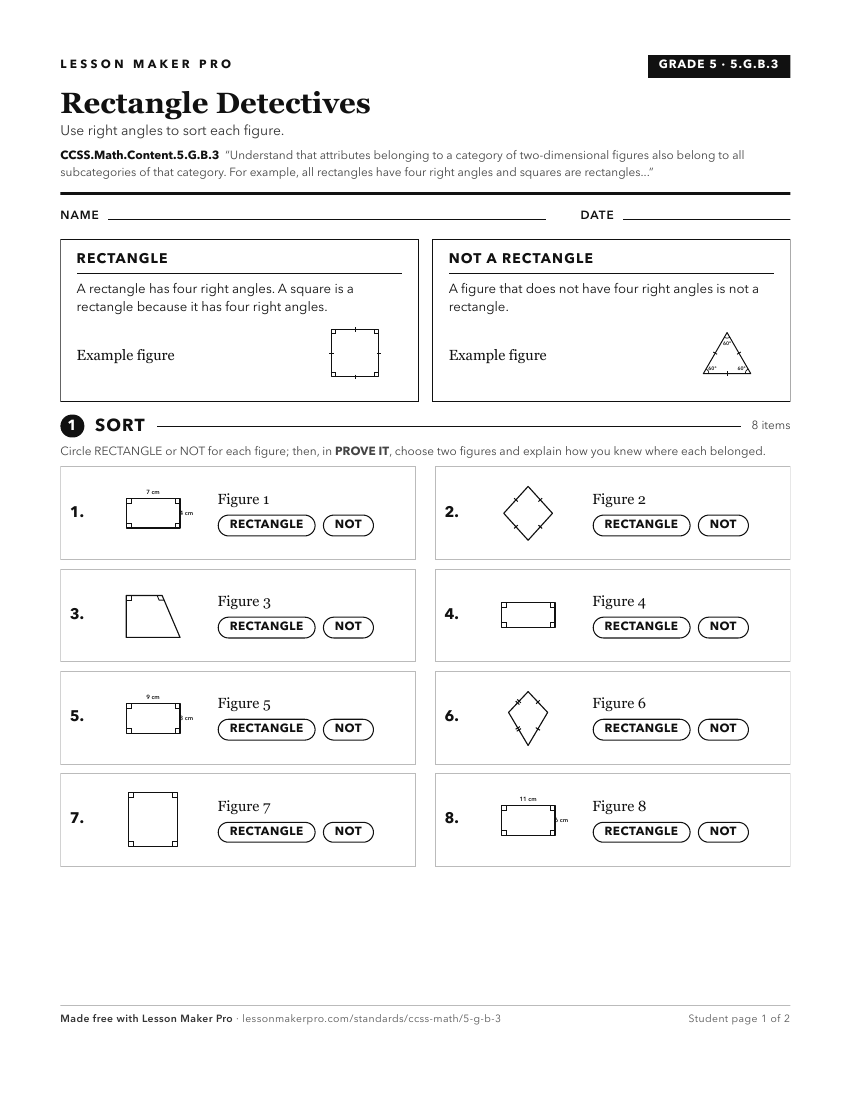
A ready-to-print activity worksheet aligned to CCSS.Math.Content.5.G.B.3, with an answer key for the teacher on its own page. No account needed.
PDF, US Letter, prints cleanly in black and white.
Download the worksheetBefore This Standard
If students are struggling here, check these first.
- CCSS.Math.Content.3.G.A.1
Students extend sorting quadrilaterals by shared attributes to reasoning that subcategories inherit all attributes of the larger category.
- CCSS.Math.Content.4.G.A.2
Classifying figures by lines and angles prepares students to see how shared attributes define categories and carry into subcategories.
- CCSS.Math.Content.4.G.A.1
Knowing side and angle features like parallel, perpendicular, and right angles supports reasoning about attributes shared by figure categories.
What This Unlocks
Mastery here sets students up for these next.
Keep exploring
Related Standards
Turn this exact standard into a lesson
Grade, subject, topic, and the complete standard are prefilled. Create one free, no account needed.
Also for this standard:Make a WorksheetMake a QuizMake a Sub Lesson