CCSS.
The Standard
Understand that shapes in different categories (e.g., rhombuses, rectangles, and others) may share attributes (e.g., having four sides), and that the shared attributes can define a larger category (e.g., quadrilaterals). Recognize rhombuses, rectangles, and squares as examples of quadrilaterals, and draw examples of quadrilaterals that do not belong to any of these subcategories.
Common Core State Standards for Mathematics · Geometry
Teacher's field guide
What This Standard Means
What Students Need to Do
- Students examine side counts, side lengths, and corners to sort and name shapes. They identify overlapping shape groups and create four-sided shapes outside familiar subgroups.
What Mastery Looks Like
- Students correctly classify familiar and unfamiliar shapes, including rotated examples. They explain how one shape can belong to several groups and draw a quadrilateral that is not a rectangle, square, or rhombus.
Common Misconceptions
- Students may think a square cannot also be a rectangle or rhombus. They may classify shapes by orientation instead of side lengths and corners. Some call every four-sided shape a rectangle.
How to Assess It
- Give students a card with a square, rectangle, rhombus, irregular quadrilateral, and pentagon. Ask them to circle all quadrilaterals, label each type, and explain one choice.
Lesson moves
Ways to Teach It
Give pairs cutout shapes to sort by number of sides, equal side lengths, and square corners, then compare their groups.
Ask students to write why a square belongs in both the rectangle group and the rhombus group.
Play Attribute Detective with shape cards, giving clues such as four sides, four square corners, or equal side lengths.
Photograph tiles, windows, signs, and tabletops around school, then label each quadrilateral and list its defining attributes.
Free download
Printable 3.G.A.1 Worksheet
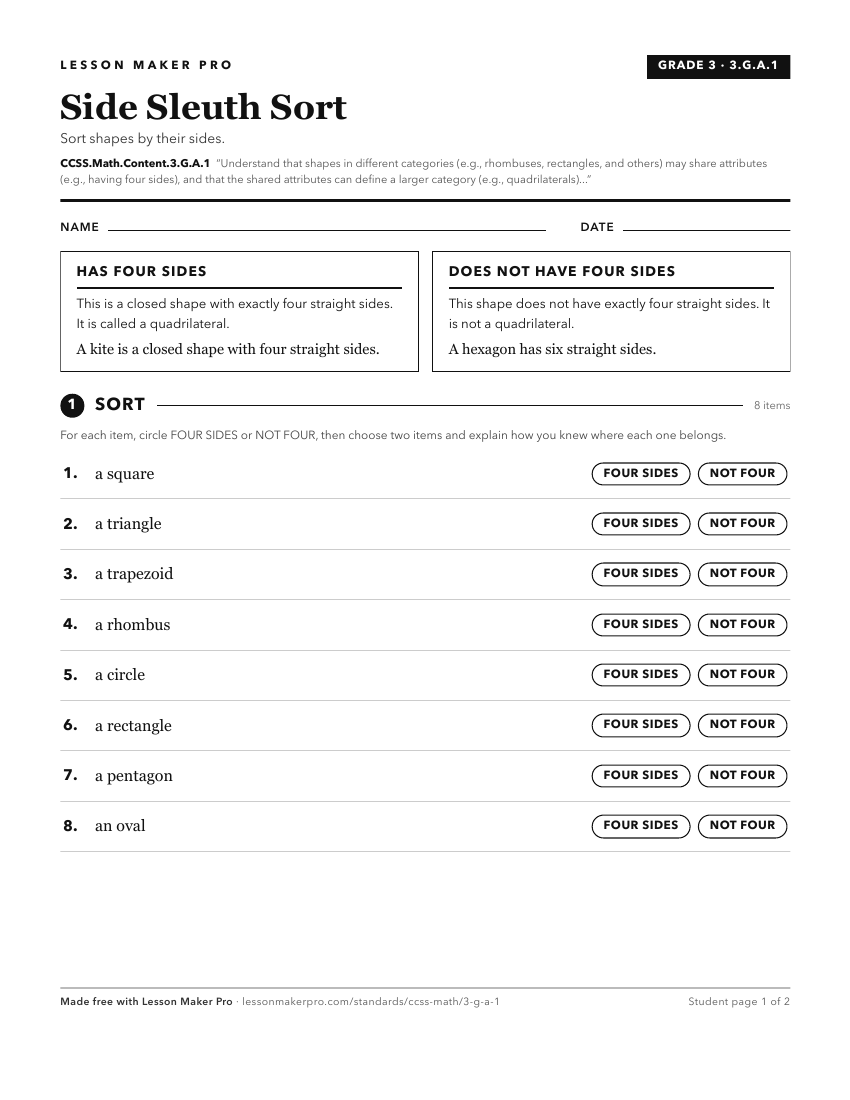
A ready-to-print activity worksheet aligned to CCSS.Math.Content.3.G.A.1, with an answer key for the teacher on its own page. No account needed.
PDF, US Letter, prints cleanly in black and white.
Download the worksheetBefore This Standard
If students are struggling here, check these first.
- CCSS.Math.Content.1.G.A.1
Classifying quadrilaterals by shared properties requires knowing which shape attributes define membership rather than color, size, or orientation.
- CCSS.Math.Content.2.G.A.1
Students use side and angle attributes from recognizing and drawing shapes to classify quadrilaterals and compare subcategories.
What This Unlocks
Mastery here sets students up for these next.
- CCSS.Math.Content.5.G.B.3
Students extend sorting quadrilaterals by shared attributes to reasoning that subcategories inherit all attributes of the larger category.
- CCSS.Math.Content.4.G.A.1
Recognizing shapes by shared attributes and sides supports identifying line segments and angle relationships within two-dimensional figures.
- CCSS.Math.Content.4.G.A.2
Classifying quadrilaterals by shared attributes supports later classification using parallel lines, perpendicular lines, and angle properties.
Keep exploring
Related Standards
Turn this exact standard into a lesson
Grade, subject, topic, and the complete standard are prefilled. Create one free, no account needed.
Also for this standard:Make a WorksheetMake a QuizMake a Sub Lesson