CCSS.
The Standard
Recognize and draw shapes having specified attributes, such as a given number of angles or a given number of equal faces. Identify triangles, quadrilaterals, pentagons, hexagons, and cubes.
Common Core State Standards for Mathematics · Geometry
Teacher's field guide
What This Standard Means
What Students Need to Do
- Students sort and name common flat shapes by counting their sides and angles. They also recognize cubes and draw shapes that match a given set of attributes.
What Mastery Looks Like
- A student correctly names shapes even when their size, color, or position changes. They draw a shape from a stated attribute and use sides, angles, and faces to justify its name.
Common Misconceptions
- Students may think a rotated or stretched shape changes its name. They may confuse sides with angles, exclude squares from quadrilaterals, or call a cube a square.
How to Assess It
- Give an exit ticket: “Draw a shape with five sides, name it, then explain how you know. Draw or circle a cube and label one face.”
Lesson moves
Ways to Teach It
Give pairs craft sticks and clay, then have them build triangles, quadrilaterals, pentagons, and hexagons and count each shape’s angles.
Show a square turned on one corner and ask, “Is it still a quadrilateral? What attributes prove your answer?”
Play Shape Riddles: read clues such as “I have six sides,” and students hold up or sketch the matching shape.
Hunt for shapes around the classroom, then record each object, its shape name, and the attributes that support the match.
Free download
Printable 2.G.A.1 Worksheet
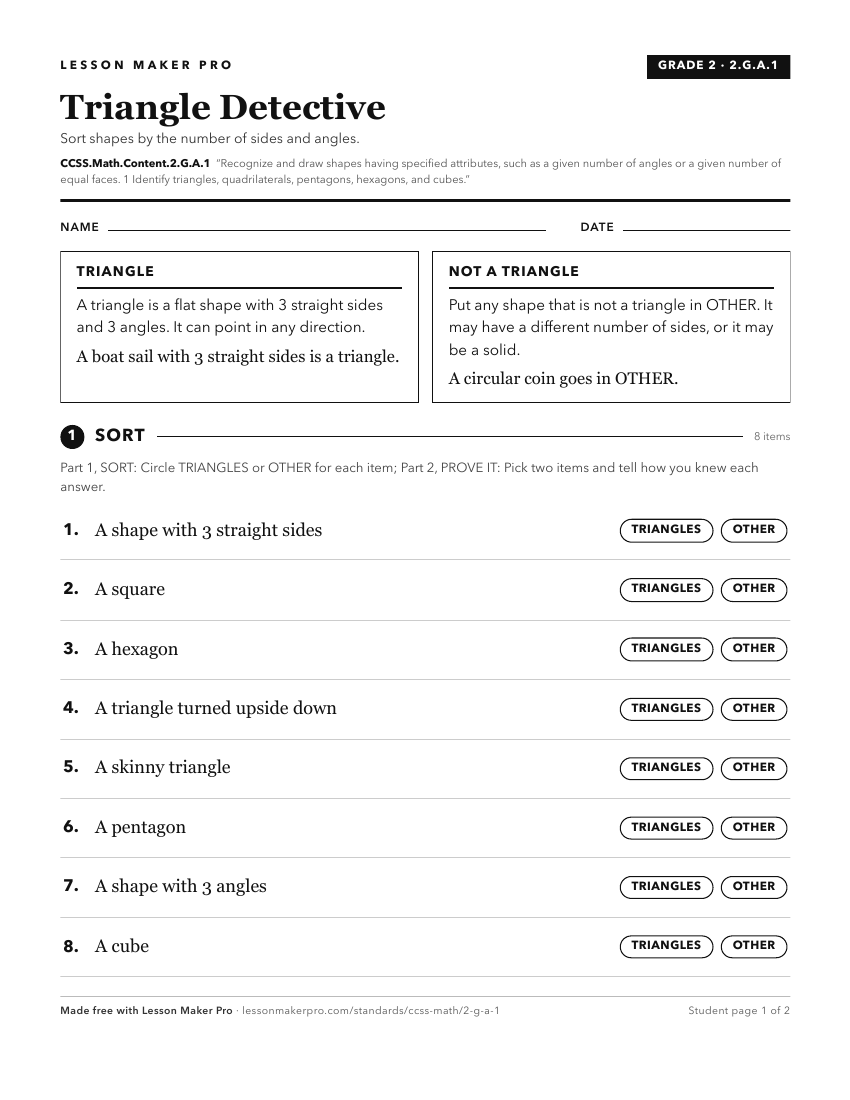
A ready-to-print activity worksheet aligned to CCSS.Math.Content.2.G.A.1, with an answer key for the teacher on its own page. No account needed.
PDF, US Letter, prints cleanly in black and white.
Download the worksheetBefore This Standard
If students are struggling here, check these first.
- CCSS.Math.Content.1.G.A.1
Grade 2 shape recognition depends on using defining attributes like sides, angles, and faces rather than color, size, or orientation.
- CCSS.Math.Content.K.G.A.2
Naming shapes across size and orientation supports later identifying and drawing them by angles, sides, and faces.
- CCSS.Math.Content.K.G.A.3
Sorting flat shapes from solids supports later work with polygons, cubes, faces, and attributes like angles.
What This Unlocks
Mastery here sets students up for these next.
- CCSS.Math.Content.4.G.A.3
Knowing and drawing basic shapes by attributes supports checking whether a line splits a figure into matching parts.
- CCSS.Math.Content.4.G.A.1
Counting angles and naming basic polygons supports seeing angles and line segments inside two-dimensional figures.
- CCSS.Math.Content.3.G.A.1
Students use side and angle attributes from recognizing and drawing shapes to classify quadrilaterals and compare subcategories.
- CCSS.Math.Content.4.MD.C.5
Counting angles in polygons supports recognizing angles as distinct features before defining them with rays and measuring them.
Keep exploring
Related Standards
- CCSS.Math.Content.4.G.A
Draw and identify lines and angles, and classify shapes by properties of their lines and angles.
- CCSS.Math.Content.4.G.A.2
Classify two-dimensional figures based on the presence or absence of parallel or perpendicular lines, or the presence or absence of angles of a specified size. ...
- CCSS.Math.Content.K.G.A
Identify and describe shapes (squares, circles, triangles, rectangles, hexagons, cubes, cones, cylinders, and spheres).
Turn this exact standard into a lesson
Grade, subject, topic, and the complete standard are prefilled. Create one free, no account needed.
Also for this standard:Make a WorksheetMake a QuizMake a Sub Lesson