CCSS.
The Standard
Draw points, lines, line segments, rays, angles (right, acute, obtuse), and perpendicular and parallel lines. Identify these in two-dimensional figures.
Common Core State Standards for Mathematics · Geometry
Teacher's field guide
What This Standard Means
What Students Need to Do
- Students draw and label basic geometric parts, using endpoints and arrowheads correctly. They classify angles and locate parallel and perpendicular lines within two-dimensional shapes.
What Mastery Looks Like
- Students use endpoints and arrowheads correctly when drawing and labeling. They accurately name angle types and find parallel or perpendicular lines within shapes, including shapes turned in different directions.
Common Misconceptions
- Students often confuse lines, segments, and rays, especially when arrowheads are missing or overlooked. They may judge an angle by arm length instead of opening size. They may also think parallel lines must be horizontal or the same length.
How to Assess It
- On an exit ticket, ask students to draw and label a point, line, segment, ray, and each angle type. Provide a simple shape and ask them to mark one parallel pair and one perpendicular pair.
Lesson moves
Ways to Teach It
Use string, craft sticks, arrow cards, and dot stickers to build and label points, lines, segments, rays, and three angle types.
Display a mixed-shape drawing and ask, “Which lines and angles can you name, and what evidence supports each label?”
Play Geometry Sort: students match diagram cards to labels, then explain one match to a partner before keeping the card.
Have students sketch classroom examples, such as window frames, clock hands, and signs, then label the line and angle relationships.
Free download
Printable 4.G.A.1 Worksheet
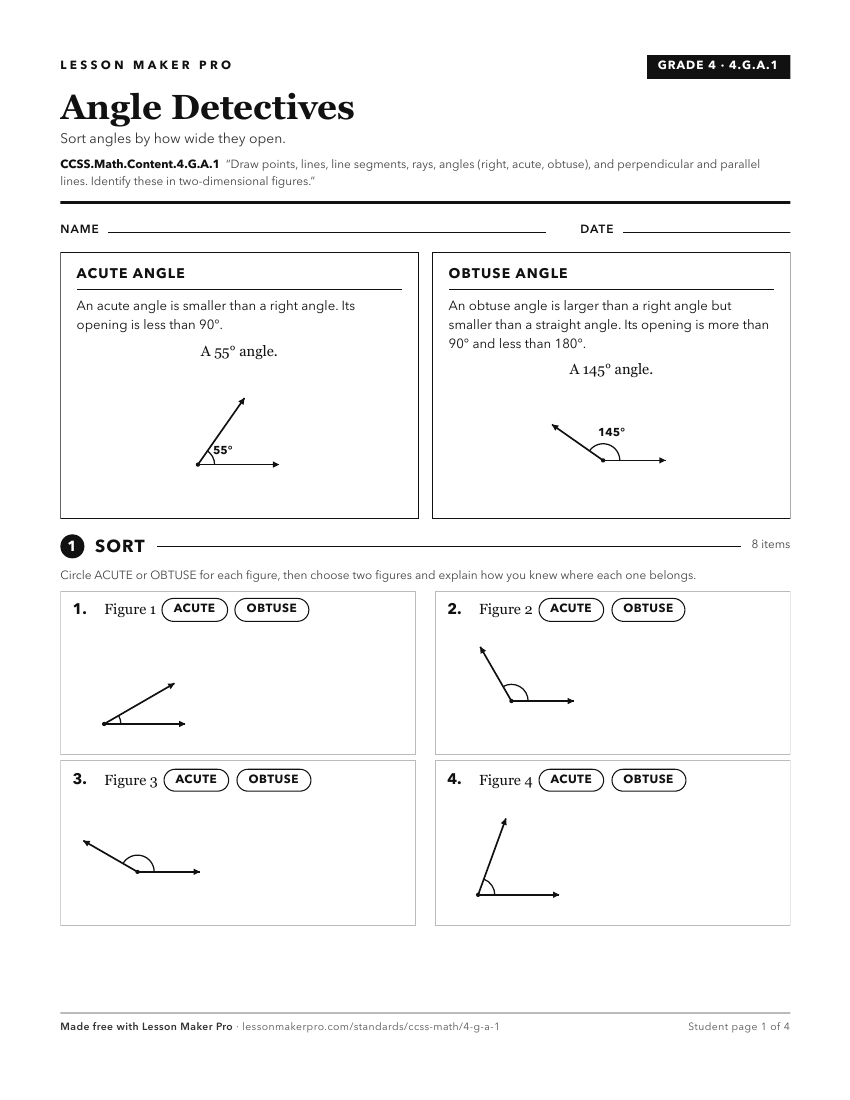
A ready-to-print activity worksheet aligned to CCSS.Math.Content.4.G.A.1, with an answer key for the teacher on its own page. No account needed.
PDF, US Letter, prints cleanly in black and white.
Download the worksheetBefore This Standard
If students are struggling here, check these first.
- CCSS.Math.Content.4.MD.C.5
Knowing angles as two rays sharing an endpoint supports drawing and identifying angles, especially right, acute, and obtuse ones.
- CCSS.Math.Content.2.G.A.1
Counting angles and naming basic polygons supports seeing angles and line segments inside two-dimensional figures.
- CCSS.Math.Content.3.G.A.1
Recognizing shapes by shared attributes and sides supports identifying line segments and angle relationships within two-dimensional figures.
What This Unlocks
Mastery here sets students up for these next.
- CCSS.Math.Content.4.MD.C.5a
Recognizing and drawing angles as two rays with a common endpoint supports understanding angle measure as a fraction of a turn.
- CCSS.Math.Content.4.G.A.2
Students must recognize parallel and perpendicular lines and angle types before classifying shapes by those features.
- CCSS.Math.Content.4.MD.C.5b
Recognizing and drawing angles gives students the angle objects they later describe as turns measured in one-degree units.
- CCSS.Math.Content.5.G.A.1
Understanding perpendicular lines and points supports seeing axes, the origin, and plotted locations in a coordinate plane.
- CCSS.Math.Content.4.G.A.3
Students use the idea of a line within a two-dimensional figure to draw and name possible symmetry lines.
- CCSS.Math.Content.5.G.B.4
Recognizing angle types and parallel or perpendicular sides supports using properties to sort shapes into broader and narrower classes.
Keep exploring
Related Standards
Turn this exact standard into a lesson
Grade, subject, topic, and the complete standard are prefilled. Create one free, no account needed.
Also for this standard:Make a WorksheetMake a QuizMake a Sub Lesson