CCSS.
The Standard
Use a pair of perpendicular number lines, called axes, to define a coordinate system, with the intersection of the lines (the origin) arranged to coincide with the 0 on each line and a given point in the plane located by using an ordered pair of numbers, called its coordinates. Understand that the first number indicates how far to travel from the origin in the direction of one axis, and the second number indicates how far to travel in the direction of the second axis, with the convention that the names of the two axes and the coordinates correspond (e.g., x-axis and x-coordinate, y-axis and y-coordinate).
Common Core State Standards for Mathematics · Geometry
Teacher's field guide
What This Standard Means
What Students Need to Do
- Students use two perpendicular number lines to locate points on a coordinate plane. They read each ordered pair as a horizontal move followed by a vertical move.
What Mastery Looks Like
- Students correctly label the origin and both axes. They plot and name points from ordered pairs, moving along the x-axis first and the y-axis second.
Common Misconceptions
- Students often reverse the coordinates or move up before moving across. They may count grid lines from 1 instead of starting at the origin, or confuse the axes.
How to Assess It
- Give students a blank coordinate grid. Ask them to label the axes and origin, plot (4, 2), and explain each move from the origin.
Lesson moves
Ways to Teach It
Tape a large coordinate grid on the floor, then have students stand at points called out as ordered pairs.
Ask students to explain in writing why (2, 5) and (5, 2) name different locations.
Play Coordinate Bingo using cards labeled with ordered pairs and game boards showing plotted points.
Use a simple map of a park, assign coordinates to landmarks, and write directions from the origin to each location.
Free download
Printable 5.G.A.1 Worksheet
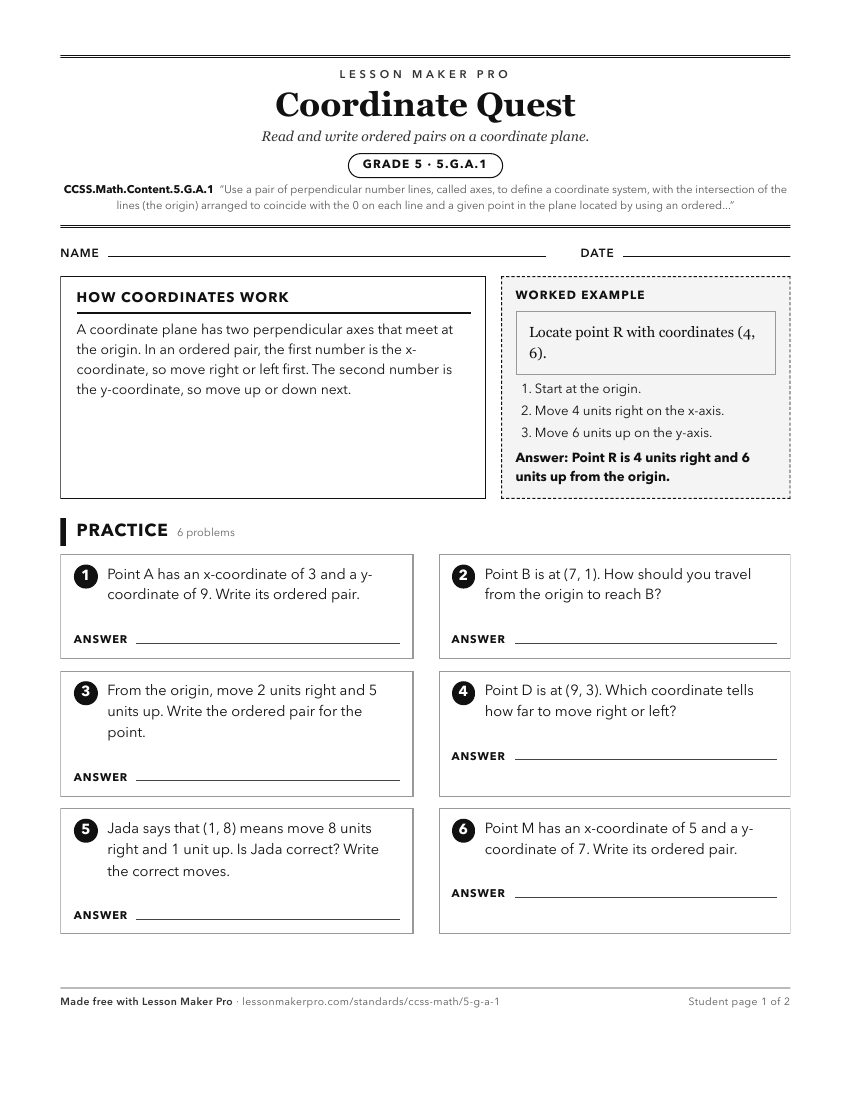
A ready-to-print activity worksheet aligned to CCSS.Math.Content.5.G.A.1, with an answer key for the teacher on its own page. No account needed.
PDF, US Letter, prints cleanly in black and white.
Download the worksheetBefore This Standard
If students are struggling here, check these first.
What This Unlocks
Mastery here sets students up for these next.
- CCSS.Math.Content.6.NS.C.6
Students extend ordered pairs, axes, and distance from the origin to include rational and negative coordinates.
- CCSS.Math.Content.6.RP.A.3a
Understanding axes, origin, and ordered pairs supports plotting ratio table values as coordinate pairs, though ratio reasoning develops separately.
- CCSS.Math.Content.5.G.A.2
Students must understand axes, the origin, and ordered pairs before they can graph and interpret first quadrant problem points.
- CCSS.Math.Content.6.NS.C.6b
Students must know axes, the origin, and ordered pairs before interpreting negative signs as quadrant locations and reflections.
- CCSS.Math.Content.5.OA.B.3
Students must know axes, origin, and coordinate order to graph pattern pairs correctly on the coordinate plane.
- CCSS.Math.Content.6.NS.C.6c
Students use axes, origin, and ordered-pair conventions from grade 5 before extending coordinates to negative and rational values.
Keep exploring
Related Standards
Turn this exact standard into a lesson
Grade, subject, topic, and the complete standard are prefilled. Create one free, no account needed.
Also for this standard:Make a WorksheetMake a QuizMake a Sub Lesson