CCSS.
The Standard
Understand signs of numbers in ordered pairs as indicating locations in quadrants of the coordinate plane; recognize that when two ordered pairs differ only by signs, the locations of the points are related by reflections across one or both axes.
Common Core State Standards for Mathematics
Teacher's field guide
What This Standard Means
What Students Need to Do
- Students plot ordered pairs with positive and negative coordinates in all four quadrants. They identify a quadrant from the signs and explain how sign changes move a point across an axis.
What Mastery Looks Like
- Given (3, -4), students can plot the point correctly and name quadrant IV. They can identify (-3, -4), (3, 4), and (-3, 4) as its reflections across the axes.
Common Misconceptions
- Students may reverse the x- and y-coordinates or move left for a positive x-value. They may also confuse which coordinate changes when reflecting across the x-axis or y-axis.
How to Assess It
- Exit ticket: Plot A(-2, 5), then plot its reflection across the x-axis, the y-axis, and both axes. Label each ordered pair.
Lesson moves
Ways to Teach It
Tape a coordinate grid on the floor, give students ordered-pair cards, and have them stand at each point and its reflections.
Ask students to explain in writing how the points (4, -2), (-4, -2), and (-4, 2) are related.
Play Reflection Match, where students pair coordinate cards showing a point and its reflection across a named axis.
Use a city map grid to locate landmarks, then describe mirrored locations across a central north-south or east-west street.
Free download
Printable 6.NS.C.6b Worksheet
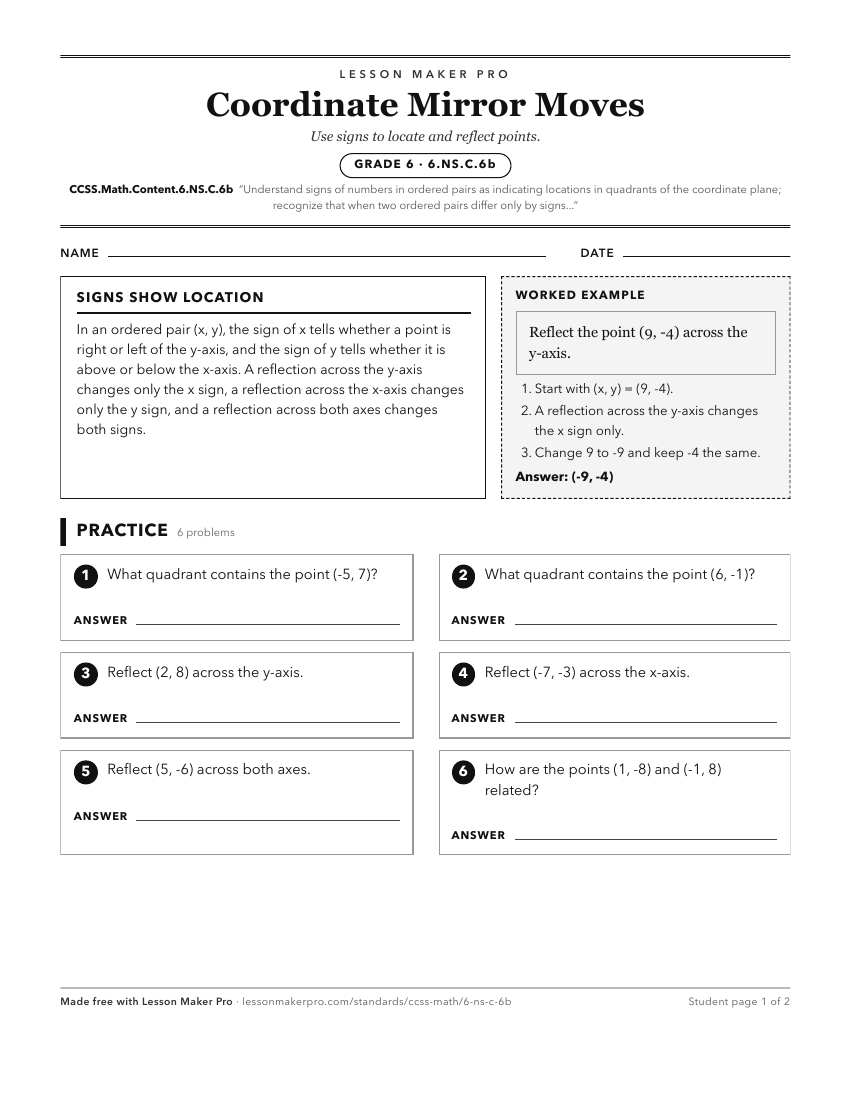
A ready-to-print activity worksheet aligned to CCSS.Math.Content.6.NS.C.6b, with an answer key for the teacher on its own page. No account needed.
PDF, US Letter, prints cleanly in black and white.
Download the worksheetLearning progression
Where This Standard Sits
Before This Standard
If students are struggling here, check these first.
- CCSS.Math.Content.5.G.A.1
Students must know axes, the origin, and ordered pairs before interpreting negative signs as quadrant locations and reflections.
- CCSS.Math.Content.6.NS.C.6a
Understanding positive and negative as opposite directions from 0 on a line supports quadrant signs and reflections across axes.
- CCSS.Math.Content.4.G.A.3
Folding symmetry across a line supports seeing sign changes as mirror reflections across the coordinate axes.
What This Unlocks
Mastery here sets students up for these next.
- CCSS.Math.Content.6.NS.C.8
Knowing how coordinate signs place points in quadrants supports graphing points and interpreting horizontal or vertical distances across axes.
- CCSS.Math.Content.6.NS.C.6c
Knowing how coordinate signs match quadrants helps students choose the correct region when plotting rational ordered pairs.
Turn this exact standard into a lesson
Grade, subject, topic, and the complete standard are prefilled. Create one free, no account needed.
Also for this standard:Make a WorksheetMake a QuizMake a Sub Lesson