CCSS.
The Standard
Recognize a line of symmetry for a two-dimensional figure as a line across the figure such that the figure can be folded along the line into matching parts. Identify line-symmetric figures and draw lines of symmetry.
Common Core State Standards for Mathematics · Geometry
Teacher's field guide
What This Standard Means
What Students Need to Do
- Students decide whether a flat shape can be split into mirror-image halves. They locate possible fold lines. They draw every symmetry line and identify shapes with none.
What Mastery Looks Like
- Students correctly classify familiar and unfamiliar shapes by their symmetry. They draw all symmetry lines, including horizontal and diagonal ones. They can explain that matching points overlap when the shape is folded.
Common Misconceptions
- Students may think a line that makes equal areas always makes matching halves. They may assume symmetry lines must be vertical or that every diagonal is a symmetry line. They may find one line and overlook others.
How to Assess It
- Give students a square, rectangle, isosceles triangle, scalene triangle, and irregular pentagon. Ask them to draw every symmetry line or write "none," then explain one answer using a fold test.
Lesson moves
Ways to Teach It
Give students paper cutouts to fold, then have them trace every crease that makes both halves overlap exactly.
Students write whether a shown rectangle has another symmetry line, then defend the answer with a labeled sketch.
Play Symmetry Sort: teams place shape cards under zero, one, two, or more than two lines, then check with mirrors.
Photograph classroom objects or logos, then mark symmetry lines on printed copies and compare the design choices.
Free download
Printable 4.G.A.3 Worksheet
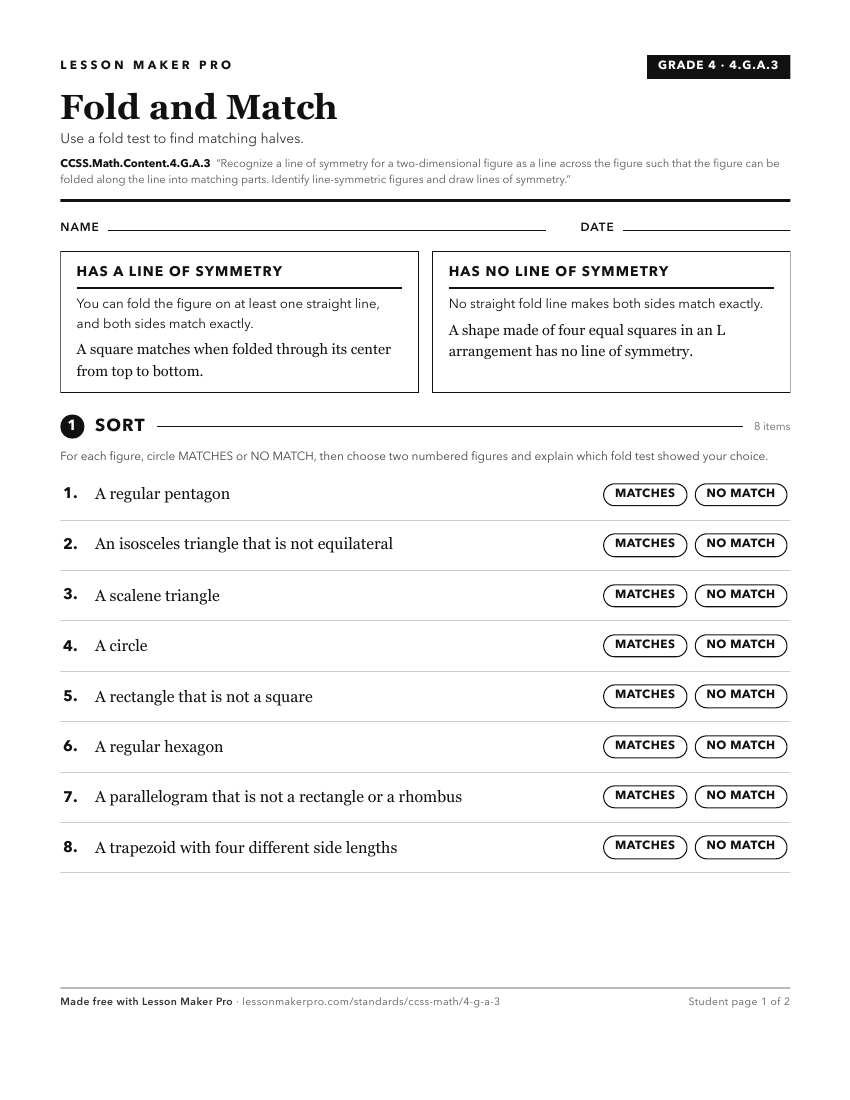
A ready-to-print activity worksheet aligned to CCSS.Math.Content.4.G.A.3, with an answer key for the teacher on its own page. No account needed.
PDF, US Letter, prints cleanly in black and white.
Download the worksheetBefore This Standard
If students are struggling here, check these first.
What This Unlocks
Mastery here sets students up for these next.
Keep exploring
Related Standards
- CCSS.Math.Content.8.G.A.2
Understand that a two-dimensional figure is congruent to another if the second can be obtained from the first by a sequence of rotations, reflections, and trans...
- CCSS.Math.Content.4.G.A.2
Classify two-dimensional figures based on the presence or absence of parallel or perpendicular lines, or the presence or absence of angles of a specified size. ...
- CCSS.Math.Content.8.G.A.4
Understand that a two-dimensional figure is similar to another if the second can be obtained from the first by a sequence of rotations, reflections, translation...
Turn this exact standard into a lesson
Grade, subject, topic, and the complete standard are prefilled. Create one free, no account needed.
Also for this standard:Make a WorksheetMake a QuizMake a Sub Lesson