CCSS.
The Standard
Understand that a two-dimensional figure is similar to another if the second can be obtained from the first by a sequence of rotations, reflections, translations, and dilations; given two similar two-dimensional figures, describe a sequence that exhibits the similarity between them.
Common Core State Standards for Mathematics · Geometry
Teacher's field guide
What This Standard Means
What Students Need to Do
- Students decide whether one plane figure can be mapped onto another using translations, rotations, reflections, and a dilation. They describe the transformations in order, including the dilation center and scale factor.
What Mastery Looks Like
- Given two similar figures on a coordinate grid, a student gives a valid transformation sequence and verifies that corresponding vertices align. The student identifies the dilation center and scale factor and explains each rigid motion.
Common Misconceptions
- Students may call figures similar because they look alike without checking corresponding angles and side lengths. They often confuse similarity with congruence or use the reciprocal scale factor. Some list correct transformations in an order that does not map the figures.
How to Assess It
- Exit ticket: Triangle A has vertices (1,1), (3,1), and (1,2). Triangle B has vertices (3,1), (7,1), and (3,3). Describe one transformation sequence that maps A onto B.
Lesson moves
Ways to Teach It
Use transparencies over a coordinate grid to mark a dilation from a chosen center, then flip, turn, or slide the image onto a target.
Ask students to write: Which transformations change size, and which preserve it? Defend your answer using one pair of corresponding sides.
Play a card match where students pair original and image figures, then record the transformation sequence, dilation center, and scale factor.
Compare two printed versions of a logo, measure corresponding sides, and identify the transformations needed to align their orientation and position.
Free download
Printable 8.G.A.4 Worksheet
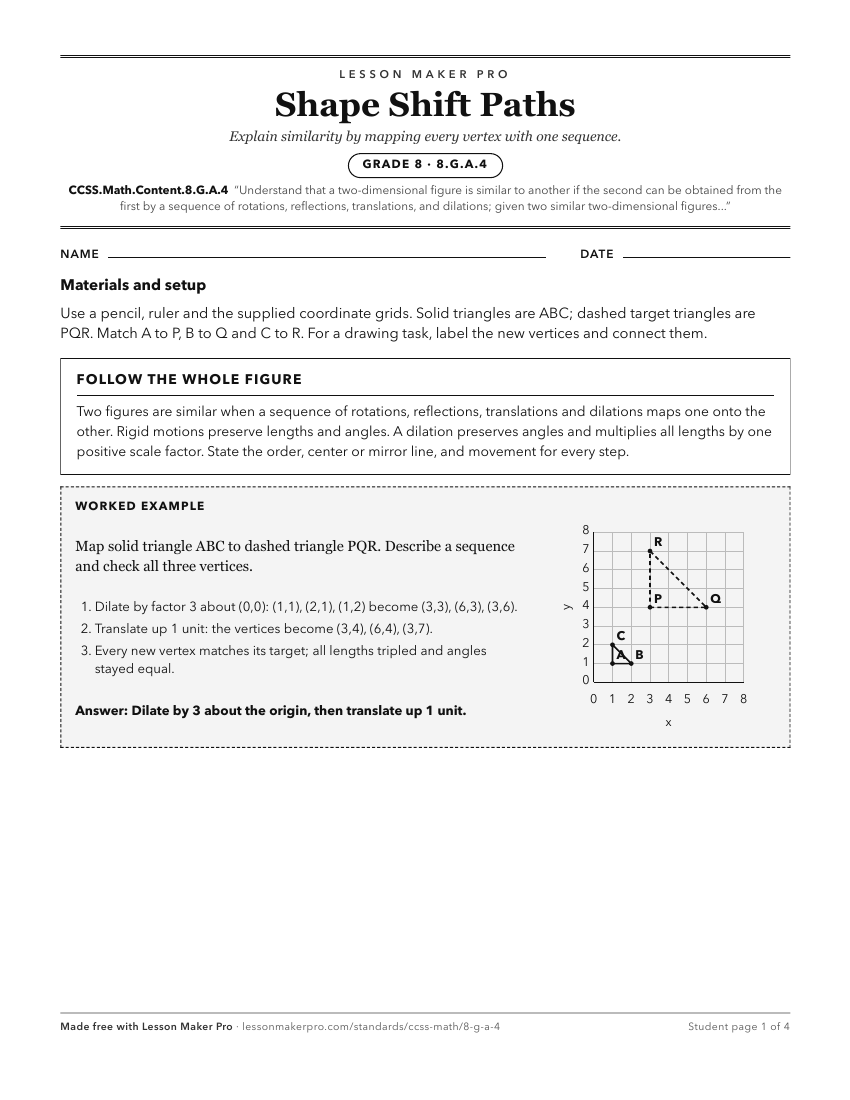
A ready-to-print activity worksheet aligned to CCSS.Math.Content.8.G.A.4, with an answer key for the teacher on its own page. No account needed.
PDF, US Letter, prints cleanly in black and white.
Download the worksheetBefore This Standard
If students are struggling here, check these first.
- CCSS.Math.Content.8.G.A.2
Similarity extends congruence by adding dilations, so students reuse rigid-motion sequences before adding scale changes.
- CCSS.Math.Content.8.G.A.3
Describing similarity sequences requires knowing how translations, rotations, reflections, and dilations move figures and change coordinates.
- CCSS.Math.Content.7.G.A.1
Scale drawings give experience with proportional side lengths and resizing figures, which supports understanding dilations within similarity transformations.
What This Unlocks
Mastery here sets students up for these next.
- CCSS.Math.Content.8.EE.B.6
Explaining constant slope with similar triangles requires recognizing triangles as similar through dilations and rigid motions.
- CCSS.Math.Content.8.G.A.5
Transformational similarity from rotations, reflections, translations, and dilations supports explaining why equal angles can prove triangle similarity.
Keep exploring
Related Standards
- CCSS.Math.Content.HSG-SRT.A.2
Given two figures, use the definition of similarity in terms of similarity transformations to decide if they are similar; explain using similarity transformatio...
- CCSS.Math.Content.HSG-SRT.A
Understand similarity in terms of similarity transformations
- CCSS.Math.Content.4.G.A.3
Recognize a line of symmetry for a two-dimensional figure as a line across the figure such that the figure can be folded along the line into matching parts. Ide...
Turn this exact standard into a lesson
Grade, subject, topic, and the complete standard are prefilled. Create one free, no account needed.
Also for this standard:Make a WorksheetMake a QuizMake a Sub Lesson