CCSS.
The Standard
Given two figures, use the definition of similarity in terms of similarity transformations to decide if they are similar; explain using similarity transformations the meaning of similarity for triangles as the equality of all corresponding pairs of angles and the proportionality of all corresponding pairs of sides.
Common Core State Standards for Mathematics
Teacher's field guide
What This Standard Means
What Students Need to Do
- Students decide whether one figure can map onto another through translations, rotations, reflections, and a dilation. For triangles, they show corresponding angles are equal and corresponding side lengths share one scale factor.
What Mastery Looks Like
- Students can name a sequence of rigid motions and a dilation that maps one figure onto another. They correctly match vertices, angles, and sides. They use one scale factor for every pair of corresponding sides.
Common Misconceptions
- Students often compare sides that do not correspond. They may use equal side differences instead of equal side ratios. Some think a rotation or reflection makes figures dissimilar.
How to Assess It
- Exit ticket: Triangle A has vertices (0,0), (2,0), (0,1), and Triangle B has vertices (1,1), (1,5), (-1,1). Decide whether they are similar, then name the transformations and verify the corresponding side ratios.
Lesson moves
Ways to Teach It
Give pairs of paper triangles and tracing paper, then have students map one triangle onto another using slides, turns, flips, and dilations.
Ask students to explain why rotating a triangle changes its position but not its angle measures or side ratios.
Use card sets showing triangle pairs, transformation sequences, and scale factors, then have teams match the three related cards.
Give students a floor plan and a scaled copy, then ask them to find the scale factor and verify three corresponding lengths.
Free download
Printable HSG-SRT.A.2 Worksheet
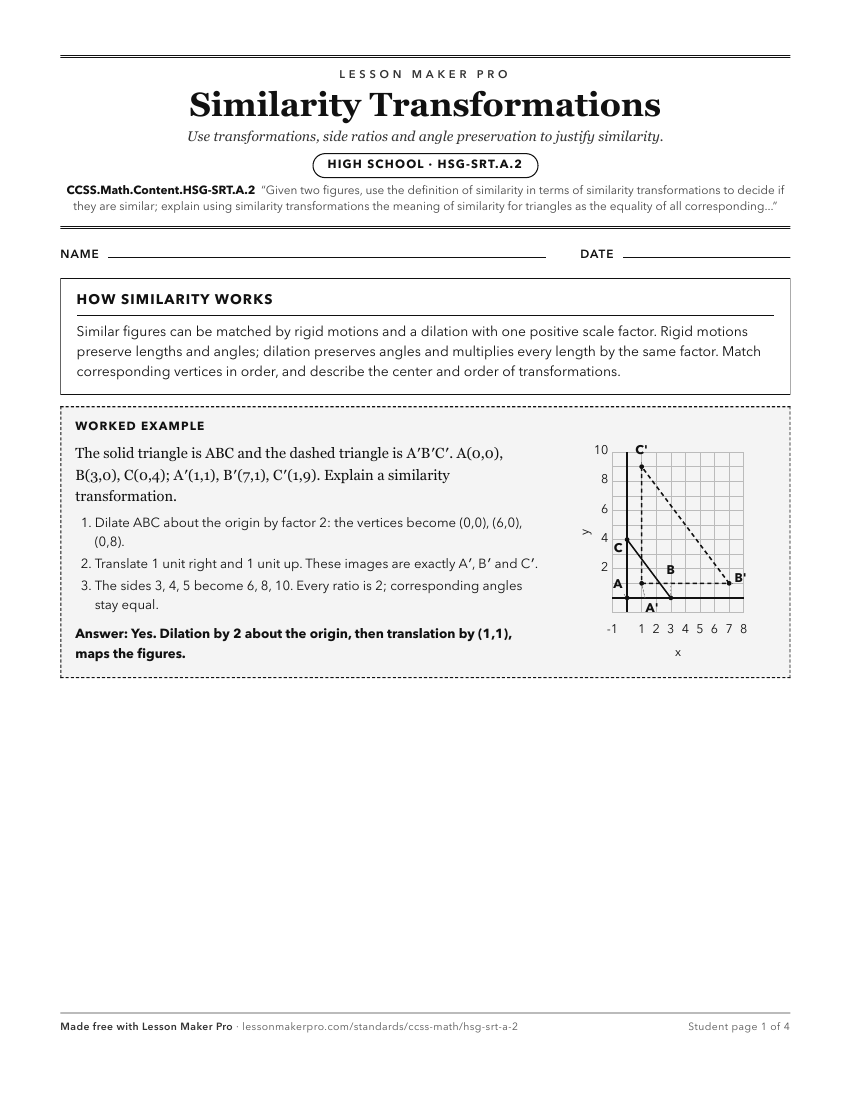
A ready-to-print activity worksheet aligned to CCSS.Math.Content.HSG-SRT.A.2, with an answer key for the teacher on its own page. No account needed.
PDF, US Letter, prints cleanly in black and white.
Download the worksheetLearning progression
Where This Standard Sits
Before This Standard
If students are struggling here, check these first.
- CCSS.Math.Content.HSG-CO.B.6
Similarity transformations extend rigid-motion congruence by adding dilations, so students reuse mapping figures and matching corresponding parts.
- CCSS.Math.Content.HSG-SRT.A.1
Similarity transformations depend on dilations preserving angles, making parallel images, and scaling lengths, which explains proportional sides.
- CCSS.Math.Content.7.RP.A.2
Recognizing proportional relationships supports understanding scale factors and proportional corresponding side lengths in similar figures.
What This Unlocks
Mastery here sets students up for these next.
- CCSS.Math.Content.HSG-C.B.5
Deriving radians and sector formulas depends on dilations showing similar circular sectors have proportional arc lengths and scaled areas.
- CCSS.Math.Content.HSG-C.A.1
Proving all circles are similar requires using similarity transformations to map centers and scale radii between any two circles.
- CCSS.Math.Content.HSG-SRT.C.6
Trigonometric ratios require knowing similar right triangles have equal angles and proportional corresponding sides, so a fixed angle gives fixed ratios.
- CCSS.Math.Content.HSG-SRT.A.3
AA proof relies on knowing triangle similarity as angle equality and side proportionality produced by similarity transformations.
- CCSS.Math.Content.HSG-SRT.B.4
Triangle proofs here use angle equality and side proportionality from similarity to justify parallel-line and Pythagorean relationships.
Keep exploring
Related Standards
- CCSS.Math.Content.HSG-SRT.A
Understand similarity in terms of similarity transformations
- CCSS.Math.Content.HSG-SRT.B.5
Use congruence and similarity criteria for triangles to solve problems and to prove relationships in geometric figures.
- CCSS.Math.Content.8.G.A.4
Understand that a two-dimensional figure is similar to another if the second can be obtained from the first by a sequence of rotations, reflections, translation...
Turn this exact standard into a lesson
Grade, subject, topic, and the complete standard are prefilled. Create one free, no account needed.
Also for this standard:Make a WorksheetMake a QuizMake a Sub Lesson