CCSS.
The Standard
Use the properties of similarity transformations to establish the AA criterion for two triangles to be similar.
Common Core State Standards for Mathematics
Teacher's field guide
What This Standard Means
What Students Need to Do
- Students explain why two matching angle pairs force two triangles to have the same shape. They use rigid motions and a dilation to map one triangle onto the other.
What Mastery Looks Like
- A student can align corresponding vertices and rays with rigid motions, then choose a dilation that matches a corresponding side. They explain why the third vertices coincide and write the similarity statement in the correct order.
Common Misconceptions
- Students may treat one equal angle as enough or match vertices in the wrong order. They may claim the triangles are congruent after a dilation or rely only on sides that look proportional.
How to Assess It
- Exit ticket: Given ∠A ≅ ∠D and ∠B ≅ ∠E, describe how rigid motions and a dilation map triangle ABC onto triangle DEF. Explain why C lands on F.
Lesson moves
Ways to Teach It
Give students grid-paper triangles to dilate, cut out, and align with a second triangle using slides, turns, and flips.
Ask students to answer: "Why are two matching angles enough, but one is not?" Draw a counterexample and explain.
Run a card sort matching triangle pairs with valid AA proofs, nonexamples, and ordered transformation sequences.
Measure a meter-stick shadow and a flagpole shadow, then use shared sun angles and right angles to justify triangle similarity.
Free download
Printable HSG-SRT.A.3 Worksheet
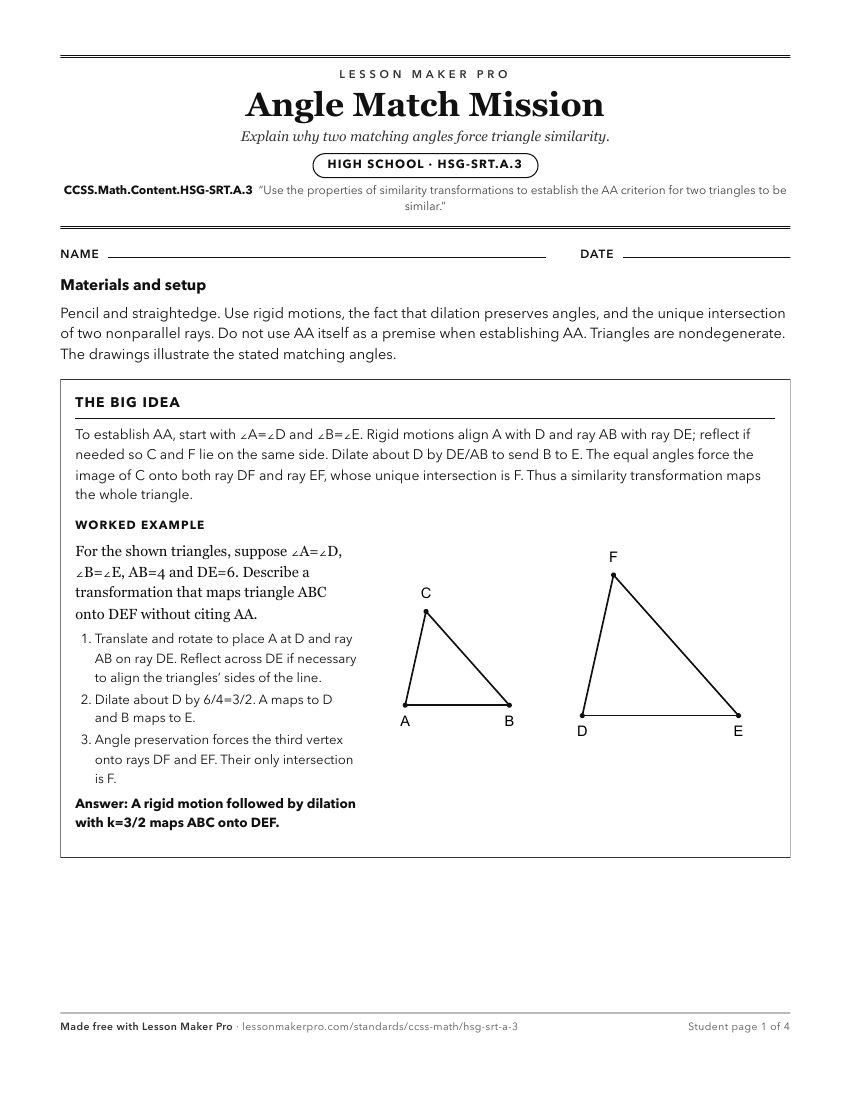
A ready-to-print activity worksheet aligned to CCSS.Math.Content.HSG-SRT.A.3, with an answer key for the teacher on its own page. No account needed.
PDF, US Letter, prints cleanly in black and white.
Download the worksheetLearning progression
Where This Standard Sits
Before This Standard
If students are struggling here, check these first.
- CCSS.Math.Content.HSG-SRT.A.1
AA similarity proof relies on knowing dilations preserve angles and scale lengths from a center by a fixed factor.
- CCSS.Math.Content.HSG-SRT.A.2
AA proof relies on knowing triangle similarity as angle equality and side proportionality produced by similarity transformations.
- CCSS.Math.Content.HSG-CO.A.2
Describing transformations as point-to-point functions supports using similarity transformations to connect triangle angles and side relationships for AA similarity.
What This Unlocks
Mastery here sets students up for these next.
- CCSS.Math.Content.HSG-SRT.C.6
AA similarity justifies that right triangles with the same acute angle have equal side ratios, which defines trig ratios.
- CCSS.Math.Content.HSG-SRT.B.4
AA similarity lets students justify similar triangles, which is essential for proving proportionality and Pythagorean theorems using similarity.
- CCSS.Math.Content.HSG-SRT.B.5
Establishing AA similarity supports later use of triangle similarity criteria to solve problems and justify figure relationships.
Keep exploring
Related Standards
Turn this exact standard into a lesson
Grade, subject, topic, and the complete standard are prefilled. Create one free, no account needed.
Also for this standard:Make a WorksheetMake a QuizMake a Sub Lesson