CCSS.
The Standard
Represent transformations in the plane using, e.g., transparencies and geometry software; describe transformations as functions that take points in the plane as inputs and give other points as outputs. Compare transformations that preserve distance and angle to those that do not (e.g., translation versus horizontal stretch).
Common Core State Standards for Mathematics
Teacher's field guide
What This Standard Means
What Students Need to Do
- Students show translations, rotations, reflections, and stretches with tracing paper, coordinates, or geometry software. They describe each transformation as a rule that maps an input point to an image point. They compare which transformations keep distances and angles unchanged.
What Mastery Looks Like
- Students can plot an image from a coordinate rule and match each original point to one image point. They can use side lengths and angle measures to explain whether a transformation preserves shape and size.
Common Misconceptions
- Students may assume every transformation keeps figures congruent. They often confuse a horizontal stretch with a horizontal translation. Some treat an image point as unrelated to its original input point.
How to Assess It
- Exit ticket: Transform the triangle with vertices (0,0), (2,0), and (0,2) using (x, y) to (2x, y). List the image points and use measurements to decide whether all distances and angles are preserved.
Lesson moves
Ways to Teach It
Use tracing paper to slide, rotate, and reflect a triangle, then compare its measured sides and angles with a stretched copy.
Discuss: How are the rules (x, y) to (x + 4, y) and (x, y) to (2x, y) alike and different?
Run a card sort matching coordinate figures, image figures, and transformation rules; students label each match distance-preserving or not.
Import a square logo into geometry software, translate it, then resize its width only; record which action changes lengths or angles.
Free download
Printable HSG-CO.A.2 Worksheet
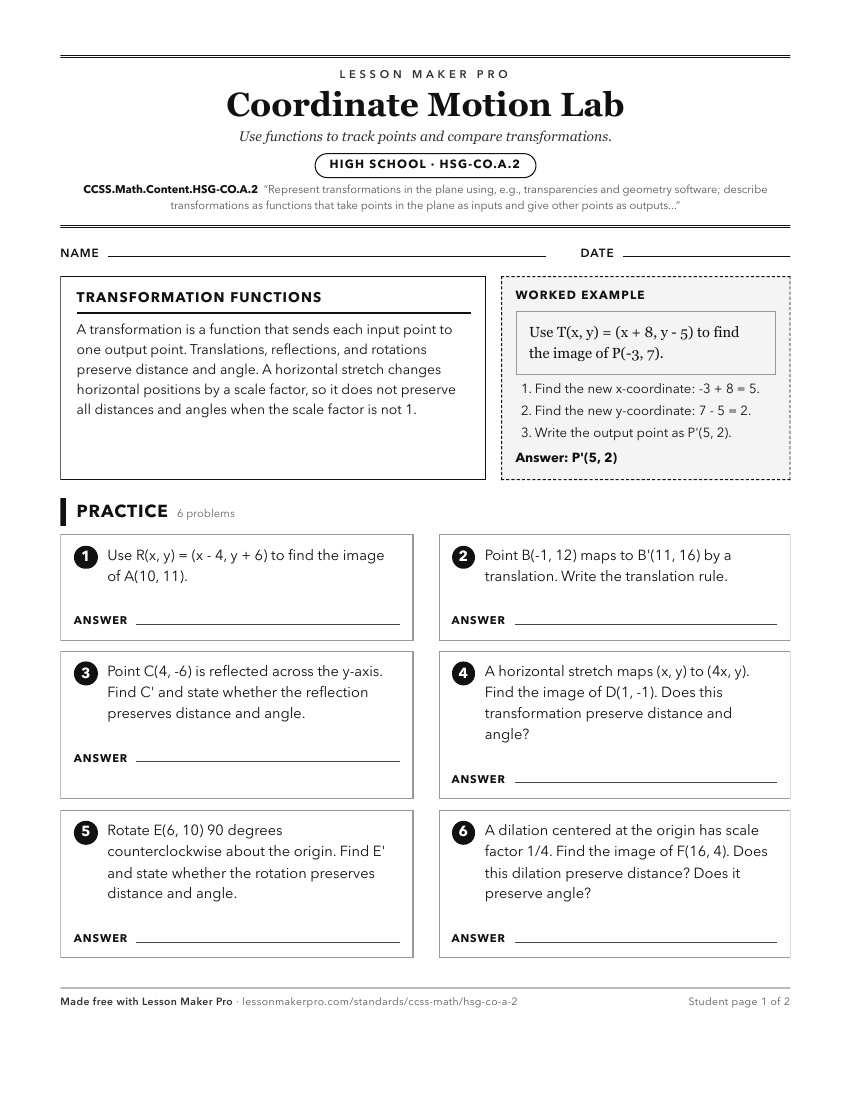
A ready-to-print activity worksheet aligned to CCSS.Math.Content.HSG-CO.A.2, with an answer key for the teacher on its own page. No account needed.
PDF, US Letter, prints cleanly in black and white.
Download the worksheetLearning progression
Where This Standard Sits
Before This Standard
If students are struggling here, check these first.
- CCSS.Math.Content.8.G.A.3
Coordinate rules for transformations support viewing transformations as point-to-point functions and distinguishing rigid motions from dilations or stretches.
- CCSS.Math.Content.8.F.A.1
Understanding a function as assigning each input one output supports viewing a transformation as mapping every point to an image point.
- CCSS.Math.Content.8.G.A.1
Experiments with rotations, reflections, and translations prepare students to represent transformations and recognize which preserve distance and angle.
What This Unlocks
Mastery here sets students up for these next.
- CCSS.Math.Content.HSG-CO.A.5
Viewing transformations as point-to-point rules supports drawing images and choosing rotations, reflections, or translations between figures.
- CCSS.Math.Content.HSG-CO.A.4
Viewing transformations as point-to-point functions supports defining rotations, reflections, and translations by their geometric effects on points.
- CCSS.Math.Content.HSG-CO.A.3
Students use transformation language and point mapping to recognize which rotations and reflections leave a figure unchanged.
- CCSS.Math.Content.HSG-SRT.A.3
Describing transformations as point-to-point functions supports using similarity transformations to connect triangle angles and side relationships for AA similarity.
- CCSS.Math.Content.HSG-SRT.A.1a
Seeing transformations as point-to-point functions supports understanding how dilation maps every point on a line to its image line.
- CCSS.Math.Content.HSN-VM.C.12
Viewing transformations as functions from points to points supports interpreting 2 by 2 matrices as plane transformations with area effects.
Keep exploring
Related Standards
Turn this exact standard into a lesson
Grade, subject, topic, and the complete standard are prefilled. Create one free, no account needed.
Also for this standard:Make a WorksheetMake a QuizMake a Sub Lesson