CCSS.
The Standard
Verify experimentally the properties of rotations, reflections, and translations:
Common Core State Standards for Mathematics
Teacher's field guide
What This Standard Means
What Students Need to Do
- Students draw rotations, reflections, and translations on grids or tracing paper. They measure before and after to check lengths, angle measures, straight lines, and parallel relationships.
What Mastery Looks Like
- Students accurately draw and label the image after a rotation, reflection, or translation. They use measurements to show that corresponding lengths and angles match, and that parallel lines remain parallel.
Common Misconceptions
- Students may treat a reflection as a slide or rotate around the figure instead of the given center. They may also think slopes stay the same after every transformation, even though parallel relationships stay intact.
How to Assess It
- Exit ticket: Plot A(1,1), B(5,1), C(1,4), D(2,2), and E(4,2). Rotate 90 degrees counterclockwise about the origin, then verify one equal length, one equal angle, and one parallel pair.
Lesson moves
Ways to Teach It
Use tracing paper to rotate, reflect, and translate a triangle, then measure corresponding sides and angles with rulers and protractors.
Ask students to write which features stayed unchanged after each transformation and cite two measurements as evidence.
Students match coordinate-grid figures to transformation cards, then earn a point by proving one preserved length, angle, or parallel pair.
Overlay a traced tile pattern on shifted, turned, and flipped copies, then check why the edges still fit without gaps.
Free download
Printable 8.G.A.1 Worksheet
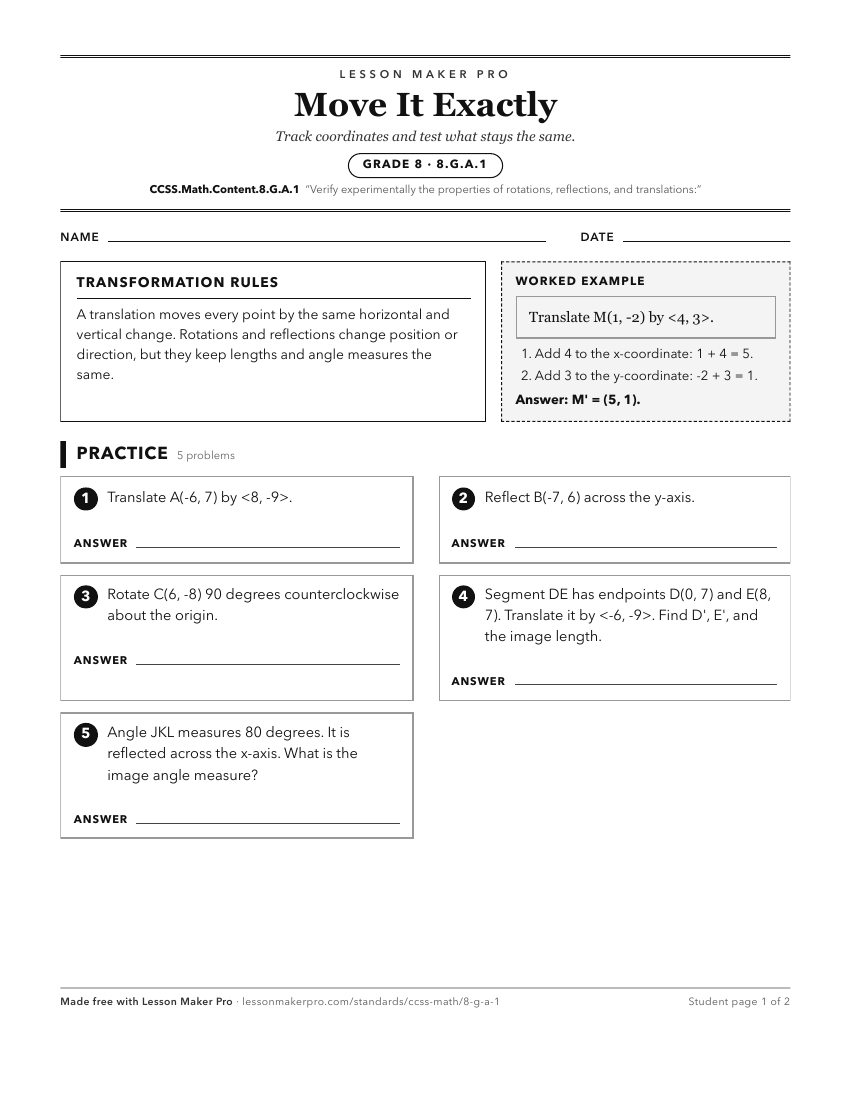
A ready-to-print activity worksheet aligned to CCSS.Math.Content.8.G.A.1, with an answer key for the teacher on its own page. No account needed.
PDF, US Letter, prints cleanly in black and white.
Download the worksheetBefore This Standard
If students are struggling here, check these first.
What This Unlocks
Mastery here sets students up for these next.
- CCSS.Math.Content.HSG-CO.B.6
Knowing rotations, reflections, and translations preserve size and shape is needed to use rigid motions to prove congruence.
- CCSS.Math.Content.8.G.A.1b
Experimenting with rotations, reflections, and translations gives students evidence to see that these transformations preserve angle measure.
- CCSS.Math.Content.8.G.A.2
Knowing rotations, reflections, and translations preserve lengths and angles is essential for using them to prove or describe congruence.
- CCSS.Math.Content.8.G.A.3
Experimental work with rigid motions prepares students to describe how translations, rotations, and reflections move coordinate points and figures.
- CCSS.Math.Content.HSG-CO.A.4
Experimental work with rotations, reflections, and translations supports turning observed movement properties into precise geometric definitions.
- CCSS.Math.Content.HSG-CO.A.3
Knowing how rotations and reflections move figures and preserve shape supports identifying which motions map a polygon onto itself.
Keep exploring
Related Standards
Turn this exact standard into a lesson
Grade, subject, topic, and the complete standard are prefilled. Create one free, no account needed.
Also for this standard:Make a WorksheetMake a QuizMake a Sub Lesson