CCSS.
The Standard
Describe the effect of dilations, translations, rotations, and reflections on two-dimensional figures using coordinates.
Common Core State Standards for Mathematics · Geometry
Teacher's field guide
What This Standard Means
What Students Need to Do
- Students apply translations, rotations, reflections, and dilations to figures on a coordinate plane. They calculate new vertex coordinates and describe how each move changes the figure.
What Mastery Looks Like
- Students correctly plot image coordinates after each transformation. They can identify the transformation from coordinate pairs and explain changes in position, orientation, size, and side lengths.
Common Misconceptions
- Students often reverse translation signs or confuse reflection rules for the x-axis and y-axis. They may rotate in the wrong direction or add the dilation factor instead of multiplying coordinates.
How to Assess It
- Exit ticket: Plot triangle A(1,1), B(3,1), C(1,2), then list its coordinates after a reflection across the y-axis and a dilation by 2 about the origin.
Lesson moves
Ways to Teach It
Trace a polygon on transparency sheets, then slide, flip, turn, and enlarge it over a coordinate grid while recording new vertices.
Ask students to compare a reflection and a rotation, then write how each changes coordinates and orientation.
Play transformation match-up using cards showing original coordinates, image coordinates, rules, and labeled diagrams.
Use a simple floor plan to move, rotate, reflect, or resize furniture shapes while keeping all vertices on a coordinate grid.
Free download
Printable 8.G.A.3 Worksheet
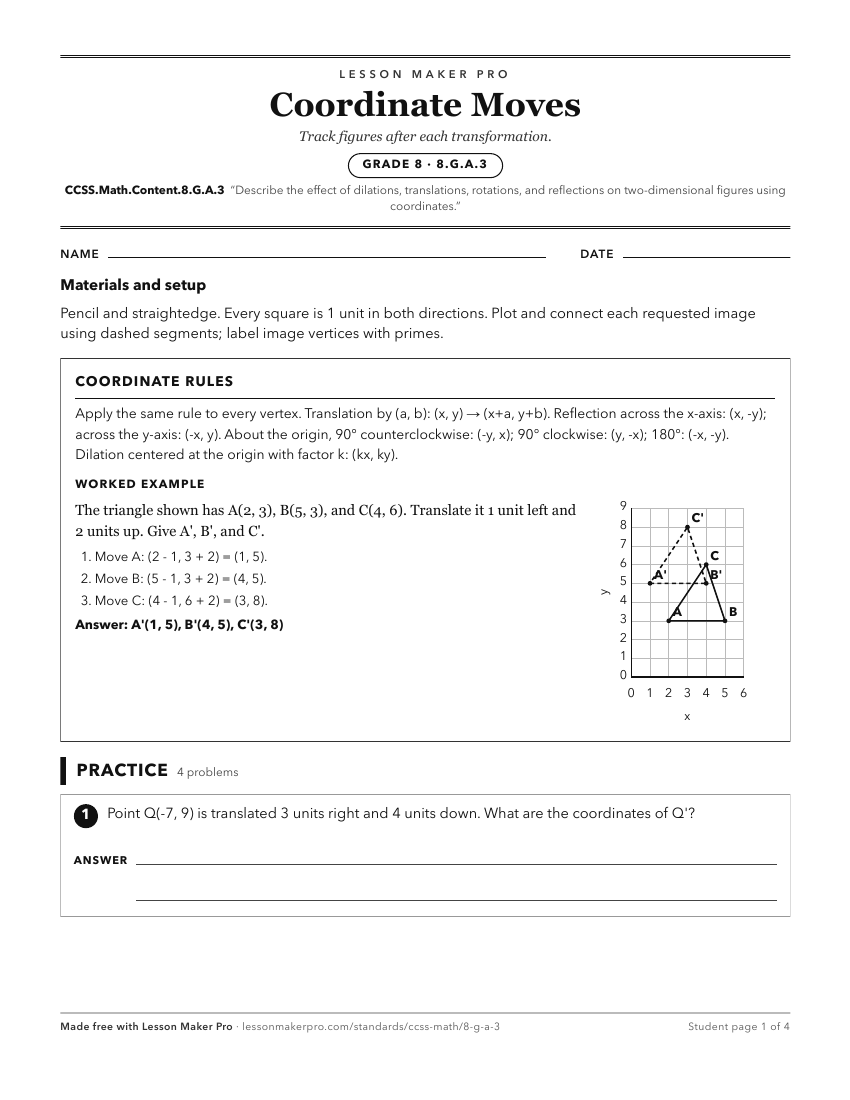
A ready-to-print activity worksheet aligned to CCSS.Math.Content.8.G.A.3, with an answer key for the teacher on its own page. No account needed.
PDF, US Letter, prints cleanly in black and white.
Download the worksheetBefore This Standard
If students are struggling here, check these first.
- CCSS.Math.Content.6.G.A.3
Plotting coordinate polygons and reading vertex coordinates supports describing how transformations change a figure’s coordinates.
- CCSS.Math.Content.6.NS.C.6
Coordinate transformations require locating and tracking points across all quadrants using signed x and y coordinates.
- CCSS.Math.Content.8.G.A.1
Experimental work with rigid motions prepares students to describe how translations, rotations, and reflections move coordinate points and figures.
What This Unlocks
Mastery here sets students up for these next.
- CCSS.Math.Content.8.G.A.4
Describing similarity sequences requires knowing how translations, rotations, reflections, and dilations move figures and change coordinates.
- CCSS.Math.Content.HSG-CO.A.2
Coordinate rules for transformations support viewing transformations as point-to-point functions and distinguishing rigid motions from dilations or stretches.
- CCSS.Math.Content.HSG-SRT.A.1a
Coordinate work with dilations helps students see how points on a line move and why image lines stay parallel or unchanged.
- CCSS.Math.Content.HSG-SRT.A.1
Coordinate descriptions of dilations prepare students to test how centers and scale factors move points and change distances.
- CCSS.Math.Content.HSG-CO.A.5
Coordinate rules for translations, rotations, and reflections support drawing images and choosing transformations that map one figure to another.
- CCSS.Math.Content.HSN-VM.A.2
Coordinate translation work supports seeing vector components as horizontal and vertical changes from an initial point to a terminal point.
Keep exploring
Related Standards
- CCSS.Math.Content.HSG-CO.A.4
Develop definitions of rotations, reflections, and translations in terms of angles, circles, perpendicular lines, parallel lines, and line segments.
- CCSS.Math.Content.8.G.A.2
Understand that a two-dimensional figure is congruent to another if the second can be obtained from the first by a sequence of rotations, reflections, and trans...
Turn this exact standard into a lesson
Grade, subject, topic, and the complete standard are prefilled. Create one free, no account needed.
Also for this standard:Make a WorksheetMake a QuizMake a Sub Lesson