CCSS.
The Standard
Given a geometric figure and a rotation, reflection, or translation, draw the transformed figure using, e.g., graph paper, tracing paper, or geometry software. Specify a sequence of transformations that will carry a given figure onto another.
Common Core State Standards for Mathematics
Teacher's field guide
What This Standard Means
What Students Need to Do
- Students draw the image of a figure after a slide, flip, or turn. They also give an ordered set of moves that maps one figure exactly onto another.
What Mastery Looks Like
- Students place every vertex correctly and preserve side lengths and angles. They can name an ordered sequence that maps one figure exactly onto another and verify the match.
Common Misconceptions
- Students often reverse clockwise and counterclockwise rotation or reflect across the wrong line. They may move each vertex differently or describe only the final position instead of the steps.
How to Assess It
- Give two congruent triangles on a coordinate grid. Ask students to draw the image and list each transformation, including direction, angle, reflection line, or translation vector.
Lesson moves
Ways to Teach It
Give pairs tracing paper to copy a polygon, then slide, flip, and turn it to match a target figure.
Show two congruent shapes and ask, "Which transformation sequence works, and how can you prove every point lands correctly?"
Play transformation relay with coordinate cards, where teams calculate one step at a time and check the final image.
Analyze a quilt pattern and describe the translations, reflections, and rotations used to repeat one tile.
Free download
Printable HSG-CO.A.5 Worksheet
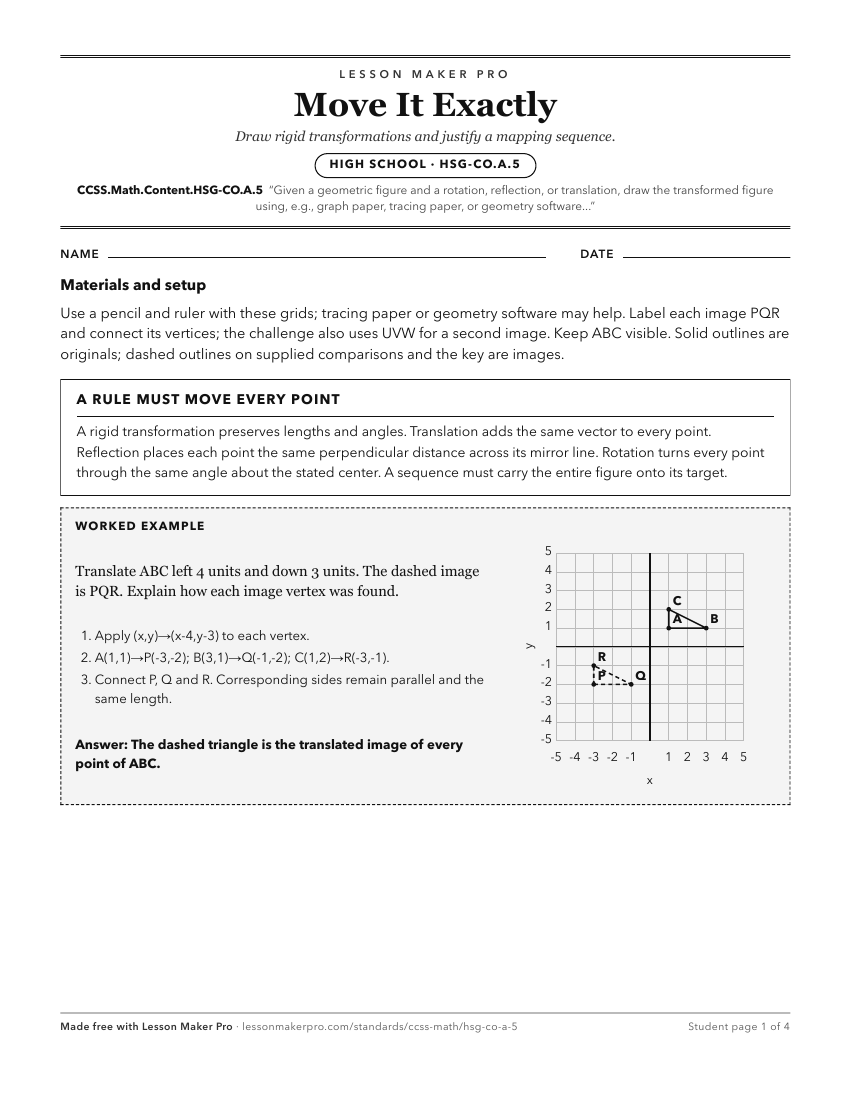
A ready-to-print activity worksheet aligned to CCSS.Math.Content.HSG-CO.A.5, with an answer key for the teacher on its own page. No account needed.
PDF, US Letter, prints cleanly in black and white.
Download the worksheetLearning progression
Where This Standard Sits
Before This Standard
If students are struggling here, check these first.
- CCSS.Math.Content.HSG-CO.A.4
Knowing rotations, reflections, and translations by their defining properties helps students draw images and choose transformation sequences accurately.
- CCSS.Math.Content.HSG-CO.A.2
Viewing transformations as point-to-point rules supports drawing images and choosing rotations, reflections, or translations between figures.
- CCSS.Math.Content.8.G.A.3
Coordinate rules for translations, rotations, and reflections support drawing images and choosing transformations that map one figure to another.
What This Unlocks
Mastery here sets students up for these next.
Keep exploring
Related Standards
- CCSS.Math.Content.HSG-CO.A.3
Given a rectangle, parallelogram, trapezoid, or regular polygon, describe the rotations and reflections that carry it onto itself.
- CCSS.Math.Content.8.G.A.2
Understand that a two-dimensional figure is congruent to another if the second can be obtained from the first by a sequence of rotations, reflections, and trans...
- CCSS.Math.Content.8.G.A.4
Understand that a two-dimensional figure is similar to another if the second can be obtained from the first by a sequence of rotations, reflections, translation...
Turn this exact standard into a lesson
Grade, subject, topic, and the complete standard are prefilled. Create one free, no account needed.
Also for this standard:Make a WorksheetMake a QuizMake a Sub Lesson