CCSS.
The Standard
Understand that a two-dimensional figure is congruent to another if the second can be obtained from the first by a sequence of rotations, reflections, and translations; given two congruent figures, describe a sequence that exhibits the congruence between them.
Common Core State Standards for Mathematics · Geometry
Teacher's field guide
What This Standard Means
What Students Need to Do
- Students decide whether one figure can be moved exactly onto another using slides, flips, and turns. They describe a sequence of moves that maps corresponding points.
What Mastery Looks Like
- Students can map one figure exactly onto another and match each corresponding vertex. They name the transformations in order and include details such as direction, distance, angle, rotation center, or reflection line.
Common Misconceptions
- Students may think figures are congruent if they have the same shape but different sizes. They may also ignore the rotation center, reverse clockwise and counterclockwise, or list transformations in the wrong order.
How to Assess It
- Give students two congruent triangles on a coordinate grid. Ask them to describe a sequence of translations, rotations, or reflections that maps the first triangle onto the second.
Lesson moves
Ways to Teach It
Have students trace a polygon on transparent paper, then slide, flip, and turn it to match a second polygon.
Ask students to explain why rotating or reflecting a figure changes its position but not its size or shape.
Play transformation relay: teams draw cards naming moves and record the sequence that maps one grid figure onto another.
Use quilt patterns or floor tiles to identify repeated shapes and describe how each copy was moved from the original.
Free download
Printable 8.G.A.2 Worksheet
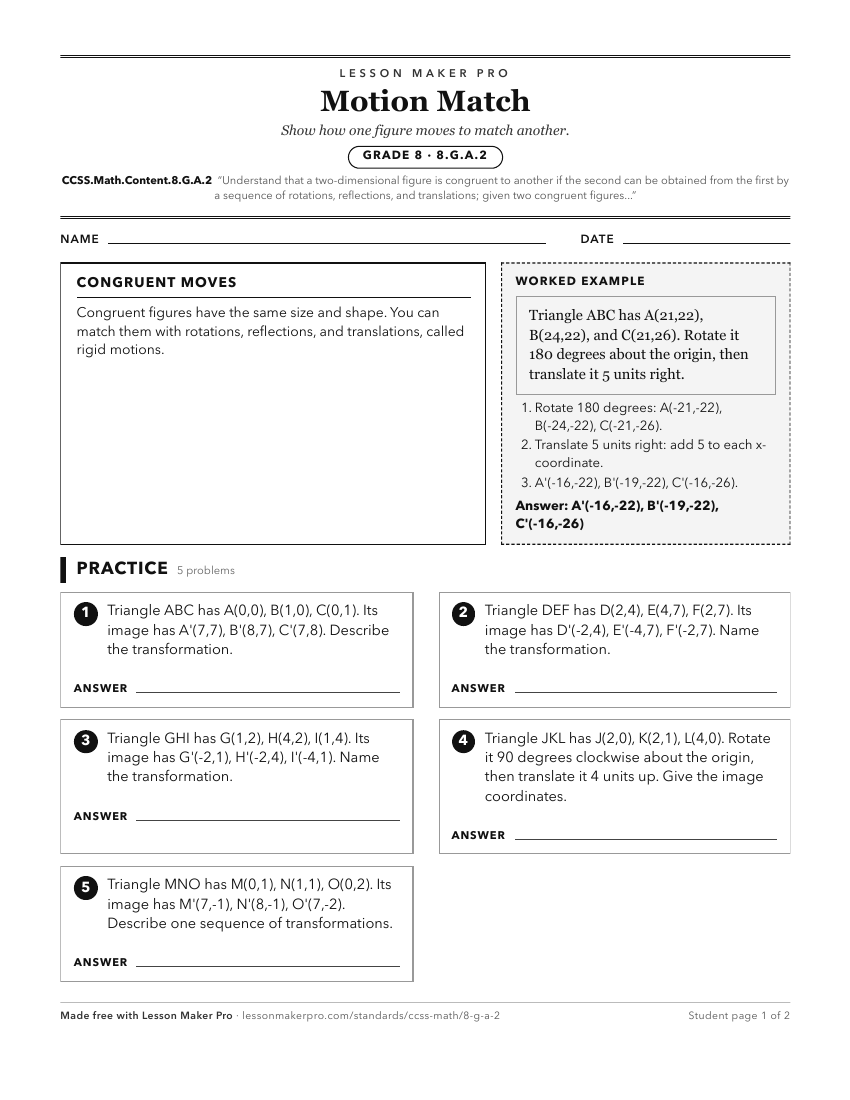
A ready-to-print activity worksheet aligned to CCSS.Math.Content.8.G.A.2, with an answer key for the teacher on its own page. No account needed.
PDF, US Letter, prints cleanly in black and white.
Download the worksheetBefore This Standard
If students are struggling here, check these first.
What This Unlocks
Mastery here sets students up for these next.
- CCSS.Math.Content.HSG-CO.B.6
Students must already connect congruence with sequences of rotations, reflections, and translations to decide congruence using rigid motions.
- CCSS.Math.Content.8.G.A.4
Similarity extends congruence by adding dilations, so students reuse rigid-motion sequences before adding scale changes.
- CCSS.Math.Content.HSG-CO.B.7
Students must understand congruence as a sequence of rigid motions before proving triangle congruence from matching sides and angles.
Keep exploring
Related Standards
Turn this exact standard into a lesson
Grade, subject, topic, and the complete standard are prefilled. Create one free, no account needed.
Also for this standard:Make a WorksheetMake a QuizMake a Sub Lesson