CCSS.
The Standard
Use the definition of congruence in terms of rigid motions to show that two triangles are congruent if and only if corresponding pairs of sides and corresponding pairs of angles are congruent.
Common Core State Standards for Mathematics
Teacher's field guide
What This Standard Means
What Students Need to Do
- Students use translations, rotations, and reflections to map one triangle exactly onto another. They connect that exact match to equal corresponding sides and angles, and explain the connection both ways.
What Mastery Looks Like
- Students correctly match vertices, sides, and angles. They describe a sequence of rigid motions that maps one triangle onto the other and explain the reasoning in both directions.
Common Misconceptions
- Students may treat a dilation as a rigid motion or think triangles must face the same direction. They may also match the wrong vertices or use equal angles alone to claim congruence.
How to Assess It
- Give triangles ABC with vertices (0,0), (3,0), (0,2) and DEF with vertices (5,1), (2,1), (5,3). Ask students to name the rigid motions, match corresponding parts, and explain how the mapping proves congruence.
Lesson moves
Ways to Teach It
Use tracing paper to translate, rotate, or reflect one triangle onto another, then label every pair of matching sides and angles.
Ask students to write why equal corresponding parts allow one triangle to map exactly onto another without resizing.
Run a card sort matching triangle pairs with transformation cards and vertex correspondence cards.
Compare two triangular shelf brackets and decide whether one can replace the other using measurements and a rigid motion sketch.
Free download
Printable HSG-CO.B.7 Worksheet
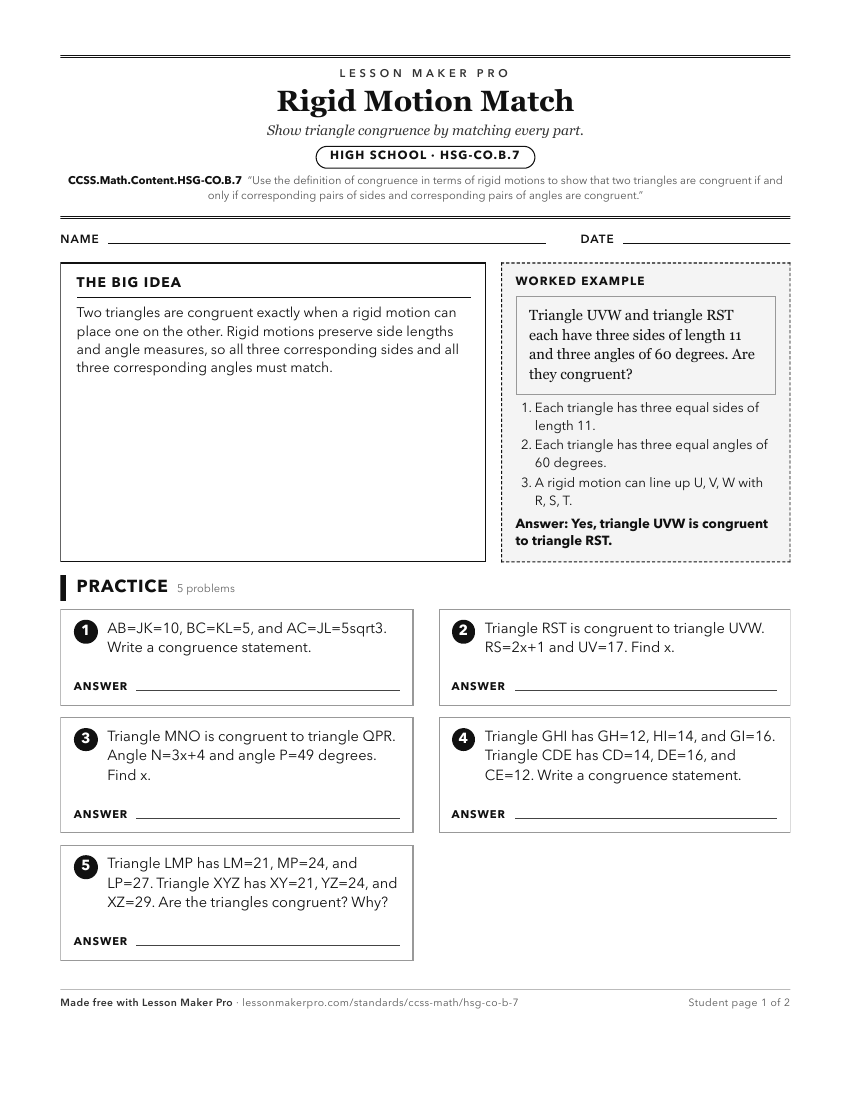
A ready-to-print activity worksheet aligned to CCSS.Math.Content.HSG-CO.B.7, with an answer key for the teacher on its own page. No account needed.
PDF, US Letter, prints cleanly in black and white.
Download the worksheetLearning progression
Where This Standard Sits
Before This Standard
If students are struggling here, check these first.
- CCSS.Math.Content.HSG-CO.B.6
Students need rigid motion congruence to connect triangle side and angle matches with an actual motion mapping one triangle to another.
- CCSS.Math.Content.8.G.A.2
Students must understand congruence as a sequence of rigid motions before proving triangle congruence from matching sides and angles.
- CCSS.Math.Content.HSG-CO.A.4
Triangle congruence by rigid motions requires knowing how rotations, reflections, and translations preserve distances, angles, and corresponding parts.
What This Unlocks
Mastery here sets students up for these next.
Keep exploring
Related Standards
Turn this exact standard into a lesson
Grade, subject, topic, and the complete standard are prefilled. Create one free, no account needed.
Also for this standard:Make a WorksheetMake a QuizMake a Sub Lesson