CCSS.
The Standard
Given a rectangle, parallelogram, trapezoid, or regular polygon, describe the rotations and reflections that carry it onto itself.
Common Core State Standards for Mathematics
Teacher's field guide
What This Standard Means
What Students Need to Do
- Students identify every reflection line and rotation that makes a figure match its starting position. They name the rotation center and angle, then connect each symmetry to the figure's structure.
What Mastery Looks Like
- Students find all symmetries without adding invalid ones. They state rotation angles and centers accurately, draw reflection lines correctly, and justify each answer using matching sides and vertices.
Common Misconceptions
- Students often treat diagonals as reflection lines for every quadrilateral. They may miss rotations greater than 180 degrees, include 360 degrees as nontrivial, or measure angles from the wrong center.
How to Assess It
- Give students a regular hexagon. Ask them to draw all reflection lines and list every nontrivial rotation less than 360 degrees that produces an exact match.
Lesson moves
Ways to Teach It
Trace each paper polygon, rotate or flip the cutout over its outline, and record every position that matches exactly.
Compare a rectangle with a nonrectangular parallelogram, then write why their reflection symmetries differ.
Sort shape cards by their number of reflection lines and rotational symmetries, then verify each choice with tracing paper.
Analyze a stop sign as a regular octagon, listing its rotation angles and drawing all reflection lines.
Free download
Printable HSG-CO.A.3 Worksheet
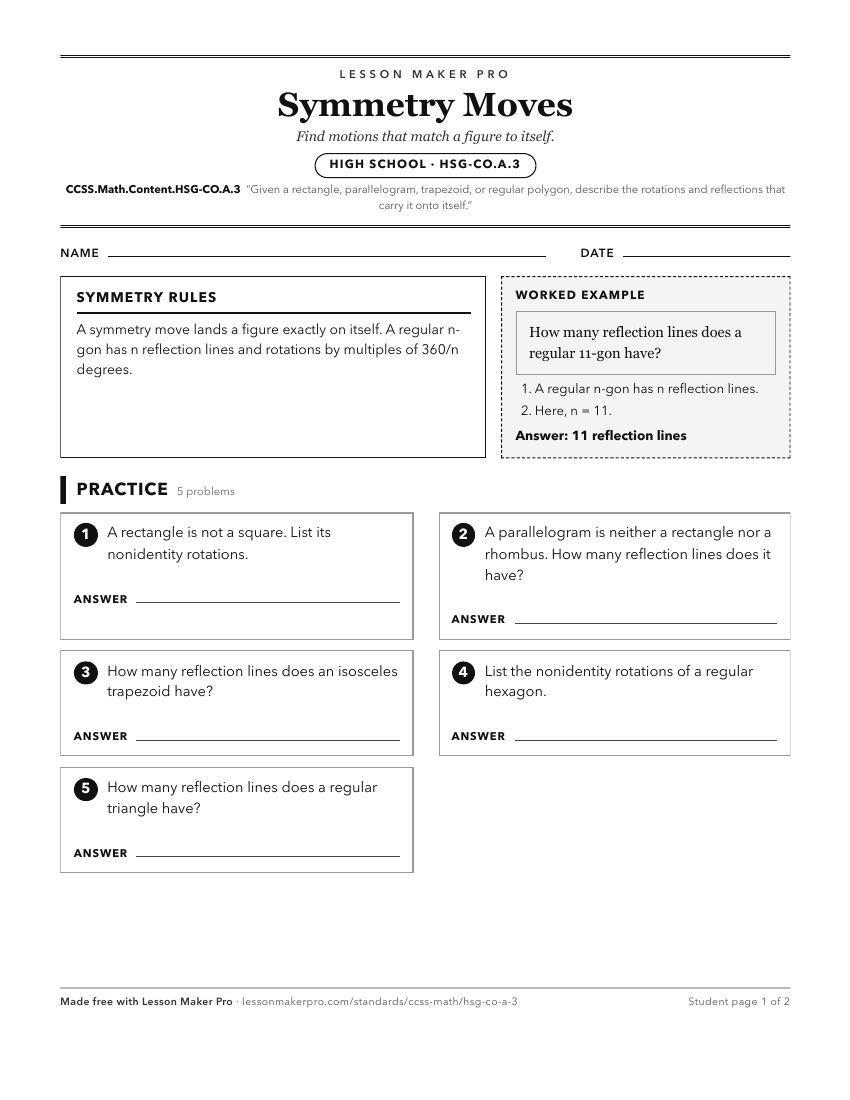
A ready-to-print activity worksheet aligned to CCSS.Math.Content.HSG-CO.A.3, with an answer key for the teacher on its own page. No account needed.
PDF, US Letter, prints cleanly in black and white.
Download the worksheetLearning progression
Where This Standard Sits
Before This Standard
If students are struggling here, check these first.
- CCSS.Math.Content.HSG-CO.A.4
Formal definitions of rotations and reflections support describing which turns or mirror lines map a polygon onto itself.
- CCSS.Math.Content.HSG-CO.A.2
Students use transformation language and point mapping to recognize which rotations and reflections leave a figure unchanged.
- CCSS.Math.Content.8.G.A.1
Knowing how rotations and reflections move figures and preserve shape supports identifying which motions map a polygon onto itself.
Keep exploring
Related Standards
Turn this exact standard into a lesson
Grade, subject, topic, and the complete standard are prefilled. Create one free, no account needed.
Also for this standard:Make a WorksheetMake a QuizMake a Sub Lesson