CCSS.
The Standard
Develop definitions of rotations, reflections, and translations in terms of angles, circles, perpendicular lines, parallel lines, and line segments.
Common Core State Standards for Mathematics
Teacher's field guide
What This Standard Means
What Students Need to Do
- Students describe rotations, reflections, and translations through exact geometric relationships, not just words like turn, flip, and slide. They use angle measure, equal distances, perpendicular bisectors, and parallel segments to explain where every point maps.
What Mastery Looks Like
- For a rotation, a student identifies equal distances from the center and the angle between each point and its image. For a reflection, they identify fixed points on the mirror line and perpendicular bisected point-image segments. For a translation, they identify parallel, equal-length point-image segments with the same direction.
Common Misconceptions
- Students may place a rotation center on the figure instead of using the point equidistant from each point-image pair. They may draw a mirror line that is not the perpendicular bisector of each point-image segment. They may call any same-length movement a translation, even when the segments are not parallel or point in the same direction.
How to Assess It
- Exit ticket: “Point P maps to P'. State the geometric facts that must be true for a rotation about O, a reflection across line m, and a translation.”
Lesson moves
Ways to Teach It
Use tracing paper, compasses, and rulers to map a triangle under each motion, then mark equal lengths, angles, and perpendicular or parallel lines.
Ask students to write why “slide,” “flip,” and “turn” are incomplete definitions, then replace each with measurable geometric conditions.
Run a card sort matching motion diagrams with definition cards and evidence cards, requiring partners to reject one tempting mismatch.
Photograph a tiled floor or logo, identify one motion, and annotate the angle, mirror line, or parallel equal displacement segments.
Free download
Printable HSG-CO.A.4 Worksheet
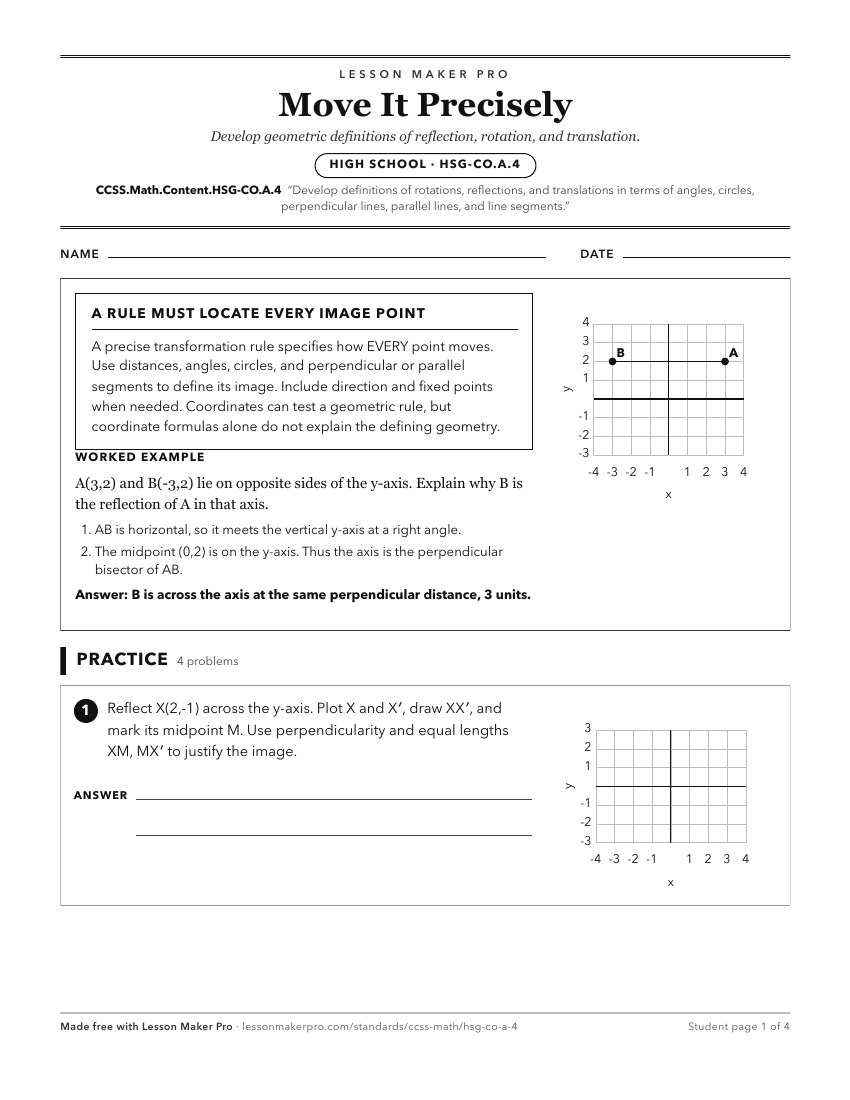
A ready-to-print activity worksheet aligned to CCSS.Math.Content.HSG-CO.A.4, with an answer key for the teacher on its own page. No account needed.
PDF, US Letter, prints cleanly in black and white.
Download the worksheetLearning progression
Where This Standard Sits
Before This Standard
If students are struggling here, check these first.
- CCSS.Math.Content.HSG-CO.A.1
Defining transformations formally requires using angles, circles, parallel and perpendicular lines, and line segments precisely.
- CCSS.Math.Content.HSG-CO.A.2
Viewing transformations as point-to-point functions supports defining rotations, reflections, and translations by their geometric effects on points.
- CCSS.Math.Content.8.G.A.1
Experimental work with rotations, reflections, and translations supports turning observed movement properties into precise geometric definitions.
What This Unlocks
Mastery here sets students up for these next.
- CCSS.Math.Content.HSG-CO.A.5
Knowing rotations, reflections, and translations by their defining properties helps students draw images and choose transformation sequences accurately.
- CCSS.Math.Content.HSG-CO.A.3
Formal definitions of rotations and reflections support describing which turns or mirror lines map a polygon onto itself.
- CCSS.Math.Content.HSG-CO.B.8
Triangle congruence proofs require knowing how rotations, reflections, and translations move figures while preserving lengths and angles.
- CCSS.Math.Content.HSG-CO.B.7
Triangle congruence by rigid motions requires knowing how rotations, reflections, and translations preserve distances, angles, and corresponding parts.
Turn this exact standard into a lesson
Grade, subject, topic, and the complete standard are prefilled. Create one free, no account needed.
Also for this standard:Make a WorksheetMake a QuizMake a Sub Lesson