CCSS.
The Standard
Know precise definitions of angle, circle, perpendicular line, parallel line, and line segment, based on the undefined notions of point, line, distance along a line, and distance around a circular arc.
Common Core State Standards for Mathematics
Teacher's field guide
What This Standard Means
What Students Need to Do
- Students state exact definitions for angles, circles, perpendicular lines, parallel lines, and line segments. They build those definitions from points, lines, endpoints, intersections, and measured distance.
What Mastery Looks Like
- Students define each figure using points, lines, endpoints, intersections, and distance. They identify examples and nonexamples, then justify each choice from the definition rather than from appearance.
Common Misconceptions
- Students may call any two lines that look evenly spaced parallel, including skew lines in space. They may confuse a circle with its filled interior, treat any intersecting lines as perpendicular, or mix up segments, rays, and lines.
How to Assess It
- Give students five small diagrams showing an angle, circle, perpendicular lines, parallel lines, and a segment. Ask them to name each figure and write the defining condition that proves the name applies.
Lesson moves
Ways to Teach It
Use string, rulers, and compasses to construct each figure, then label endpoints, equal distances, intersections, and right angles.
Ask students to explain why a circle is not a filled disk and why skew lines are not parallel.
Run a card sort matching each term with its definition, a correct diagram, and a carefully chosen nonexample.
Examine a classroom floor plan and verify parallel walls, perpendicular corners, segments, angles, and circular features using measurements.
Free download
Printable HSG-CO.A.1 Worksheet
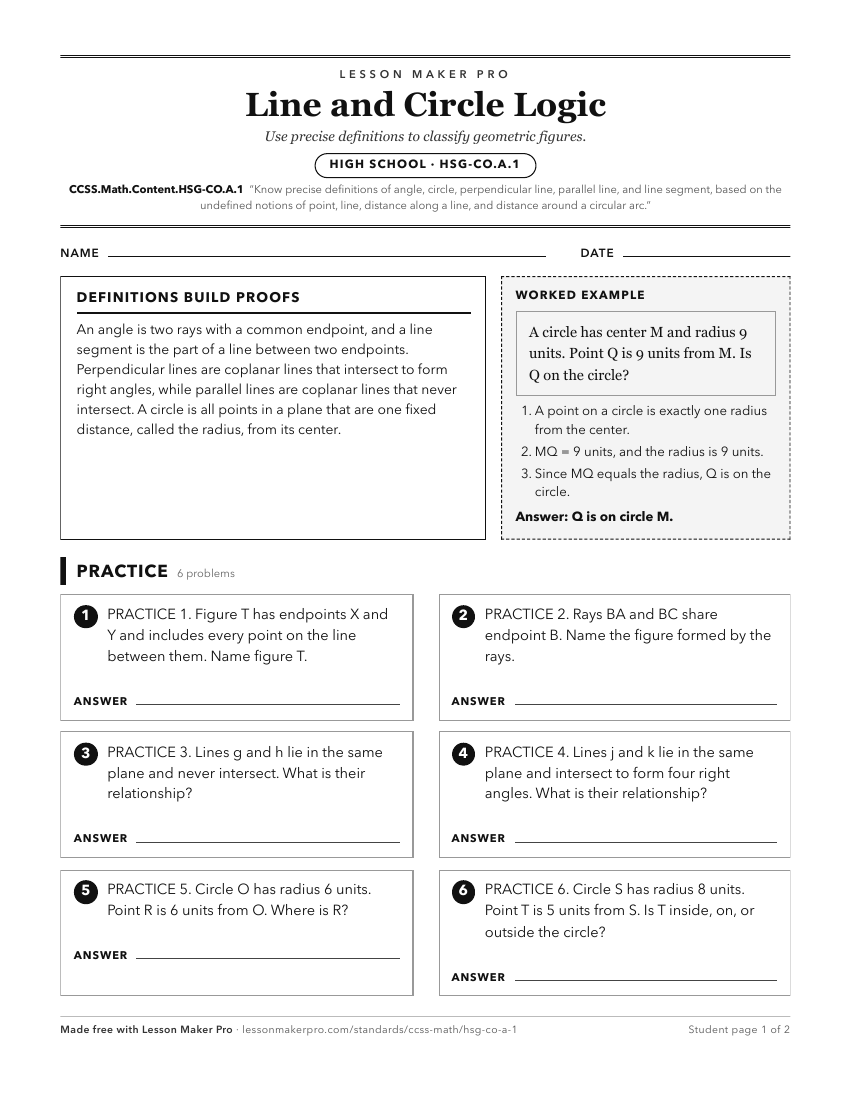
A ready-to-print activity worksheet aligned to CCSS.Math.Content.HSG-CO.A.1, with an answer key for the teacher on its own page. No account needed.
PDF, US Letter, prints cleanly in black and white.
Download the worksheetLearning progression
Where This Standard Sits
What This Unlocks
Mastery here sets students up for these next.
- CCSS.Math.Content.HSG-CO.D.13
Precise meanings of circle, segment, and angle support constructing and justifying equal chords and vertices on the circle.
- CCSS.Math.Content.HSG-CO.C.11
Parallelogram proofs use precise meanings of parallel lines, line segments, and angles to state givens and justify conclusions.
- CCSS.Math.Content.HSG-CO.A.4
Defining transformations formally requires using angles, circles, parallel and perpendicular lines, and line segments precisely.
- CCSS.Math.Content.HSG-C.A.1
The proof uses the precise definition of a circle and radius to show a dilation maps one circle onto another.
- CCSS.Math.Content.HSG-CO.D.12
Constructions require recognizing segments, angles, perpendicular lines, parallel lines, and circles as the objects being copied or created.
- CCSS.Math.Content.HSG-CO.C.10
Triangle proofs rely on precise meanings of angles, segments, parallel lines, and perpendicular lines to state relationships and justify steps.
Keep exploring
Related Standards
- CCSS.Math.Content.HSG-C.A
Understand and apply theorems about circles
- CCSS.Math.Content.4.MD.C
Geometric measurement: understand concepts of angle and measure angles.
- CCSS.Math.Content.4.G.A.1
Draw points, lines, line segments, rays, angles (right, acute, obtuse), and perpendicular and parallel lines. Identify these in two-dimensional figures.
Turn this exact standard into a lesson
Grade, subject, topic, and the complete standard are prefilled. Create one free, no account needed.
Also for this standard:Make a WorksheetMake a QuizMake a Sub Lesson