CCSS.
The Standard
Prove theorems about parallelograms.
Common Core State Standards for Mathematics
Teacher's field guide
What This Standard Means
What Students Need to Do
- Students use definitions, angle facts, and triangle congruence to prove relationships among sides, angles, and diagonals. They also use diagonal properties to justify when a quadrilateral is a parallelogram or rectangle.
What Mastery Looks Like
- Students can write a clear proof with statements supported by definitions, angle relationships, and triangle congruence. They can distinguish a theorem from its converse and explain when diagonal facts prove a quadrilateral is a parallelogram or rectangle.
Common Misconceptions
- Students often rely on how the diagram looks instead of using given facts. They confuse diagonals that bisect each other with diagonals that are congruent. They may claim that any quadrilateral with congruent diagonals must be a rectangle.
How to Assess It
- Exit ticket: In parallelogram ABCD, draw diagonal AC and prove AB is congruent to CD using two congruent triangles. Include a reason for each step.
Lesson moves
Ways to Teach It
Cut a paper parallelogram, draw both diagonals, then fold or measure to test which segments, sides, and angles match.
Ask: Does a quadrilateral with congruent diagonals have to be a rectangle? Defend your answer with a counterexample or proof.
Give groups shuffled cards showing proof statements and reasons, then have them race to arrange a valid parallelogram proof.
Measure a classroom tabletop’s opposite sides and diagonals, then decide whether the measurements support classifying it as a rectangle.
Free download
Printable HSG-CO.C.11 Worksheet
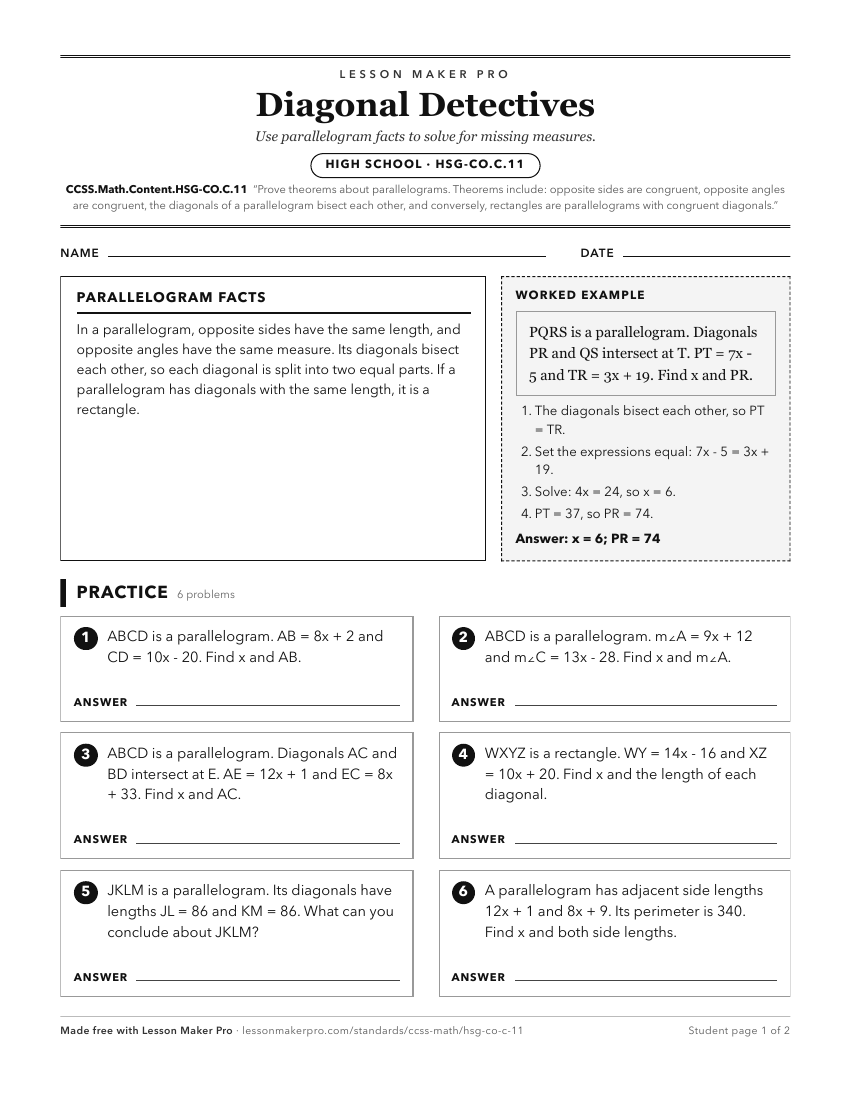
A ready-to-print activity worksheet aligned to CCSS.Math.Content.HSG-CO.C.11, with an answer key for the teacher on its own page. No account needed.
PDF, US Letter, prints cleanly in black and white.
Download the worksheetLearning progression
Where This Standard Sits
Before This Standard
If students are struggling here, check these first.
- CCSS.Math.Content.HSG-CO.A.1
Parallelogram proofs use precise meanings of parallel lines, line segments, and angles to state givens and justify conclusions.
- CCSS.Math.Content.HSG-CO.C.9
Parallelogram proofs rely on parallel-line angle relationships to set up congruent triangles and prove side, angle, and diagonal properties.
- CCSS.Math.Content.HSG-CO.B.8
Triangle congruence criteria justify many parallelogram proofs, such as using diagonals to show opposite sides or angles are congruent.
What This Unlocks
Mastery here sets students up for these next.
Keep exploring
Related Standards
Turn this exact standard into a lesson
Grade, subject, topic, and the complete standard are prefilled. Create one free, no account needed.
Also for this standard:Make a WorksheetMake a QuizMake a Sub Lesson