CCSS.
The Standard
Prove theorems about triangles.
Common Core State Standards for Mathematics
Teacher's field guide
What This Standard Means
What Students Need to Do
- Students build logical proofs about triangle angles, isosceles triangles, midsegments, and medians. They justify each step using definitions, congruence criteria, parallel-line facts, coordinate methods, or earlier results.
What Mastery Looks Like
- Given a labeled triangle, students can write a clear proof with statements and valid reasons. They can add a useful auxiliary line, choose an appropriate congruence test, or use coordinates to support the argument.
Common Misconceptions
- Students often use a diagram as proof or assume a triangle is isosceles because it looks symmetric. They may confuse medians with perpendicular bisectors or angle bisectors. They also skip reasons when introducing parallel lines or congruent triangles.
How to Assess It
- Exit ticket: In triangle ABC, D and E are midpoints of AB and AC. Prove that DE is parallel to BC and has half its length, giving a reason for each step.
Lesson moves
Ways to Teach It
Have students tear off a paper triangle's corners and arrange them along a straight line, then write a proof explaining the result.
Ask students to compare a median, angle bisector, altitude, and perpendicular bisector, using a diagram and one precise sentence for each.
Run a proof card sort where pairs match shuffled statements and reasons for an isosceles triangle or midsegment proof.
Give students a scale drawing of a roof truss and ask them to calculate and justify the length of a midpoint brace.
Free download
Printable HSG-CO.C.10 Worksheet
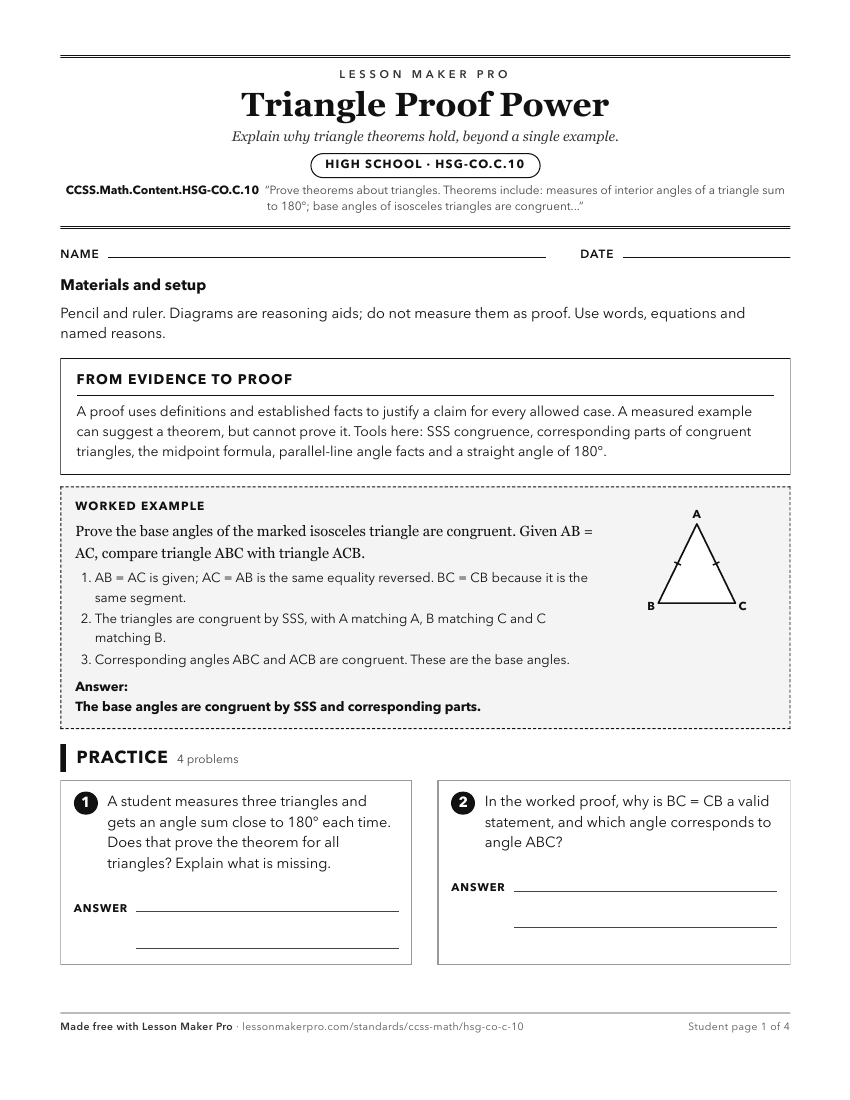
A ready-to-print activity worksheet aligned to CCSS.Math.Content.HSG-CO.C.10, with an answer key for the teacher on its own page. No account needed.
PDF, US Letter, prints cleanly in black and white.
Download the worksheetLearning progression
Where This Standard Sits
Before This Standard
If students are struggling here, check these first.
- CCSS.Math.Content.HSG-CO.C.9
Triangle proofs often use angle relationships, parallel-line facts, and proof habits from line and angle theorems.
- CCSS.Math.Content.HSG-CO.A.1
Triangle proofs rely on precise meanings of angles, segments, parallel lines, and perpendicular lines to state relationships and justify steps.
- CCSS.Math.Content.HSG-CO.B.8
Understanding why ASA, SAS, and SSS work supports using congruent triangles as evidence in proofs of triangle theorems.
What This Unlocks
Mastery here sets students up for these next.
- CCSS.Math.Content.HSG-SRT.B.4
Prior triangle proofs develop angle relationships and proof reasoning used when proving similarity-based triangle results.
- CCSS.Math.Content.HSG-C.A.3
Triangle angle theorems and proof habits support justifying triangle circle centers and cyclic quadrilateral angle relationships.
- CCSS.Math.Content.HSG-C.A.2
Triangle angle and congruence facts help explain why radii form isosceles triangles and why inscribed-angle relationships hold.
- CCSS.Math.Content.HSG-SRT.B.5
Proving triangle theorems develops the angle, side, and auxiliary-line reasoning often used with congruence and similarity criteria.
Keep exploring
Related Standards
Turn this exact standard into a lesson
Grade, subject, topic, and the complete standard are prefilled. Create one free, no account needed.
Also for this standard:Make a WorksheetMake a QuizMake a Sub Lesson