CCSS.
The Standard
Identify and describe relationships among inscribed angles, radii, and chords.
Common Core State Standards for Mathematics
Teacher's field guide
What This Standard Means
What Students Need to Do
- Students identify central, inscribed, and circumscribed angles and connect each angle measure to its intercepted arc. They use diameter, chord, radius, and tangent relationships to find missing measures and explain their reasoning.
What Mastery Looks Like
- Given a diagram, students find central and inscribed angles from arc measures. They find circumscribed angles from the difference of intercepted arcs. They also recognize right angles formed by diameters and by radii meeting tangents.
Common Misconceptions
- Students often double an inscribed angle instead of halving its intercepted arc, or use the arc sum instead of the difference for an exterior angle. They may assume any radius is perpendicular to any chord, or place the right angle away from the tangent point. They may also miss that a diameter creates a right inscribed angle.
How to Assess It
- Exit ticket: A, B, C, and D lie on circle O, AB is a diameter, minor arc AD measures 120°, and a tangent touches at A. Find ∠AOD, ∠ACD if it intercepts minor arc AD, ∠ACB, and the angle between OA and the tangent, then name each relationship.
Lesson moves
Ways to Teach It
Cut out a paper circle, draw chords and radii, then use folding and a protractor to test angle and perpendicular relationships.
Write an explanation for why an inscribed angle intercepting a diameter must measure 90 degrees.
Run a card sort matching circle diagrams with central, inscribed, or circumscribed angle measures and the rule used.
Sketch a bicycle wheel touching level ground, then explain why the radius to the contact point is perpendicular to the ground.
Free download
Printable HSG-C.A.2 Worksheet
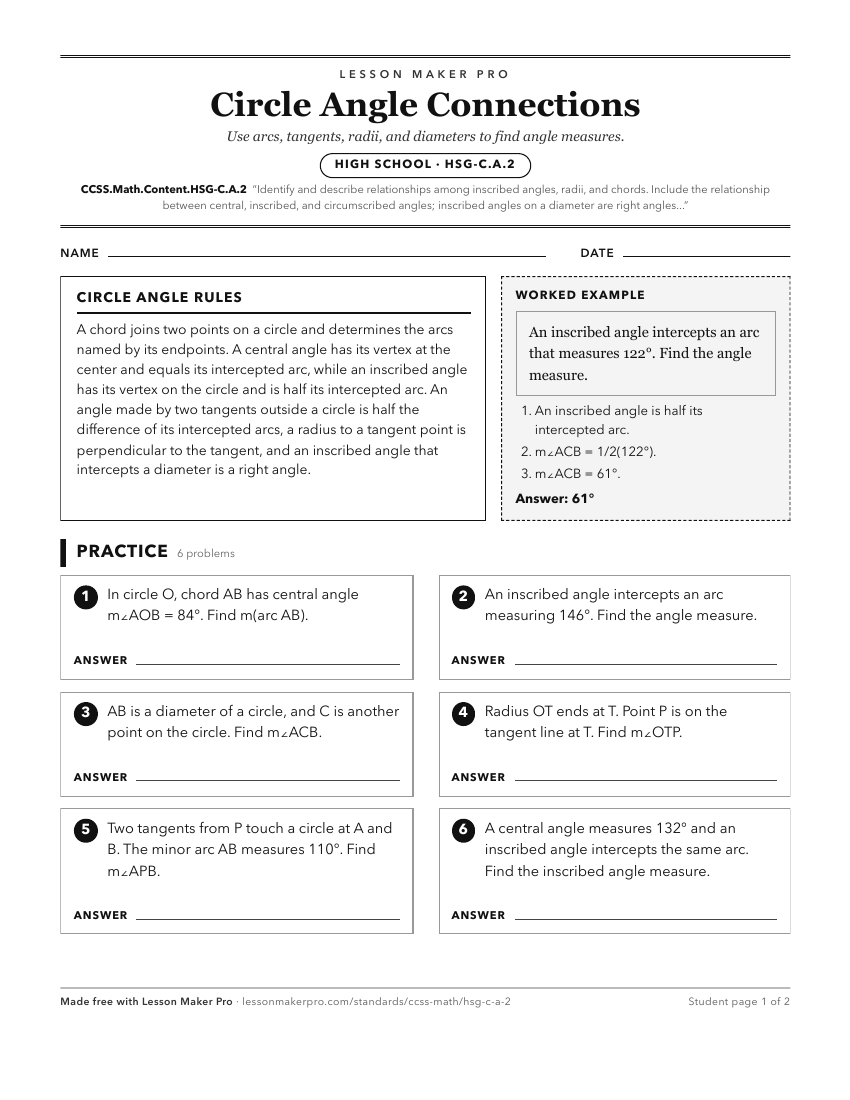
A ready-to-print activity worksheet aligned to CCSS.Math.Content.HSG-C.A.2, with an answer key for the teacher on its own page. No account needed.
PDF, US Letter, prints cleanly in black and white.
Download the worksheetLearning progression
Where This Standard Sits
Before This Standard
If students are struggling here, check these first.
- CCSS.Math.Content.HSG-CO.C.9
Angle relationships from line theorems help students reason about inscribed angles and chord-radius configurations in circles.
- CCSS.Math.Content.HSG-CO.A.1
Precise meanings of circle, angle, and line segment support describing radii, chords, and inscribed angle relationships clearly.
- CCSS.Math.Content.HSG-CO.C.10
Triangle angle and congruence facts help explain why radii form isosceles triangles and why inscribed-angle relationships hold.
What This Unlocks
Mastery here sets students up for these next.
- CCSS.Math.Content.HSG-C.A.3
Inscribed angle relationships support proving cyclic quadrilateral angle properties, though triangle circle constructions mainly use bisectors and perpendicular bisectors.
- CCSS.Math.Content.HSG-C.A.4
The tangent construction uses radii and the inscribed angle in a semicircle to locate a right angle at the tangency point.
Keep exploring
Related Standards
- CCSS.Math.Content.HSG-CO.A.4
Develop definitions of rotations, reflections, and translations in terms of angles, circles, perpendicular lines, parallel lines, and line segments.
- CCSS.Math.Content.4.MD.C.5
Recognize angles as geometric shapes that are formed wherever two rays share a common endpoint, and understand concepts of angle measurement:
Turn this exact standard into a lesson
Grade, subject, topic, and the complete standard are prefilled. Create one free, no account needed.
Also for this standard:Make a WorksheetMake a QuizMake a Sub Lesson