CCSS.
The Standard
Recognize angles as geometric shapes that are formed wherever two rays share a common endpoint, and understand concepts of angle measurement:
Common Core State Standards for Mathematics
Teacher's field guide
What This Standard Means
What Students Need to Do
- Students identify the vertex and the two rays that define an angle. They treat angle size as the amount of turn and relate degrees to 360 equal parts of a full turn.
What Mastery Looks Like
- A student identifies angles in drawings, even when they are rotated or have rays of different lengths. They explain that a 72 degree angle spans 72 one-degree turns and that a full turn measures 360 degrees.
Common Misconceptions
- Students often judge an angle by ray length or by how much space the drawing takes up. Some think rotating an angle changes its measure. Others confuse angle measure with the distance between the ray endpoints.
How to Assess It
- Exit ticket: Show two 60 degree angles, one rotated with longer rays. Ask, "Are their measures equal? Explain using the idea of turn."
Lesson moves
Ways to Teach It
Fasten two craft sticks with a brad; students make quarter, half, and small turns, then label the vertex and rays.
Prompt: Why does extending one ray not make an angle larger? Students draw and defend an answer using turn language.
Play Angle Match with cards showing degree measures, turn descriptions, and diagrams; teams collect matching sets.
Photograph clock hands, open doors, and scissors; students mark each vertex and estimate the turn in degrees.
Free download
Printable 4.MD.C.5 Worksheet
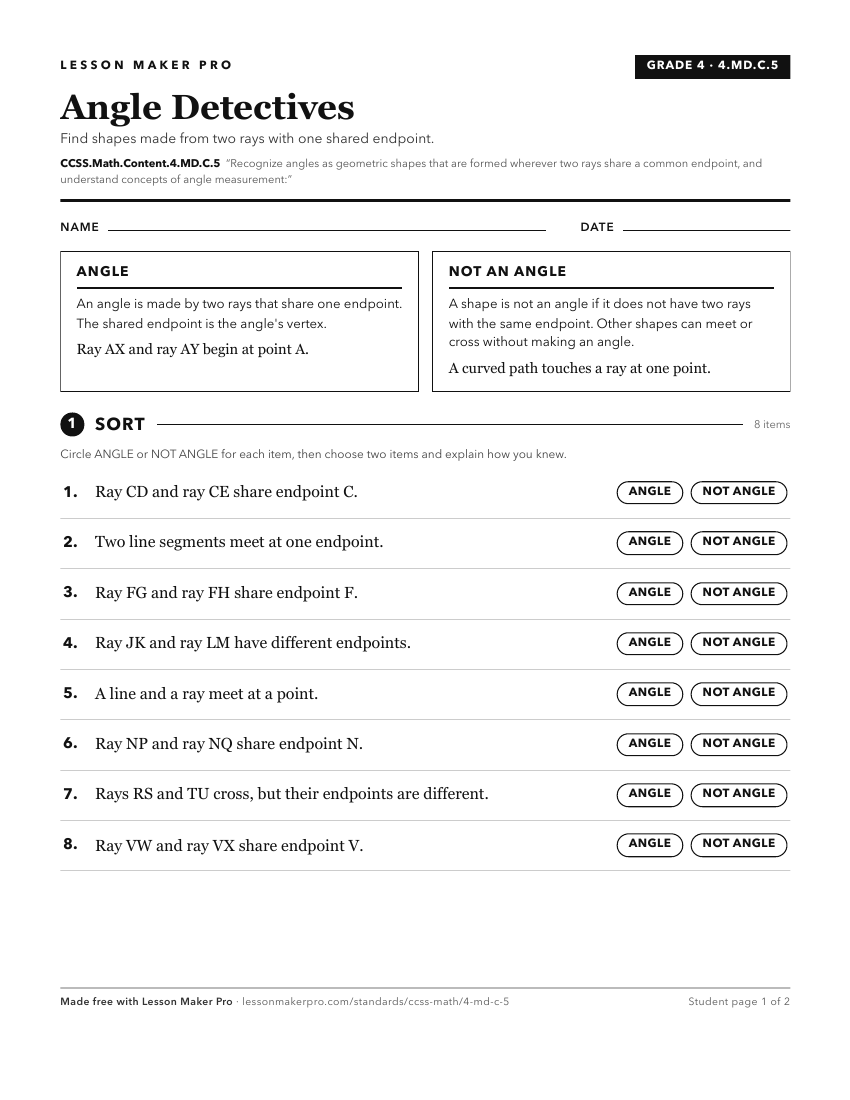
A ready-to-print activity worksheet aligned to CCSS.Math.Content.4.MD.C.5, with an answer key for the teacher on its own page. No account needed.
PDF, US Letter, prints cleanly in black and white.
Download the worksheetLearning progression
Where This Standard Sits
See the whole path on the Measurement & Data progression map.
Before This Standard
If students are struggling here, check these first.
What This Unlocks
Mastery here sets students up for these next.
- CCSS.Math.Content.4.G.A.1
Knowing angles as two rays sharing an endpoint supports drawing and identifying angles, especially right, acute, and obtuse ones.
- CCSS.Math.Content.4.MD.C.7
Students must understand what angles and angle measures mean before combining or subtracting angle measures in decomposed diagrams.
- CCSS.Math.Content.4.MD.C.6
Students need to understand angles as ray pairs and degrees as angle units before measuring or drawing angles with a protractor.
- CCSS.Math.Content.4.G.A.2
Understanding angles and their measures supports classifying shapes by angle size and recognizing triangles with right angles.
Keep exploring
Related Standards
- CCSS.Math.Content.4.MD.C
Geometric measurement: understand concepts of angle and measure angles.
- CCSS.Math.Content.3.MD.C.5
Recognize area as an attribute of plane figures and understand concepts of area measurement.
- CCSS.Math.Content.4.MD.C.5a
An angle is measured with reference to a circle with its center at the common endpoint of the rays, by considering the fraction of the circular arc between the ...
Turn this exact standard into a lesson
Grade, subject, topic, and the complete standard are prefilled. Create one free, no account needed.
Also for this standard:Make a WorksheetMake a QuizMake a Sub Lesson