CCSS.
Standard Cluster
Geometric measurement: understand concepts of angle and measure angles.
Common Core State Standards for Mathematics
Cluster contents
Standards in This Cluster
CCSS.Math.Content.4.MD.C is a cluster heading. These are the individual standards under it.
- CCSS.Math.Content.4.MD.C.5
Recognize angles as geometric shapes that are formed wherever two rays share a common endpoint, and understand concepts of angle measurement:
- CCSS.Math.Content.4.MD.C.5a
An angle is measured with reference to a circle with its center at the common endpoint of the rays, by considering the fraction of the circular arc between the ...
- CCSS.Math.Content.4.MD.C.5b
An angle that turns through n one-degree angles is said to have an angle measure of n degrees.
- CCSS.Math.Content.4.MD.C.6
Measure angles in whole-number degrees using a protractor. Sketch angles of specified measure.
- CCSS.Math.Content.4.MD.C.7
Recognize angle measure as additive. When an angle is decomposed into non-overlapping parts, the angle measure of the whole is the sum of the angle measures of ...
Teacher's field guide
What This Cluster Means
What Students Need to Do
- Students treat an angle as an amount of turn between two rays. They measure and draw angles in degrees with a protractor. They also split angles into parts and use addition or subtraction to find missing measures.
What Mastery Looks Like
- Students identify the vertex and rays, then measure angles accurately with a protractor. They sketch angles of given measures and find unknown angles by adding or subtracting adjacent angle measures.
Common Misconceptions
- Students may judge an angle by ray length or page position instead of the amount of turn. They may use the wrong protractor scale, misplace the center point, or assume angles cannot be added.
How to Assess It
- Give students one printed angle to measure and one 65° angle to draw. Ask them to label the vertex and explain how they checked each answer.
Lesson moves
Ways to Teach It
Join two craft sticks with a fastener, then have students build, measure, and label acute, right, obtuse, and straight angles.
Ask students to explain why two angles with different ray lengths can still have the same measure.
Play angle estimate and check: students estimate a displayed angle, measure it with a protractor, and score points for close estimates.
Photograph angles in doors, ramps, clocks, or playground equipment, then measure printed copies and compare their sizes.
Free download
Printable 4.MD.C Worksheet
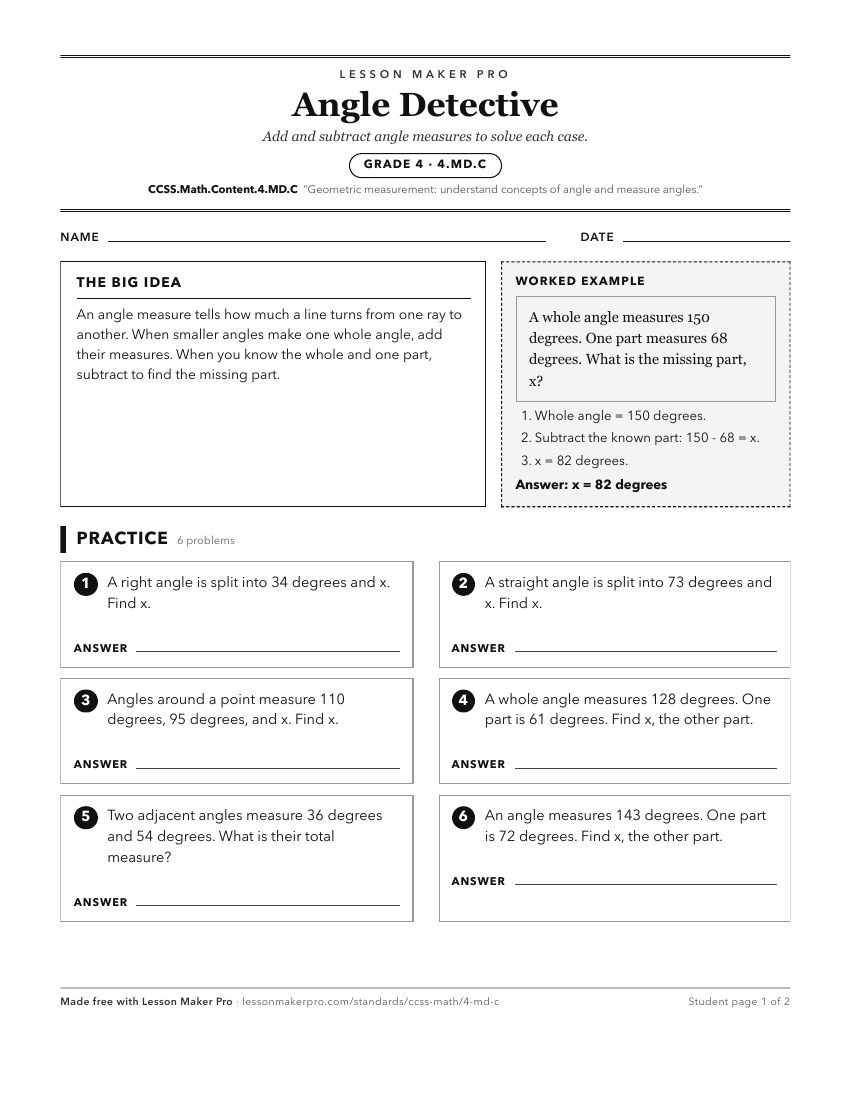
A ready-to-print activity worksheet aligned to CCSS.Math.Content.4.MD.C, with an answer key for the teacher on its own page. No account needed.
PDF, US Letter, prints cleanly in black and white.
Download the worksheetKeep exploring
Related Standards
- CCSS.Math.Content.3.MD.D
Geometric measurement: recognize perimeter as an attribute of plane figures and distinguish between linear and area measures.
- CCSS.Math.Content.3.MD.C
Geometric measurement: understand concepts of area and relate area to multiplication and to addition.
- CCSS.Math.Content.5.MD.C
Geometric measurement: understand concepts of volume and relate volume to multiplication and to addition.
Turn this cluster into a lesson
Grade, subject, topic, and the complete cluster are prefilled. Create one free, no account needed.
Also for this cluster:Make a WorksheetMake a QuizMake a Sub Lesson