CCSS.
The Standard
Recognize angle measure as additive. When an angle is decomposed into non-overlapping parts, the angle measure of the whole is the sum of the angle measures of the parts. Solve addition and subtraction problems to find unknown angles on a diagram in real world and mathematical problems, e.g., by using an equation with a symbol for the unknown angle measure.
Common Core State Standards for Mathematics · Measurement and Data
Teacher's field guide
What This Standard Means
What Students Need to Do
- Students find a whole angle by adding the measures of its non-overlapping parts. They also use addition or subtraction equations to find an unknown angle measure in a diagram.
What Mastery Looks Like
- Students write an addition or subtraction equation that matches a divided angle diagram. They find the missing measure, label it in degrees, and check that the parts equal the whole.
Common Misconceptions
- Students may add angles that overlap, subtract in the wrong order, or treat side lengths as angle measures. They may also assume a drawing is to scale instead of using the labeled measures.
How to Assess It
- Give a diagram of a 110° angle split into angles of 47° and x°. Ask students to write an equation, find x, and explain their operation.
Lesson moves
Ways to Teach It
Cut paper angles into two non-overlapping parts, measure each part, and verify that their measures add to the original angle.
Show a divided angle and ask, “How can you find the missing measure without using a protractor?”
Play Angle Detective with cards showing whole and partial measures, then have pairs calculate and match each missing angle.
Use clock hands at two times, provide one part of the angle, and have students calculate the remaining part. WhatStudentsDo
Free download
Printable 4.MD.C.7 Worksheet
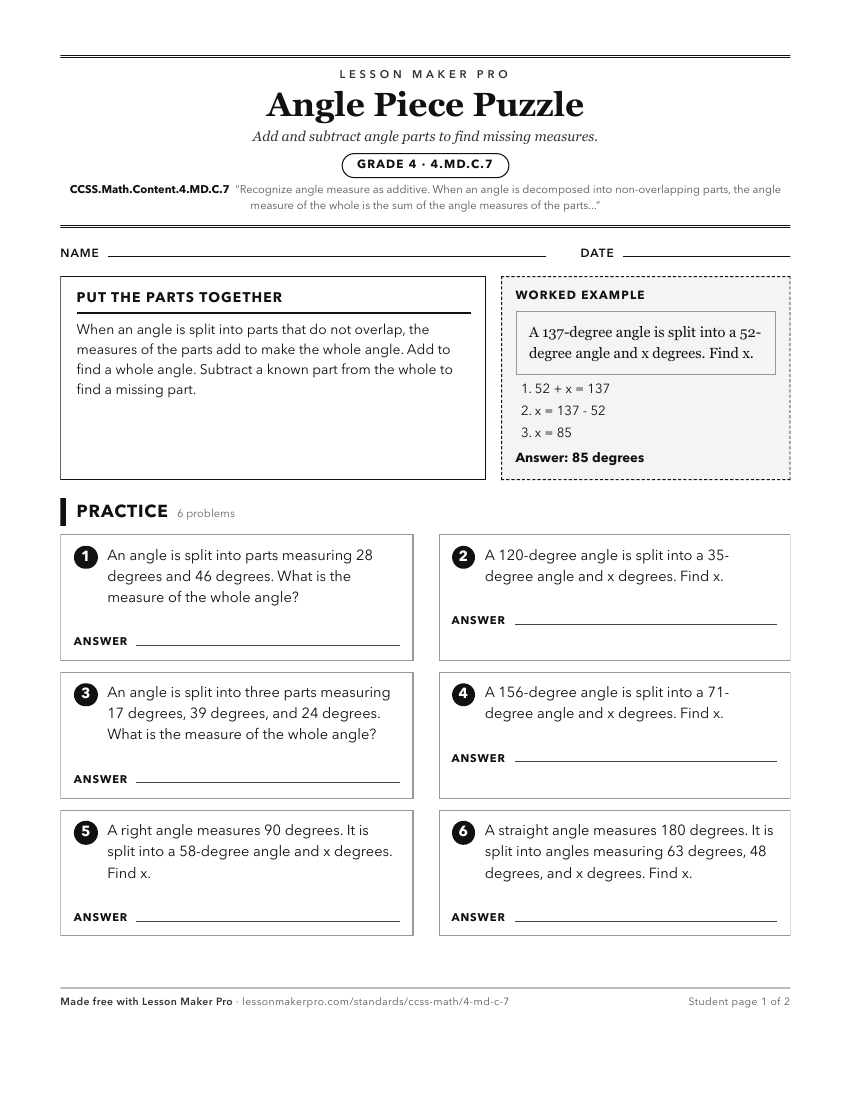
A ready-to-print activity worksheet aligned to CCSS.Math.Content.4.MD.C.7, with an answer key for the teacher on its own page. No account needed.
PDF, US Letter, prints cleanly in black and white.
Download the worksheetLearning progression
Where This Standard Sits
See the whole path on the Measurement & Data progression map.
Before This Standard
If students are struggling here, check these first.
- CCSS.Math.Content.4.MD.C.5
Students must understand what angles and angle measures mean before combining or subtracting angle measures in decomposed diagrams.
- CCSS.Math.Content.4.MD.C.6
Measuring and drawing angles in degrees gives students the angle-size units needed to combine or separate angle measures.
- CCSS.Math.Content.3.OA.D.8
Writing equations for unknowns in word problems supports unknown-angle equations, but angle additivity is a distinct geometric concept.
Keep exploring
Related Standards
- CCSS.Math.Content.7.G.B.5
Use facts about supplementary, complementary, vertical, and adjacent angles in a multi-step problem to write and solve simple equations for an unknown angle in ...
- CCSS.Math.Content.4.MD.C
Geometric measurement: understand concepts of angle and measure angles.
- CCSS.Math.Content.3.MD.C.7d
Recognize area as additive. Find areas of rectilinear figures by decomposing them into non-overlapping rectangles and adding the areas of the non-overlapping pa...
Turn this exact standard into a lesson
Grade, subject, topic, and the complete standard are prefilled. Create one free, no account needed.
Also for this standard:Make a WorksheetMake a QuizMake a Sub Lesson