CCSS.
The Standard
Use facts about supplementary, complementary, vertical, and adjacent angles in a multi-step problem to write and solve simple equations for an unknown angle in a figure.
Common Core State Standards for Mathematics · Geometry
Teacher's field guide
What This Standard Means
What Students Need to Do
- Students recognize vertical, adjacent, complementary, and supplementary angle relationships in diagrams. They use those relationships to write equations, solve for a variable, and calculate unknown angle measures.
What Mastery Looks Like
- Students correctly identify which angles are equal and which total 90 or 180 degrees. They write an equation, solve for the variable, find each requested angle, and check that the measures fit the diagram.
Common Misconceptions
- Students often swap complementary and supplementary angle sums. They may assume any adjacent angles total 180 degrees or that vertical angles are supplementary. Some report the value of x instead of substituting to find the requested angle.
How to Assess It
- Exit ticket: Two angles forming a straight line measure (3x + 10) degrees and (5x − 6) degrees. Find x and both angle measures, then name the relationship used.
Lesson moves
Ways to Teach It
Cross two paper strips, label one angle 68 degrees, predict the other three angles, then check each with a protractor.
Show two intersecting lines and ask students to explain why adjacent angles are not always complementary or supplementary.
Give groups cards showing diagrams, equations, and angle values, then have them race to assemble matching sets.
Use a street intersection map with one angle labeled algebraically, then calculate the remaining turn angles for drivers and pedestrians.
Free download
Printable 7.G.B.5 Worksheet
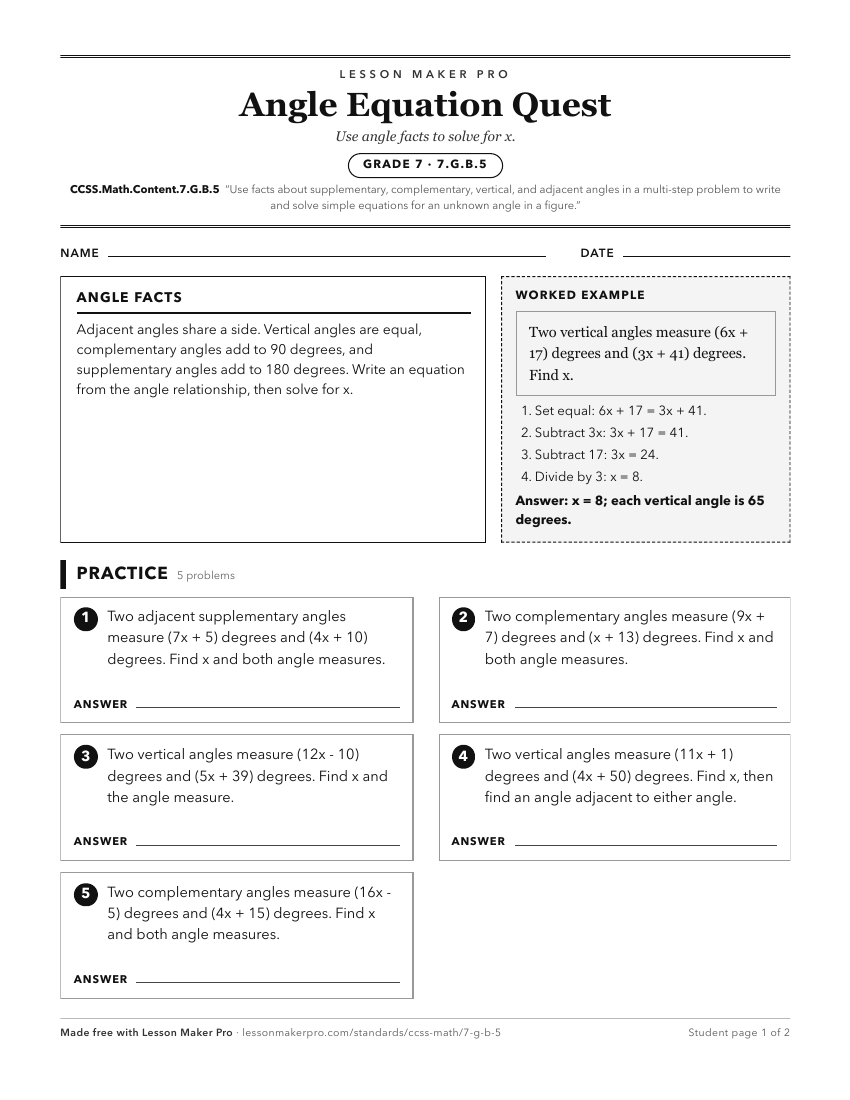
A ready-to-print activity worksheet aligned to CCSS.Math.Content.7.G.B.5, with an answer key for the teacher on its own page. No account needed.
PDF, US Letter, prints cleanly in black and white.
Download the worksheetBefore This Standard
If students are struggling here, check these first.
- CCSS.Math.Content.7.EE.B.4a
Solving angle equations depends on fluently representing relationships and solving linear equations like x + 35 = 90 or 2x = 180.
- CCSS.Math.Content.6.EE.B.7
Solving one-step equations with rational numbers supports finding unknown angle measures from sums and products in angle relationships.
What This Unlocks
Mastery here sets students up for these next.
- CCSS.Math.Content.8.G.A.5
Solving with supplementary, vertical, and adjacent angles supports the angle reasoning needed for transversals, triangle sums, and similarity.
- CCSS.Math.Content.HSG-SRT.C.7
Recognizing complementary angles supports seeing the two acute angles in a right triangle and comparing opposite and adjacent sides.
Keep exploring
Related Standards
Turn this exact standard into a lesson
Grade, subject, topic, and the complete standard are prefilled. Create one free, no account needed.
Also for this standard:Make a WorksheetMake a QuizMake a Sub Lesson