CCSS.
The Standard
Explain and use the relationship between the sine and cosine of complementary angles.
Common Core State Standards for Mathematics
Teacher's field guide
What This Standard Means
What Students Need to Do
- Students identify that the two acute angles in a right triangle add to 90°. They use side labels to show why the sine of one angle matches the cosine of the other.
What Mastery Looks Like
- Students can use one trigonometric value to find the matching value for the other acute angle without recalculating. They can justify the match by labeling the same two sides from each angle.
Common Misconceptions
- Students may think sine and cosine are equal for the same angle, or that their values always add to 1. They may also forget that opposite and adjacent sides change when the reference angle changes.
How to Assess It
- Give this exit ticket: “In a right triangle, the acute angles are 32° and 58°. If sin 32° = 0.530, find cos 58° and explain why.”
Lesson moves
Ways to Teach It
Cut a paper right triangle, label sides from each acute angle, and write matching sine and cosine ratios in corresponding colors.
Prompt students: explain why the side opposite one acute angle is adjacent to the other and how that affects the ratios.
Use matching cards with complementary angles, sine expressions, cosine expressions, and decimal values, then have pairs justify every match.
Measure a ladder’s angle with the ground, find its angle with the wall, and compare the related sine and cosine ratios.
Free download
Printable HSG-SRT.C.7 Worksheet
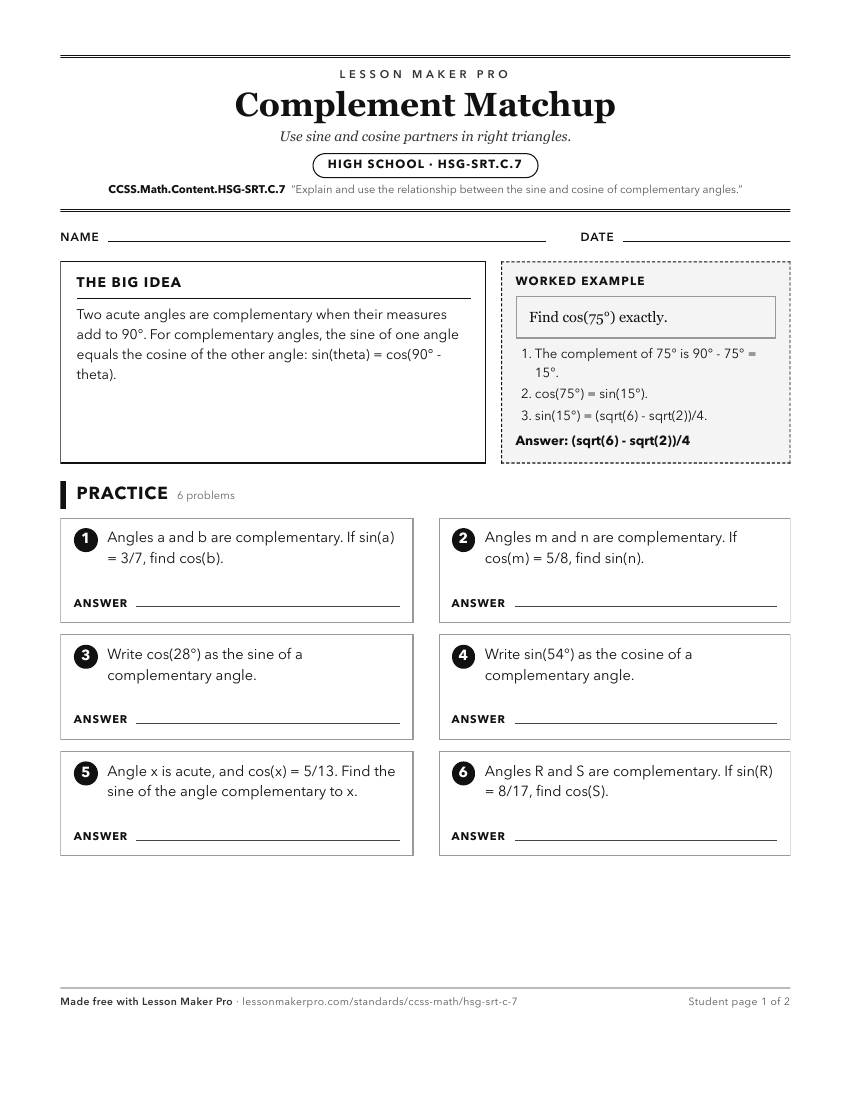
A ready-to-print activity worksheet aligned to CCSS.Math.Content.HSG-SRT.C.7, with an answer key for the teacher on its own page. No account needed.
PDF, US Letter, prints cleanly in black and white.
Download the worksheetLearning progression
Where This Standard Sits
Before This Standard
If students are struggling here, check these first.
- CCSS.Math.Content.8.G.A.5
Triangle angle-sum and similarity ideas support seeing the acute angles in a right triangle as complementary with matching side ratios.
- CCSS.Math.Content.HSG-SRT.C.6
Students need right-triangle sine and cosine ratios tied to angles to see complementary angles swap opposite and adjacent sides.
- CCSS.Math.Content.7.G.B.5
Recognizing complementary angles supports seeing the two acute angles in a right triangle and comparing opposite and adjacent sides.
Keep exploring
Related Standards
- CCSS.Math.Content.HSG-SRT.D.10
(+) Prove the Laws of Sines and Cosines and use them to solve problems.
- CCSS.Math.Content.HSF-TF.C.9
(+) Prove the addition and subtraction formulas for sine, cosine, and tangent and use them to solve problems.
- CCSS.Math.Content.HSG-SRT.D.11
(+) Understand and apply the Law of Sines and the Law of Cosines to find unknown measurements in right and non-right triangles (e.g., surveying problems, result...
Turn this exact standard into a lesson
Grade, subject, topic, and the complete standard are prefilled. Create one free, no account needed.
Also for this standard:Make a WorksheetMake a QuizMake a Sub Lesson